
 English
 Français
 Español
 Árabe
 Deutsch
 简体中文
 Português
 Русский
 日本語
 한국어
 हिंदी
 Prancis
 Türkçe
 Tiếng Việt
 Italiano
 ไทย

A refrigerated container can fit a chassis’s container positions while the complete road arrangement still has unresolved details. A generator may occupy space near the tractor or beneath the frame, existing equipment may obstruct access, and the delivery team may not know who manages the change between power sources.
These questions should be addressed before the vehicle is ordered or assigned. This guide explains the enquiry and handover information needed for a reefer-chassis proposal. It does not supply an electrical connection procedure, refrigeration settings or approval of a particular generator installation.
Identify the actual reefer and its transport envelope
Record container type, length, height, identification and the relevant equipment information. Do not treat a refrigerated unit as dimensionally and operationally identical to a dry container merely because both are described as 40ft. Obtain the actual arrangement needed for the intended service.
Include the refrigeration machinery and any attached generator in the complete envelope. The container’s nominal dimensions do not describe every additional component or service-access requirement. Give the trailer and tractor specialists the drawings for the configuration that will actually travel.
Keep loaded gross mass and equipment mass on a clear basis. Identify whether an attached generator, its operating contents and other carried equipment are already included in a stated figure or must be recorded separately. The complete combination still needs the relevant load-distribution and route assessment.
Choose a generator arrangement before reserving space
Reefer generator equipment is available in different arrangements, including container-mounted clip-on and chassis-mounted undermount types. Thermo King’s SG-3500 literature illustrates these distinct formats. That demonstrates the need for a defined configuration; it does not establish that any listed unit fits a GENRON chassis.
Obtain the proposed generator model, mounting drawing, mass, complete envelope and required service clearances. Do not use a generic box dimension if the actual installation has projections, mounting hardware or access needs outside that box.
State whether the generator travels with the container, remains with one chassis or is exchanged through a defined fleet process. Those are different operating patterns. The ownership and handling arrangements can influence the mounting interface, identification records and equipment required at collection and delivery.
Source: Thermo King: SG-3500 generator formats and configurations
Reefer chassis interfaces to define separately
| Interface | Information needed | Review owner |
|---|---|---|
| Container to chassis | Actual container type, support and locking arrangement | Chassis supplier and transport operator |
| Generator mounting | Model-specific envelope and approved attachment information | Generator and vehicle specialists |
| Vehicle clearance | Tractor, frame equipment and complete moving envelope | Vehicle designer and transport planner |
| Electrical connection | Compatible equipment and protected access requirements | Qualified electrical/equipment personnel |
| Cold-chain handover | Set-point authority, monitoring and power responsibility | Cargo owner, operator and receiving parties |
For clip-on equipment, review the complete front envelope
A container-mounted generator can change the space occupied near the front of the container. Provide the actual equipment drawing to the tractor-chassis compatibility review. The question concerns the complete combination and its required movements, not only a parked side photograph.
Ask the responsible designer to assess relevant clearances to the tractor and other vehicle equipment. Include the actual coupling arrangement and container position. A dry-container clearance drawing should not silently become the acceptance record for a reefer with additional front-mounted equipment.
Service access also matters. Confirm that the required control and inspection areas remain reachable through the approved work method. A physically non-contacting installation can still be impractical if routine access is blocked. Keep that requirement in the drawing review rather than discovering it during a delivery.
For undermount equipment, include everything already on the chassis
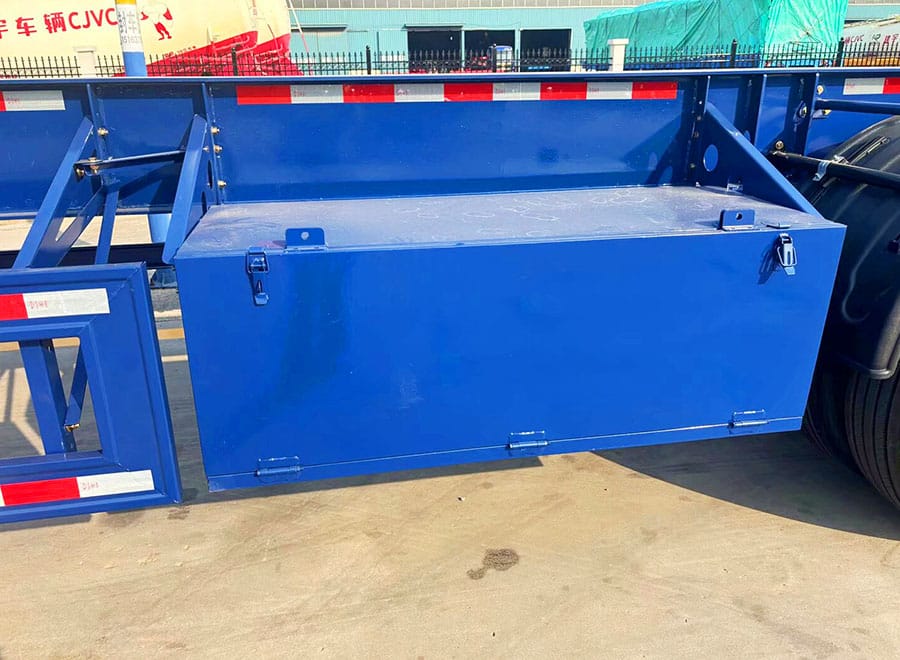
The underside of a chassis is not an empty space. Toolboxes, spare-wheel equipment, air reservoirs, lines, landing gear and other fittings may occupy or pass through the proposed generator area. Show the existing equipment on the same drawing as the new installation.
Obtain the generator manufacturer’s mounting and service information, then have the installation reviewed by the responsible vehicle and equipment specialists. Do not infer that an available gap is an approved mounting position or that existing structural members can accept unreviewed attachments.
Include relevant ground and movement clearances for the complete proposed configuration. This article does not prescribe a universal minimum or suggest moving safety-related components to make room. Any relocation or structural change belongs within an explicitly reviewed design and equipment scope.
Use product layouts as a discussion base, not a reefer certificate
The three-axle skeletal container chassis and two-axle skeletal container chassis are container-chassis layouts to discuss with GENRON. Start with the container support and locking requirements, then add the generator, tractor and equipment information. Their nominal container descriptions do not confirm a specific reefer installation.
Ask the supplier to identify exactly which container and generator cases the proposal covers. If the fleet requires both dry-container and reefer work, list those configurations separately. An installation may affect usable arrangements or equipment access even where the main container positions remain unchanged.
Compare inclusions carefully. A chassis quotation may reserve space only, supply mounting provisions or include a complete reviewed equipment package. These are materially different scopes. The order should state which one is supplied, who provides the generator and who accepts the final interfaces.
Define cable routing and access without improvising connections
Give the qualified equipment personnel the actual generator and reefer requirements. Ask them to identify the compatible electrical interface and the access needed for the approved connection arrangement. A photograph of a connector is not enough to establish compatibility.
The vehicle layout should account for protecting and stowing cables and preventing conflicts with moving parts, hot areas or loading equipment through a reviewed design. Include the relevant access and storage provisions in the order. Do not leave a supplied cable to find its own route around existing chassis hardware.
This guide does not instruct anyone to energise equipment, alter plugs or bypass protective systems. Electrical operation and maintenance require the correct manufacturer information and qualified personnel. The procurement task is to ensure that compatibility, protection and responsibility are defined before the equipment is delivered.
Keep cargo-care requirements separate from vehicle fit
A compatible chassis and generator do not by themselves establish the required cargo condition. The cargo owner must define the relevant temperature and other transport requirements, and the responsible parties must manage them through the journey. Do not convert a successful vehicle-fit check into a cold-chain performance guarantee.
Hapag-Lloyd’s reefer guidance emphasises cargo preparation, appropriate stowage and airflow as part of refrigerated transport. This is useful context for separating cargo care from chassis selection. The article does not prescribe settings, packing methods or preparation instructions for a particular consignment.
Record who has authority to issue or change cargo instructions. Keep those instructions linked to the correct container and journey. A driver should not be expected to resolve inconsistent settings or product requirements from unrelated messages after the vehicle reaches the terminal.
Source: Hapag-Lloyd: Reefer cargo-handling context
Plan each change of power responsibility
List the stages of the journey: collection, terminal release, road transport, waiting and receipt. Identify which party is responsible for power availability and equipment operation at each stage. A route can involve several handovers even when there is only one road movement.
Agree the records that demonstrate the handover, such as container identity, relevant equipment status, instruction reference and time. The responsible parties should define the procedure and escalation arrangements. Do not invent a universal allowable interruption or assume the same limit suits every cargo.
Include delays and destination changes in the planning discussion. If a receiver cannot accept the container at the expected time, identify who decides the next action. This is an operating-responsibility question, not something that can be solved by selecting a larger fuel tank from a catalogue.
Make monitoring and exception handling part of the enquiry
Ask what information the cargo owner and operator require during transport and at receipt. Distinguish the generator’s operating information from the reefer’s records and from any independent cargo-monitoring system. They do not necessarily describe the same condition or prove the same result.
Define who receives an exception, who can act and how the decision is recorded. Avoid vague promises that someone will keep an eye on the load. A useful handover file identifies the relevant equipment, instruction and responsible contact without exposing private account credentials or relying on informal access.
Where a digital service is proposed, establish its actual scope and limitations. A connectivity feature should not be presented as guaranteed coverage or automatic protection of every cargo. The buying decision should separate vehicle hardware, monitoring service and the organisation’s response process.
Compare an existing fleet with a new dedicated arrangement
An operator may want to adapt an existing chassis or purchase a dedicated reefer arrangement. Compare the two against the same container and generator schedule. Identify structural review, equipment conflicts, service access and documentation required for each option.
An adaptation can appear less expensive while leaving important interfaces outside the quotation. A new arrangement can include unnecessary equipment if the operating pattern is poorly described. Use an included/excluded/open-item table so price is compared against a complete scope rather than a familiar vehicle appearance.
Include dry-container return work where relevant. Unused generator equipment and cables still need an accepted arrangement, and the complete vehicle condition may differ. State whether the equipment remains fitted, is exchanged or is removed through an approved process; do not assume the return journey is irrelevant because the container is empty.
Accept the completed configuration against one final drawing set
At handover, reconcile the container cases, chassis, generator and equipment schedule with the accepted drawings. Confirm that the supplied mounting and access provisions correspond to the actual equipment, not a model considered earlier. Record substitutions and unresolved items before the configuration is used.
Obtain the appropriate manufacturer and installation documents from the responsible parties. Keep electrical and refrigeration instructions with their relevant equipment identities. This article does not claim that a general inspection photograph demonstrates compatibility or that a product page provides installation approval.
For future changes, use the final configuration record as the comparison basis. A different generator model, tractor, container arrangement or relocated chassis item can affect the original assumptions. A controlled update is more reliable than treating one accepted reefer movement as proof that every refrigerated container will fit.
Reefer-chassis enquiry checklist
Container types, identities and complete envelopes:
Packed mass basis and additional equipment:
Generator model, format, mounting and service drawings:
Tractor/coupling and existing chassis-equipment layout:
Qualified electrical-interface and cable-access review:
Cargo instructions, monitoring and power-handover owners:
Dry-container or empty-return configurations:
Acceptance documents, exceptions and change control:
An illustrative comparison: interchangeable equipment or dedicated service
Consider a fleet that collects a container-mounted generator with each allocated reefer and another fleet that keeps an undermount unit on one chassis. The first enquiry needs clear container-equipment identity and front-envelope information. The second needs a defined chassis installation, service access and the complete vehicle mass condition. Neither pattern is inherently approved by this example.
Ask each proposal to state the operating cases it covers and the equipment changes expected between journeys. Include the empty and dry-container return conditions, not only the refrigerated outward load. That reveals whether an apparently flexible arrangement depends on equipment handling or facilities the fleet has not arranged.
Compare responsibility as well as hardware. Identify who supplies, maintains and releases each generator, who confirms compatibility and who receives an exception during transport. A well-defined equipment handover can be more important to a usable specification than an attractive catalogue dimension considered on its own.
FAQ: Reefer containers on skeletal chassis
Does a 40ft chassis automatically suit a 40ft reefer?
No. Confirm the actual container support and locking arrangement, additional equipment, complete envelope and mass. A generator installation and the tractor interface may introduce questions not covered by a dry-container layout. Obtain a configuration-specific proposal.
Is a clip-on generator always better than an undermount?
There is no universal choice. Compare ownership, interchange pattern, mounting interfaces, vehicle clearance and service access for the actual equipment. The two formats solve different operating requirements, and neither should be selected from a generic photograph alone.
Can a toolbox be moved to make room for a generator?
Only through an appropriate reviewed change. The complete chassis layout and affected equipment must be considered by the responsible specialists. An apparent gap does not approve mounting, and this guide does not authorise relocation of vehicle components.
Can the article tell me which electrical plug to use?
No. Use the actual generator and reefer specifications and qualified personnel. The article identifies the need for compatibility and protected access; it does not provide an electrical connection or modification procedure.
Does a running generator prove that the cargo remained within specification?
Not by itself. Generator operation, reefer performance and cargo-condition records answer different questions. The cargo owner and responsible operating parties should define the evidence, monitoring and exception process appropriate to the consignment.
Can reefer and dry-container work share one chassis?
Potentially, if both configurations are included in the reviewed arrangement. Identify what remains fitted, which container positions are available and how unused cables or equipment are managed. Do not infer unrestricted interchangeability from one accepted refrigerated load.
Product Options to Discuss
These product links do not confirm generator mounting or electrical compatibility. Request a reviewed configuration for the actual reefer and equipment.
Related Reading
References
Manufacturer formats are examples, not a statement that a particular system is supplied or approved by GENRON. Cargo care and electrical work require the relevant instructions and responsible specialists.


