
 English
 Français
 Español
 Árabe
 Deutsch
 简体中文
 Português
 Русский
 日本語
 한국어
 हिंदी
 Prancis
 Türkçe
 Tiếng Việt
 Italiano
 ไทย

Two tanker quotations may both say metering system included while covering very different equipment. One may identify a complete delivery arrangement, controller and output records. Another may mention only a meter. Comparing their prices before clarifying that scope can leave important work outside the order.
This guide explains how to prepare a useful metered-delivery enquiry and compare the responses. It does not provide fuel-transfer instructions, calibration procedures or a universal legal tolerance. The objective is a defined system and acceptance record for the intended product and destination.
Describe how the tanker will deliver at each type of customer
List the intended delivery modes and receiving arrangements. Identify whether the operation needs a particular gravity, pumped or hose-reel duty, as applicable to the actual project. These descriptions should come with the relevant site requirements rather than a broad request for a standard metering package.
Distinguish bulk deliveries from smaller multi-stop quantities and describe the operating range the supplier must assess. Include the product schedule and any required separation between product paths. A package selected for one defined duty should not silently become a promise that every customer and quantity can be served.
Ask the receiving parties what interfaces and evidence they require. The loading terminal and the delivery customer may have different acceptance processes. Keep those requirements separate so a tanker approved for loading is not assumed to have an accepted metered-delivery arrangement at every destination.
Specify a system rather than an isolated meter
Request a system description and equipment schedule identifying what is supplied, how it is integrated and where its scope ends. Relevant items may include product-transfer equipment, measurement and control components, records and interfaces, depending on the approved design. The responsible supplier should identify the actual arrangement.
Alfons Haar’s road-tanker literature illustrates that metering packages can use different technologies and delivery configurations. This is evidence that the application and system scope matter, not a recommendation that any named package is supplied on a GENRON tanker. Ask for the specific proposed equipment and its documentation.
If one supplier provides the tanker and another the metering equipment, name the party responsible for the interfaces and final integration. A list of individually supplied components does not establish an accepted working system. The order needs a clear route from component specifications to the completed installation.
Source: Alfons Haar: Road-tanker metering system configurations
Metered-delivery scope for an order comparison
| Scope item | Question to resolve | Evidence expected |
|---|---|---|
| Application | Which products, quantities and delivery modes are covered? | Defined duty and operating-range statement |
| Equipment | What makes up the proposed complete system? | Identified equipment schedule and arrangement |
| Measurement | What quantity and reference basis are recorded? | System description and output definitions |
| Integration | Who accepts interfaces with the tanker and receiving site? | Named responsibilities and verification scope |
| Acceptance | Which destination process applies? | Relevant approval/verification requirements and records |
State products and operating conditions accurately
Provide the exact products and current material information needed by the equipment supplier. Different product properties or service conditions may affect selection and operating limits. Do not assume that a package described for fuel is suitable for every petroleum product or another liquid.
Ask the supplier to state the range and conditions covered by the proposal, including any limitations relevant to the intended deliveries. Where flow or other operating requirements are uncertain, identify who will establish them. A quotation should not turn an unknown condition into an unstated design assumption.
Include planned product switching and shared equipment in the review. The system’s product path, identification and customer acceptance requirements should be clear. Metering does not itself resolve contamination, product separation or the tanker’s suitability for a changed cargo.
Compare measured quantity on the same reference basis
Clarify what the system reports and what the commercial delivery record requires. A stated volume can be associated with defined measurement and reference conditions; a mass record is a different quantity. The responsible supplier and commercial parties should identify the basis explicitly.
If correction or conversion features are included, request their scope, required inputs and output labelling. Do not assume that two readings are directly comparable because both display litres. Nor should a buyer invent a conversion factor to reconcile an unexplained difference.
Keep the measurement basis consistent across the quotation, display, printed or digital record and acceptance documents. A technically capable system can still create disputes if the delivery note does not identify what quantity was reported. Clear definitions are part of the specification, not merely a formatting choice.
Separate accuracy, verification and commercial tolerance
Ask what a supplier’s accuracy statement refers to: a component, a complete configuration, a defined test or an accepted operating system. Retain the conditions and evidence behind the statement. A short percentage without that context is not a complete basis for comparing metering proposals.
OIML R 117:2019 concerns dynamic measuring systems for liquids other than water. Its existence does not prove that a particular tanker system is certified or accepted in the destination. Establish the actual local approval and verification requirements with the relevant authority and competent supplier.
A commercial discrepancy rule is a separate agreement. Do not present it as an equipment specification or assume it matches a legal metrology limit. The order should distinguish technical performance evidence, regulatory acceptance and the process for handling delivery-record differences.
Source: OIML: R 117:2019, dynamic liquid measuring-system publication
Give the tanker layout enough space for the defined package
Show the proposed system on the vehicle arrangement, including the access and service space identified by its supplier. Guards, cabinets, hoses and adjacent equipment can affect practicality. A catalogue image of a meter does not explain how the complete package fits the tanker.
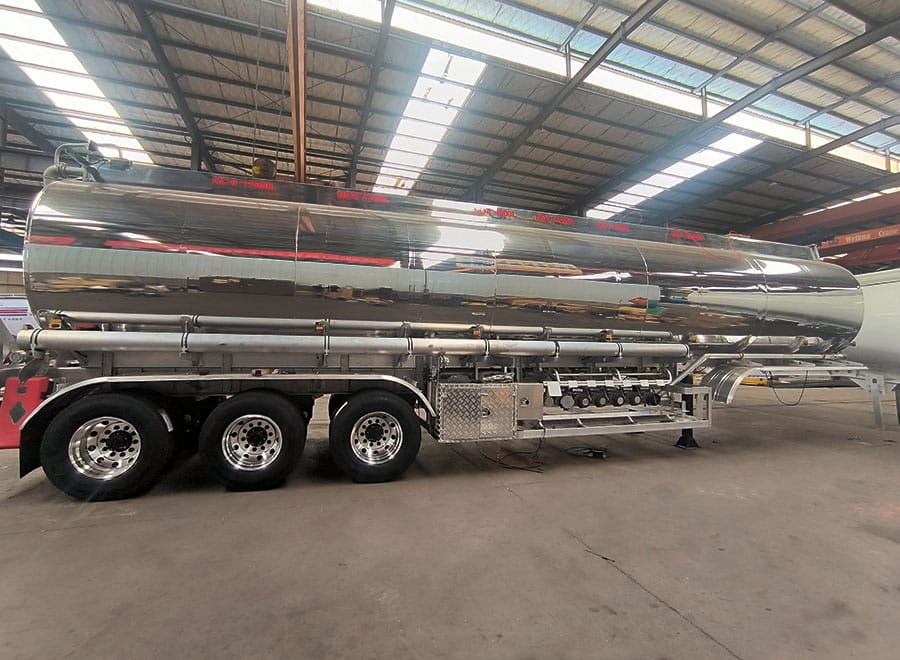
The carbon-steel fuel tanker layout and aluminum fuel tanker layout are tanker layouts to discuss with GENRON when defining the vehicle side of the project. Their product pages do not confirm that a particular meter, pump, controller or approval is included. Request a written equipment and integration scope for the actual offered configuration.
If equipment changes affect mass, space or vehicle interfaces, include those consequences in the complete review. Do not treat integration as a cosmetic addition after the main tanker order. The buyer should know which drawings and acceptance records will describe the completed vehicle.
Make delivery records useful to the receiving party
Agree the information required on a delivery record: vehicle and system identity, product, measured quantity and basis, relevant transaction references and other items required by the responsible parties. The exact record should follow the applicable system and commercial requirements.
Distinguish what the equipment produces automatically from what the operator enters or confirms. A printed ticket, a digital export and a customer signature may serve different functions. Ask the supplier to identify the available outputs and their limitations rather than promising seamless integration without a defined receiving process.
If digital systems are involved, establish ownership, access and retention requirements through the responsible organisation. Do not put private login credentials into a trailer enquiry or assume a data connection guarantees successful delivery of every record. Define how exceptions and missing records are handled.
Use a neutral discrepancy example to test the paperwork
Suppose two hypothetical documents show 10,000 litres and 9,980 litres. The arithmetic difference is 20 litres, or 0.2 percent of the first figure. That calculation alone says nothing about the cause, whether the records use the same basis or whether the difference is acceptable.
Before reaching a conclusion, identify the systems, quantities, reference conditions, transaction boundaries and records involved. The responsible specialists should assess measurement and equipment questions. The commercial parties should apply their agreed discrepancy process. Do not label the difference as theft, leakage or meter failure from arithmetic alone.
This example is useful during procurement because it exposes missing output definitions and responsibility. Ask how the proposed package’s records would support a fair reconciliation. A well-described record process is more valuable than an unsupported promise that no quantity disagreement can ever occur.
Define acceptance and commissioning before delivery
Name the parties responsible for integration, equipment verification and destination acceptance. Ask for the required documents and activities to be identified in the order. A factory scope and a local authority’s process may not be the same, and neither should be assumed to cover the other automatically.
Any commissioning or testing must follow the approved procedures and be performed by the appropriate competent personnel. This article supplies no live-product test method, adjustment instruction or bypass procedure. The buyer’s task is to ensure the scope, responsibilities and required evidence are agreed.
Keep incomplete items visible at handover. If local verification remains outstanding, state that clearly rather than describing the system as universally ready for trade. The delivered equipment should be identifiable, documented and accepted for its defined use through the applicable process.
Plan service support without changing the accepted system casually
Request model and part identification, manuals, service contacts and the supplier’s requirements for maintenance and verification. The fleet should know how to obtain support without replacing a component solely because a similar one is available locally.
A replacement, software change or altered product path can affect the basis on which the system was accepted. Establish the change process with the responsible supplier and local requirements. Do not assume that a component swap leaves metrological performance or approval unchanged.
For a remote operation, include practical support questions in the commercial comparison: documentation language, parts identification, service arrangements and ownership of local acceptance tasks. These are concrete scope items. They are more useful than a broad claim that a premium meter makes the entire delivery operation maintenance-free.
Compare offers with an included, excluded and open-item schedule
Send the same duty and output requirements to every supplier. For each line, ask whether it is included, excluded or awaiting information. Record the exact equipment references and which party supplies the missing interface. This makes differences visible without assuming that the cheapest or most expensive package is inherently better.
For example, one offer may include a controller and agreed record output while another includes only measurement hardware. Another may exclude destination verification. These can all be legitimate quotations, but they are not equivalent until the buyer accounts for the remaining work and responsibilities.
Close the comparison with a final accepted system schedule and drawing revision. Keep any limitations and destination tasks with that record. The result should describe the vehicle and system actually ordered, not a collection of favourable phrases taken from several equipment brochures.
Metered fuel-delivery enquiry brief
Products, customers and delivery modes:
Required operating range and site interfaces:
Complete equipment and integration scope:
Measured quantity, reference basis and record outputs:
Destination approval and verification responsibilities:
Acceptance/commissioning documents and open tasks:
Service support, parts and change-control requirements:
Commercial discrepancy process and responsible parties:
FAQ: Fuel-tanker metering packages
Should I review a sample delivery-record format before ordering?
Yes. Ask for a representative sample with quantity definitions, units and relevant identifiers, without private customer data. Confirm which fields the system supplies and which require operator or office input. A sample can reveal an output mismatch early, but it does not replace equipment acceptance or demonstrate measurement performance. Keep the agreed format and its scope with the final system specification.
Is a flow meter the same as a complete metered-delivery system?
No. Define the complete application, equipment, integration, outputs and acceptance scope. A component may be part of the proposal without covering all the functions needed for the intended delivery. Ask the responsible supplier to describe the actual system rather than relying on a short equipment label.
Does a meter accuracy percentage guarantee delivery accuracy?
Not without its scope and conditions. Identify whether it concerns a component or complete system and what evidence supports it. The installed configuration, operating conditions and applicable acceptance process still matter. Do not turn an isolated percentage into an unconditional guarantee.
Can one system handle every fuel and every delivery quantity?
Do not assume so. State the exact product range, delivery modes and operating requirements, then obtain the supplier’s covered range and limitations. Different duties may require a different configuration or further review.
Does an OIML reference prove local approval?
No. Identify the actual equipment documentation and destination requirements with the responsible supplier and authority. A reference to an international recommendation does not establish that every component, installation or market acceptance task has been completed.
What does a difference between two litre records prove?
Arithmetic establishes the numerical difference only. Reconcile the quantity basis, reference conditions, transaction and measurement records before drawing conclusions. The example in this article is not an allowable tolerance or evidence of a particular failure.
Should metering be specified before ordering the tanker?
Yes. The package can affect space, equipment, interfaces, documents and acceptance responsibilities. Define those early and request one accepted system schedule for the final vehicle. Adding an undefined meter after the main order can leave important integration tasks unresolved.
Product Options to Discuss
A metering package is not assumed included in either linked layout. Confirm the exact delivery system, material suitability and acceptance scope in the proposal.
Related Reading
References
Equipment examples do not establish supply, certification or local acceptance of a GENRON installation. The numerical example is hypothetical, not a legal tolerance or calibration instruction.


