
 English
 Français
 Español
 Árabe
 Deutsch
 简体中文
 Português
 Русский
 日本語
 한국어
 हिंदी
 Prancis
 Türkçe
 Tiếng Việt
 Italiano
 ไทย

A container described as 40ft high cube is not just another length entry on a chassis quotation. Compared with a standard-height general-purpose container, its extra height affects the overall vehicle envelope. That question must be kept separate from whether the chassis has the correct container support and locking arrangement.
This guide explains the information to exchange before ordering a container chassis. It provides a deliberately hypothetical calculation and a route-record template, not a universal road-height limit or a method for driving under an uncertain obstruction.
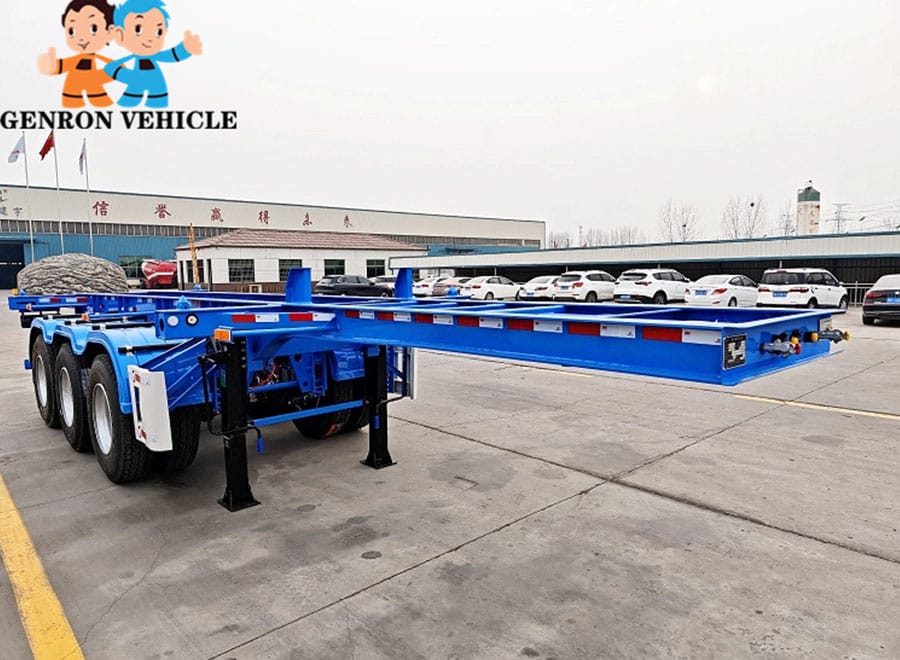
Start With the Actual Container Type and External Dimensions
Identify the container by its type information and relevant records rather than by a booking abbreviation alone. General-purpose high cube, refrigerated, open-top and other equipment should not be treated as interchangeable simply because a length description is shared. Obtain the dimensions and requirements for the equipment the operation will actually use.
Hapag-Lloyd’s container specification booklet gives nominal external heights of 2,591 mm for the 8 ft 6 in category and 2,896 mm for the 9 ft 6 in category, a difference of 305 mm. These are useful dimensional references, not measurements of your allocated container or a statement about permissible vehicle height on a road.
The carrier also explains that fleet specifications are examples and can vary by manufacturer. Keep actual equipment information with the quotation. If the fleet expects to handle several types, make a container schedule so the chassis proposal can address each required arrangement explicitly.
Source: Hapag-Lloyd: Container Specification, nominal external dimensions; Hapag-Lloyd: 40ft standard high cube, fleet-example qualification
Do Not Mix These Height Measurements
| Measurement | What it describes | Use in the comparison |
|---|---|---|
| Internal container height | Space inside the container. | Cargo fit; not the outer vehicle envelope. |
| External container height | The container’s outside dimension on a defined basis. | One input to the overall transport-height review. |
| Container support-plane height | The chassis support level above the ground in the stated combination and condition. | The corresponding lower input for a first-pass height sum. |
| Overall combination height | The complete vehicle’s highest relevant point under defined conditions. | Requires confirmation for the actual combination and route assessment. |
Ask Where the Chassis Height Is Measured
A catalogue entry labelled chassis height can refer to a different reference point from the one needed for your calculation. Ask the supplier to mark the container support plane on the drawing and state the vehicle condition used for the dimension. Do not add container height to an undefined frame dimension.
Record the proposed tractor, coupling arrangement, tires and suspension configuration alongside the drawing. The supplier’s assessment should use the intended combination. A dimension from an empty standalone trailer or a different tractor arrangement should not silently become the operating dimension in the customer’s route file.
Where the support arrangement has geometry relevant to the particular container, have the supplier identify it explicitly. A photograph is useful for explaining the layout, but the purchasing record should show the actual support and locking positions and the dimensional references used in the review.
Use a Height Sum Only as a Screening Calculation
For an invented example, suppose the container support plane is 1,100 mm above the ground in the specified combination condition. Adding a nominal container height of 2,896 mm gives 3,996 mm. If a second hypothetical proposal uses a 1,250 mm support plane, the equivalent sum is 4,146 mm.
The difference between these examples is 150 mm, matching the assumed difference in support-plane height. It helps explain the comparison but does not prove that either proposal fits a real route. Neither support height is a GENRON specification, and neither resulting total is a legal limit or an approved clearance.
The responsible transport team must confirm the actual overall envelope and the route requirements. The calculation does not include an invented universal clearance allowance. Changes in configuration, the relevant operating condition and the highest point of the complete vehicle need proper review rather than being hidden behind rounded arithmetic.
Illustrative Height Worksheet — Not Route Approval
| Input or result | Proposal A | Proposal B |
|---|---|---|
| Assumed support-plane height | 1,100 mm, invented. | 1,250 mm, invented. |
| Nominal external container height used | 2,896 mm. | 2,896 mm. |
| Simple screening sum | 3,996 mm. | 4,146 mm. |
| Unresolved before operation | Actual vehicle envelope, equipment condition and route review. | The same checks; no clearance conclusion follows from this table. |
Review Locking and Support Separately From Height
Lower overall height does not establish that a chassis correctly supports and secures the required container. The proposal still needs the approved container arrangement, support locations and locking equipment. These are separate fields in the comparison, not benefits that follow automatically from a low frame.
If several arrangements are required, list each one with the relevant container type, position and gross mass information. Ask the supplier to identify which configurations were assessed and which remain outside the proposal. Do not assume an arrangement shown in a sales image is included in every version of a chassis.
Keep the combination’s load-distribution review with those arrangements. A container’s maximum gross marking is not the same as the permissible cargo mass of the complete road vehicle. The tractor, chassis, container and cargo information must be considered on the basis appropriate to the intended operation.
Build a Route Record That Covers Both Ends of the Journey
The route review should include the port or depot, intermediate facilities and the final receiving site. A clear main road does not resolve an entrance canopy, a warehouse access point or other restricted part of the actual journey. Give the transport team the complete origin and destination information.
Record who verified the relevant restrictions, what equipment and vehicle condition were considered and when the information was checked. The review belongs with the route and operating responsibility, not with a sales article. Do not approach an uncertain overhead obstruction to test whether the vehicle fits.
Include return movements where they differ from the outward journey. An empty container still has its external height, while a different return container may change the envelope or required arrangement. State the actual return equipment rather than assuming that empty means dimensionally smaller.
Compare a Lower Proposal as a Complete Chassis Configuration
When an offer proposes a lower support arrangement, ask for the complete specification and the conditions behind the dimension. Compare the required container layouts, tractor compatibility, clearances, equipment and maintenance documentation together. A lower quoted number is not a universal indication of a better trailer.
Ensure that the agreed tire and suspension specification appears in the final documents. Do not obtain a lower operating height by making an unreviewed change to the vehicle. The purchase decision should use the assessed configuration, not an informal adjustment suggested after the order.
Retain the final dimensional drawing with the operating records. If the fleet changes tractors, equipment or a relevant configuration later, have the impact reviewed. The original height worksheet is a record of its stated inputs, not permanent approval for every combination the chassis might form.
Request Evidence That Answers the Height Question
Useful quotation evidence includes a drawing with the support-plane reference marked, the intended tractor information and the container schedule. At handover, obtain the agreed dimensional or inspection records for the actual vehicle where included in scope. Resolve differences between the completed configuration and the original proposal before relying on old figures.
For marketing photographs, describe what is visible without inventing an approval claim. An empty chassis photo cannot show the overall height of a loaded high cube combination. A photo of a container on a chassis can illustrate an arrangement, but it does not replace measured information or a route assessment.
High Cube Container Chassis Enquiry Sheet
Container type and relevant identification records:
External container dimensions and information source:
Required container arrangements and gross masses:
Proposed tractor and coupling arrangement:
Chassis drawing and revision:
Container support-plane reference and height:
Vehicle condition used for that height:
Tire and suspension configuration:
Actual combination-height confirmation requested:
Origin, destination and intermediate facilities:
Return container or empty-return arrangement:
Route verification managed by and date:
Unresolved dimensions or compatibility items:
High Cube Chassis Questions
Can I use the container’s internal height to calculate road height?
No. Internal height concerns cargo space. The vehicle-envelope review needs the external container dimension and the correctly defined support-plane information.
Does a 40ft description confirm that any chassis will fit?
No. Confirm the actual container type and the assessed support and locking arrangement, along with the complete combination’s weight and dimensional requirements.
Is an empty high cube container lower than a loaded one?
Its external container height does not disappear when empty. Establish the actual vehicle condition and return arrangement rather than treating empty as a smaller equipment type.
Does the numerical example prove compliance with a four-metre limit?
No road limit is asserted here. The inputs are illustrative, and the actual route, vehicle envelope and applicable requirements need separate confirmation.
Related Reading
References and Scope
Hapag-Lloyd: Container Specification, nominal external dimensions
Hapag-Lloyd: 40ft standard high cube, fleet-example qualification
Carrier dimensions are reference information. The two chassis support heights are invented examples, not product specifications, permitted heights or route-clearance recommendations.


