
 English
 Français
 Español
 Árabe
 Deutsch
 简体中文
 Português
 Русский
 日本語
 한국어
 हिंदी
 Prancis
 Türkçe
 Tiếng Việt
 Italiano
 ไทย

A motor grader presents an unusual transport problem: a long machine, several wheel contacts and a blade assembly that can sit well outside the tire envelope. A low bed that appears generous in a catalogue may still leave an unresolved issue at the loading transition or around the blade. The enquiry therefore needs more than the grader's model name and operating weight.
For a contractor buying a trailer, the objective is a repeatable transport arrangement for the actual grader. That means identifying the configuration, showing how the wheels reach their travelling positions and assigning responsibility for machine preparation. The following approach helps turn a general machinery enquiry into a quotation that can be reviewed by the equipment owner, trailer supplier and carrier.
Start with the machine that will actually travel
Record the manufacturer, full model designation, machine identification and fitted equipment. Include the tire configuration, blade extensions, front attachments, rear ripper or scarifier, counterweights and accessories that will remain installed. An older machine may have replacement components that differ from the original specification. Ask the owner to confirm the present condition rather than treating an internet photograph as a configuration record.
Caterpillar's 140 technical specifications distinguish blade widths and tire-related widths, and state operating weights for particular configurations. This is a useful example of why measurements need their stated configuration; the figures do not establish dimensions for every grader carrying a similar name. Obtain current information for the specific machine before requesting a final trailer proposal. Caterpillar 140 technical specifications: configuration, blade and tire dimensions
Separate the blade envelope from the supporting wheels
The outside tire dimensions describe where the grader can stand, not necessarily its widest transport outline. Record the blade and circle assembly in the intended transport position, including end bits and any retained extensions. Show projections relative to a common machine centreline so that the supplier can distinguish a wide attachment from a wide wheel track.
Do not select a convenient blade position simply because it produces an attractive drawing. The equipment owner's competent personnel must establish the permitted preparation and transport condition from the applicable operating instructions. If the blade needs repositioning or an extension needs removal, describe that as a planned task with an owner, rather than an assumed feature of the trailer.
Treat articulation as a configuration question
A photograph of a grader turning on a worksite is not a transport drawing. The machine's articulation, front-wheel orientation and blade arrangement need a clearly defined condition for measurement, loading and travel. These may involve different stages of preparation. The buyer should provide the relevant machine instructions and ask the parties responsible for the operation to agree how those stages will be managed.
Avoid writing a generic instruction to straighten, lean or articulate every grader in the same way. Control systems and manufacturer requirements differ. The useful purchase document identifies the agreed travelling configuration and refers to the correct machine instructions, while the site loading plan addresses who operates the grader and how the movement is controlled.
Identify mass and the location of the load
State the mass of the complete transport configuration, its source and what is included. A base-machine figure may omit equipment that remains attached. Separate items carried on the same trailer also count toward the proposed load, even when they are listed as tools or accessories on the packing sheet. Keep uncertainty visible until the owner resolves it.
Total mass is only part of the design information. Ask for the available axle or wheel-load information and the machine's longitudinal geometry. The trailer supplier needs to assess load distribution for the intended position, while the carrier must assess the complete tractor and trailer combination against the route's requirements. A nominal trailer capacity does not settle either assessment by itself.
Draw the wheel contacts, not just a rectangular outline
Provide wheelbase information, tandem arrangement, tire widths and wheel spacing. Identify the intended tire contact positions on the proposed deck. The drawing should show whether all supporting tires are within the structure intended to carry them, including any change in deck width or construction along the machine's length.
Removable extensions and infill pieces need an explicitly stated purpose and duty. They should not become wheel supports merely because they fill a visual gap beside the deck. Ask the supplier to confirm the accepted contact arrangement in the order drawing. This also gives the collection team a reference when a substitute grader or different tire arrangement arrives at short notice.
Review the whole loading path
A grader's length and low central equipment make the journey onto the deck important. Give the reviewer a side profile showing the wheels, underside, blade assembly and front and rear projections. The assessment needs to cover the approach, ramp transitions and final position rather than checking only a parked silhouette on a level deck.
Describe the assumed collection surface and available straight approach. An arrangement assessed for a prepared loading area should not quietly become a proposal for an uneven roadside location. Ask the supplier to identify the conditions used in its review and any outstanding information. Do not substitute a generic maximum ramp angle for a machine-specific loading assessment.
Compare complete loading arrangements
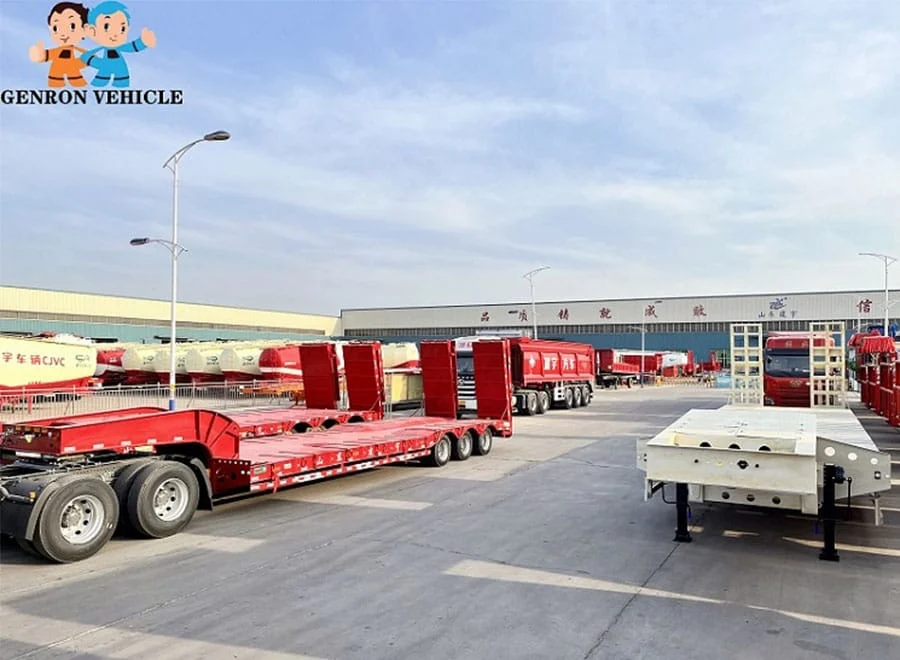
GENRON's three-axle low bed with rear loading ramps and removable-gooseneck lowboy layout represent different loading layouts to discuss with the supplier. A rear-ramp arrangement and a detachable-gooseneck arrangement change the route onto the deck, the preparation required and the working space needed. Neither layout is automatically the correct answer for every grader.
Compare proposals using the same machine drawing and the same sites. Ask what equipment, operating steps and personnel each arrangement assumes, and which items are included in the price. An apparently simpler trailer can require additional site arrangements, while another configuration may create handling or space requirements that the buyer cannot accommodate. The comparison should make those dependencies visible before purchase.
Keep blade support and load restraint separate
The blade's transport preparation, any required support and the restraint of the machine are related but different questions. A blade resting near the deck should not be assumed to provide an accepted support or restraint point. Similarly, a prominent frame feature should not be selected for securing simply because it is easy to reach.
Request the machine manufacturer's relevant transport and securing information. Have the responsible carrier or load-restraint specialist develop the journey-specific arrangement using suitable trailer attachment points. The purchase specification should provide the information and equipment scope needed for that work, not invent chain quantities, angles or attachment methods for an unidentified grader and route.
Make the loaded outline a combination drawing
The grader's own transport height is not the complete vehicle height. Ask for a drawing of the machine in its accepted position on the proposed trailer, with the tractor interface and relevant projections included. Identify the dimensions that remain provisional until the machine configuration or trailer design is confirmed.
The carrier should use the actual combination for route review, including access through gates, turns and overhead restrictions. A lowered deck may address one dimension without resolving width, length or turning requirements. Keep route approval separate from a supplier's general statement that the trailer is suitable for machinery transport. They answer different questions and are normally supported by different evidence.
Plan for a grader that is not ready to move
Used-equipment collections do not always involve a fully operational machine. State whether the grader starts, steers and moves as intended, and disclose known defects before the loading arrangement is selected. If the condition is uncertain, require inspection or confirmation rather than asking the driver to discover the problem when the trailer arrives.
A non-running or damaged grader needs a separately developed recovery and loading plan. Do not assume that a standard ramp trailer, an improvised pull or the presence of another machine resolves that situation. Identify who is responsible for preparing the grader, providing any specialist equipment and deciding whether the planned collection can proceed under the actual conditions.
Account for intermediate handling locations
If the journey includes a port, storage yard or transfer to another vehicle, identify those locations before finalising the transport scope. Ask which organisation accepts the grader and trailer there, what cargo information it requires and whether the machine must be moved again. The agreed preparation for the first road leg may not explain a later handling operation.
Keep the blade and attachment records with the shipping documents so that an intermediate operator can recognise the agreed configuration. Any additional handling should have its own accepted arrangements and responsible personnel. A procurement comparison should include those services where required, rather than treating arrival at the first terminal as completion of the delivery.
Include removed attachments in the delivery plan
If the agreed configuration involves removing a blade extension or another attachment, record its dimensions, mass, approved handling needs and destination. Decide whether it travels on the same trailer or on a separate vehicle. An empty-looking space beside the grader may be required for securing access or may not offer appropriate support for a loose component.
Give each removed item an identity that links it to the grader and the receiving record. Allocate responsibility for packaging, retaining hardware, protection and reassembly. A quotation that excludes attachment removal and reinstatement can still be useful, but those exclusions must be understood when comparing its price and assessing the complete delivery schedule.
Design the enquiry around repeated fleet work
If the trailer will carry several graders, submit a machine schedule instead of asking for coverage of a broad model family. The longest machine, the heaviest machine and the widest blade arrangement may be different units. Review the relevant loading cases rather than combining unrelated maximum figures into a fictional machine.
Ask the supplier to state which machines and configurations its proposal covers and which remain outside the reviewed scope. Keep the accepted records available to dispatch staff. A fleet purchase becomes easier to manage when an additional machine triggers a documented review, rather than an assumption that every grader must fit because the first delivery went well.
Use acceptance evidence that matches the order
Before dispatch, compare the finished trailer with the approved drawing, supplied equipment list and agreed inspection requirements. Check the dimensions and attachment features that matter to the grader arrangement, and record unresolved differences. General factory photographs cannot demonstrate that a particular wheel-contact position or machine clearance has been assessed.
If a demonstration or trial loading is part of the contract, define its machine, location, responsibilities and acceptance record in advance. It should be an organised verification activity, not an informal experiment after delivery. Retain the final configuration record with the trailer documents so that later staff can distinguish approved arrangements from unreviewed alternatives.
What to send with a quotation request
A useful enquiry combines a current machine record, the intended transport configuration, confirmed mass information, dimensioned outline and wheel-contact geometry. Add collection and delivery conditions, the intended tractor combination and any separate components. State who will provide the machine instructions, route review and loading supervision, with unresolved matters assigned to a named party.
The resulting quotation should describe a defined application rather than promise to carry any grader within a headline tonnage. Ask GENRON to identify the proposed trailer layout, assumptions, included accessories and information still required. That makes the next technical discussion more efficient and gives the purchasing team a sounder basis for comparing scope, price and delivery arrangements.
Frequently asked questions
Is the grader's blade width the trailer deck width I need?
Not necessarily. Blade width contributes to the outside cargo envelope, while tire spacing and contact positions determine where the machine loads the deck. Both need review. A wider deck does not automatically resolve a projecting blade, and a blade positioned within a narrow outline does not prove that the wheel contacts are properly supported. Submit a dimensioned drawing of the agreed transport configuration and ask the supplier to identify the accepted support arrangement.
Can I use operating weight for the transport enquiry?
It can be an initial reference only if its equipment assumptions are understood. Confirm the actual machine, retained attachments and separate items travelling on the same vehicle. Record where the mass comes from and whether it has been verified for that configuration. If there is a difference between published and actual equipment, resolve it before approving the trailer proposal rather than silently selecting the more convenient figure.
Does a fitted rear ripper change the transport enquiry?
It can change the mass, rear projection and clearance information used in the assessment. Identify the fitted assembly and show its permitted transport position on the machine profile. Do not assume that a published base-machine drawing includes it. If removal is proposed, the owner must confirm the appropriate method and allocate handling, packaging and reinstatement work. A removed ripper still needs an identified delivery arrangement; it should not become an unrecorded loose item placed wherever space appears available on the trailer.
Should the trailer buyer decide the blade and articulation position?
The buyer should coordinate the information, not invent a universal preparation method. The equipment owner and competent personnel should establish the permitted configuration from the instructions for the actual grader. The carrier's loading and securing plan must then use that condition. If different settings are required during loading and travel, identify those stages and the responsible operator rather than assuming that one sketch explains the whole operation.
What if the grader has different tires when it is collected?
Treat the change as something to review against the accepted machine record. Tire dimensions can affect supporting contacts, outside dimensions and the underside relationship used in the loading assessment. Notify the trailer supplier and carrier before collection, provide the updated information and obtain confirmation of any consequences. The fact that the machine model is unchanged does not establish that all assumptions in the original proposal remain valid.
What should a useful supplier response contain?
It should identify the exact trailer layout, the grader configuration reviewed, intended support position and assumed loading conditions. It should also explain the included accessories, technical information still required and limits of the supplied scope. Route approval, machine preparation and a journey-specific securing plan should have clear owners. A response consisting only of deck length, nominal payload and a price leaves important parts of a motor-grader transport purchase unresolved.
Product Options to Discuss
Related Reading
Low Bed Trailer for Excavators: A Dimension and Ramp Checklist
Fixed vs Detachable Gooseneck Low Bed Trailers: Choosing the Loading Arrangement
Low Bed Trailer Width Extensions: Deck Support, Machine Fit and Route Planning


