
 English
 Français
 Español
 Árabe
 Deutsch
 简体中文
 Português
 Русский
 日本語
 한국어
 हिंदी
 Prancis
 Türkçe
 Tiếng Việt
 Italiano
 ไทย

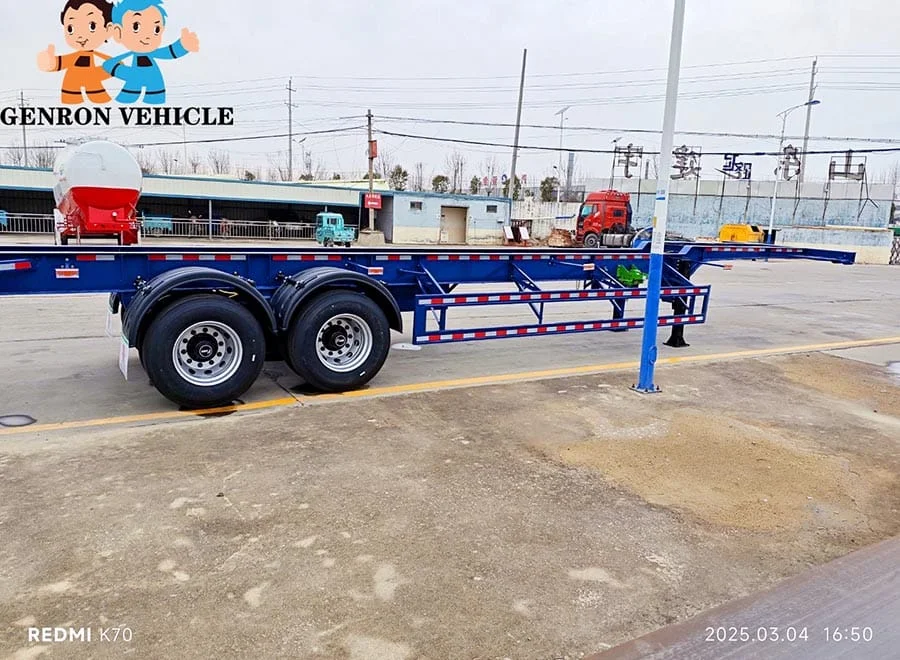
A 20-foot ISO tank container and a 20-foot dry freight container can share a familiar length description without presenting the same purchasing task. A chassis buyer still needs to understand the actual tank-container frame, its loaded condition, equipment clearances and the way its weight is transferred to the vehicle. Matching a catalogue length is only the beginning.
The correct question is whether the proposed chassis and tractor combination has been assessed for the identified tank container and operating cases. This guide explains the information to collect for that assessment. It does not approve a particular tank-container movement, establish dangerous-goods compliance or claim that every general container chassis is suitable for carrying a loaded tank container.
Begin with the actual tank-container identity
Ask the tank owner or operator for the equipment identification and current technical information. Obtain the relevant drawings, identification-plate details and documents needed by the responsible reviewers. A photograph showing a cylindrical tank inside a frame does not reveal the complete specification. Avoid treating a broad description such as chemical ISO tank as though it identifies one interchangeable item of cargo.
If the operation uses a leased fleet, establish which tank-container types may actually be allocated. The purchase should address the accepted range, not just a sample unit that happened to be available when the enquiry was prepared. Record any variation in frame arrangement, overall envelope or installed equipment that could affect the chassis interface. Unknown future types should remain outside the confirmed scope until reviewed.
Separate the tank container from a road tanker
An intermodal tank container is carried by the chassis; it is not the same product as a conventional road tanker semi trailer with its own tank installation. Keep the two equipment scopes distinct in enquiries and quotations. A chassis quotation should not silently become a claim about the tank's product compatibility, pressure rating, inspection status or permission to carry a particular substance.
Eurotainer's fleet summary distinguishes several tank-container categories and shows that dimensions, materials, fittings and other characteristics vary across them. That is a useful reason to request actual equipment data rather than rely on the generic words tank container. It is not evidence that any listed Eurotainer specification applies to a GENRON chassis or to the tank a buyer has been allocated. Eurotainer: tank-container fleet categories and specification differences
Establish the frame geometry and support interface
Obtain the tank-container drawing that identifies the relevant corner fittings and the intended support arrangement. Ask the container provider which parts of the frame are designed to transfer loads to the chassis and what interface information the chassis designer needs. Do not assume that any convenient lower member, protective rail or surface under the tank can be used as an additional support.
The chassis proposal should show the corresponding support locations and locking arrangement. Where an existing chassis is being considered, compare the actual geometry rather than its nominal product name. A statement that the locks line up addresses only part of the question. The responsible designer must also assess the supported condition, structural suitability and loading case of the complete proposed arrangement.
Confirm the loaded case rather than the empty appearance
Ask for the actual tank-container tare information and the proposed product load for each relevant operating case. Keep permitted equipment ratings separate from the quantity planned for one journey. The tank provider and operator must establish the accepted filling conditions for the specific tank and product; the chassis supplier should not invent them from a photograph or nominal tank volume.
Provide the resulting container gross mass and any required load-distribution information to the vehicle reviewer. Do not use the chassis's headline load figure as the sole acceptance test. The location of the load, the chassis configuration and the tractor interface matter as well. An empty tank container sitting neatly on four supports does not demonstrate the suitability of the combination when loaded.
Review chassis position and tractor loading together
The proposed tank position needs to be reviewed with the kingpin and axle arrangement, not selected only for visual balance. Ask the designer to identify the cases used to assess the tractor and trailer axle loads. The relevant limits of the actual vehicles and the destination operation also need review. More trailer axles do not automatically resolve every loading constraint.
If several container positions are offered, ask which positions are intended for the identified tank and whether they have different conditions of use. A multi-position chassis should come with clear configuration information, not an assumption that all available lock positions are interchangeable under the same load. The fleet's dispatch staff need an understandable accepted arrangement rather than a menu of unexplained hardware positions.
Consider height and centre-of-gravity information
The tank-container provider should identify the information needed to assess the loaded equipment's centre of gravity and relevant operating cases. The vehicle designer can then consider that information alongside chassis height and the full combination. Avoid reducing the assessment to a rule that lower is always sufficient or that a particular axle count guarantees acceptable behaviour.
Specialised tank-container chassis exist for defined duties. Van Hool, for example, publishes a dedicated container-chassis product for specified tank-container lengths, demonstrating that this is an application-specific equipment category. Its design features or dimensional values should not be transferred to another manufacturer. A buyer should ask what the proposed GENRON arrangement is designed and assessed to carry, and which cases remain unconfirmed. Van Hool: dedicated 20-foot tank-container chassis brochure
Map the fittings that need space around them
Include the tank-container equipment envelope in the drawing review. Outlet assemblies, protective structures, hose boxes, ladders and other fitted items may affect clearances and access. Ask the container provider to identify the actual arrangement rather than relying on a photograph of another unit. A chassis crossmember can appear acceptable in a general view while creating an issue around a specific fitting.
The receiving-site requirements should also be recorded. State whether the operation expects a particular outlet orientation or working position and ask the responsible parties to review the interface. Do not assume that a tank container will be rotated, modified or given an alternative connection to suit a chassis after arrival. Access for inspection or maintenance must follow the relevant equipment instructions and operating arrangements.
Keep transfer equipment separate from transport equipment
Identify whether any pumps, hoses, heating connections or other service equipment are being requested with the chassis. Each additional item needs a defined supplier, mounting arrangement and integration responsibility. A general promise of ready for discharge leaves too much unresolved. The buyer should distinguish what the chassis carries from what the tank-container provider and receiving facility must supply.
Do not infer that the chassis is intended to tilt or tip because a different container chassis has that capability. Any such operation requires a specifically assessed system and the relevant tank-container acceptance. Likewise, a standard chassis product page is not a transfer procedure. Keep the quotation within its verified scope and route product-handling questions to the responsible tank provider and operating specialists.
Obtain the required compliance review early
The operator should identify the applicable requirements for the actual product, equipment and territories before the order is committed. Where dangerous goods are involved, suitably qualified parties need to confirm the relevant transport and operating obligations. Neither this guide nor a chassis recommendation establishes that a particular substance may be carried. Tank status and chassis suitability are separate parts of a wider acceptance process.
Ask which documents the operator, terminal, tank owner and destination customer require, then assign responsibility for providing them. Keep transport permissions, tank inspection evidence and chassis technical information clearly identified. A certificate supplied for one item should not be presented as approval of the entire combination. Unresolved requirements should remain explicit purchasing dependencies rather than disappear into a vague statement of international standard compliance.
Compare a 20-foot chassis with a multi-position alternative
The two-axle container-chassis layout provides a starting point for a 20-foot chassis enquiry. The three-axle container-chassis layout may support a discussion of other container-length requirements. Neither listing, by itself, establishes acceptance for the buyer's specific loaded tank container. Ask GENRON to review the actual frame, support interface, mass and operating brief before recommending an offered configuration.
If the fleet also moves dry containers, explain the genuine mixed-duty requirement. A more flexible chassis is useful only if its intended configurations are assessed and the operator can manage them correctly. Compare the physical arrangements, actual masses and service demands rather than buying flexibility as an abstract benefit. In some operations separate equipment allocations may provide a clearer answer than one nominally universal vehicle.
Define what must be inspected before handover
Agree an acceptance plan covering the supplied chassis configuration and its traceable technical records. Identify the evidence required for support geometry, locking equipment, supplied accessories and the actual tractor interface. The inspection should compare the built unit with the accepted drawing. A general walk-around photograph is useful documentation but cannot replace the checks that require measurement or technical judgement.
If a tank-container trial is part of the agreed plan, define the exact unit, loading condition, personnel and controlled procedure through the responsible parties. Do not treat a convenient empty-container fit check as a full loaded acceptance assessment. Record any outstanding issue and the action needed to close it. The vehicle should not enter an unconfirmed duty merely because the collection date has arrived.
Plan for interchange and changing tank allocations
Tank containers may be exchanged between operators, depots and transport modes. The fleet therefore needs a process for checking that an allocated unit falls within the chassis's accepted scope. Ask what identifying information dispatch staff and drivers will receive. They should not be left to judge suitability from a familiar paint colour or an assumption that all 20-foot tanks are equivalent.
Establish who reviews an unfamiliar frame type, equipment projection or loaded condition before allocation. Keep rejected or unconfirmed cases visible in the transport planning system. This is especially helpful where a chassis serves more than one customer. A well-defined escalation route prevents the urgency of one collection from turning an unanswered compatibility question into an informal operational decision.
Preserve the equipment boundary in the commercial offer
The final quotation should identify the supplied chassis and its stated intended duty, together with the information used for assessment. Clarify whether a tank container is included at all. Many misunderstandings start when a photograph of a complete combination is interpreted as the scope of sale. List the supplied accessories and buyer-arranged work in words that both parties understand.
Keep limitations specific and useful. Rather than accepting a blanket claim that a chassis carries every ISO tank, ask which identified tank-container cases are covered and what further information is needed for others. This creates a more reliable foundation for procurement, interchange planning and later technical support. It also makes it easier to detect whether a proposed equipment change requires a fresh review.
Use an example allocation to expose missing information
Before finalising the order, walk through one intended collection using documents rather than assumptions. Identify the tank that would be allocated, the product loading case, the tractor, the proposed chassis configuration and the destination interface. Ask each responsible party whether the information provided is sufficient for its part of the acceptance decision. Keep unanswered questions assigned to a named organisation or role.
This exercise is not a transport authorisation or a loading trial. Its value is that it reveals gaps in the buying brief while they can still be resolved. For example, the tank owner may hold a drawing the haulier has never requested, or the receiver may expect access around an outlet that was absent from the original photographs. Resolve those interfaces before accepting a generic promise of compatibility.
Frequently asked questions
Can any 20-foot container chassis carry a 20-foot ISO tank?
Do not assume so. Nominal length is only one interface detail. The actual tank-container frame, support arrangement, loaded condition, equipment clearances and vehicle loading case must be assessed. Provide the tank provider's data to the chassis supplier and responsible operator. A dry-container application or an empty tank that physically fits does not establish acceptance for every loaded tank-container operation.
Does a matching twist-lock pattern prove suitability?
It helps establish the physical connection arrangement, but it does not answer every structural and operational question. The support locations, actual container mass, load distribution and equipment envelope still require review. Ask for an identified accepted configuration rather than relying only on the fact that locks engage. Any uncertainty about the frame's intended support points should be referred to the container provider and chassis designer.
Is a tank-container chassis the same as a fuel tanker semi trailer?
No. A tank-container chassis carries separate intermodal equipment, whereas a road tanker semi trailer has a different equipment arrangement and scope. Keep the quotation boundaries explicit. Chassis supply does not establish tank compatibility with a fuel or chemical, inspection status or authorisation for a particular product. Those matters require the relevant tank documentation and the responsible operator's acceptance process.
Why should the buyer supply more than tank volume?
Volume alone does not identify the transported mass, frame arrangement or loaded equipment behaviour. The reviewer needs the actual tank identity, its tare information, proposed product load and other data requested for the accepted case. Tank capacity is not a substitute for that information. Do not estimate a universal payload from a litre figure and describe the result as approved for the chassis.
Can the chassis be used for different tank-container types later?
Only within a scope that has been properly assessed and accepted. Give the supplier the intended range at the enquiry stage, and establish a review process for future types or changed loading cases. Similar length descriptions do not guarantee the same supports, equipment clearances or other interfaces. Keep a record of confirmed configurations so the dispatch team can distinguish accepted allocations from cases still needing technical review.
What if a depot allocates a different tank at collection?
Check the allocated unit against the documented accepted range rather than relying on the booking's length description. A different frame, equipment projection or loading case may need review. If the unit falls outside the confirmed scope, refer it to the designated operator, tank provider and chassis technical contact before accepting that allocation. Dispatch pressure does not supply the missing evidence. Keep the replacement unit's identity and the resulting decision with the transport record so the accepted configuration remains traceable.
Product Options to Discuss
Related Reading
Container Chassis for 40ft High Cube Containers: Overall Height and Fit Checks
Container Chassis Twist Lock Layout: Positions, Container Types and Drawings
Heavy 20ft Containers on a Chassis: Mounting Position and Axle-Load Checks


