
 English
 Français
 Español
 Árabe
 Deutsch
 简体中文
 Português
 Русский
 日本語
 한국어
 हिंदी
 Prancis
 Türkçe
 Tiếng Việt
 Italiano
 ไทย

A short container can be a demanding road load. Its length says little about how much it weighs or where its cargo is concentrated. That is why a chassis described as suitable for both 20ft and 40ft containers still needs a specific review for a heavy 20ft movement.
This article addresses container position and load distribution. It does not repeat a twist-lock layout guide or a high-cube height checklist. The aim is to help buyers ask for the evidence behind a proposed mounting arrangement before ordering a chassis or assigning one to a new route.
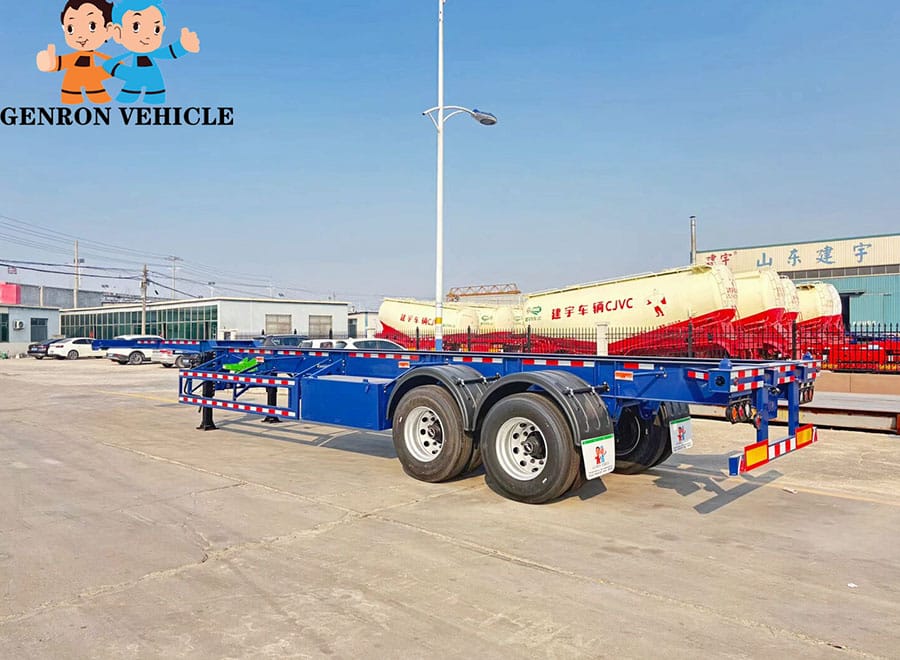
Start with container gross mass, not cargo mass alone
The road combination carries the container as well as its contents. Record the expected gross mass of the packed unit, identify the container type and obtain the relevant documentation. If the enquiry begins with net cargo mass, add the actual container and associated packing information rather than assuming a convenient tare figure.
A container’s marked maximum gross mass is not the same as the mass of a particular shipment. Nor is it permission to carry that shipment on any chassis or public road. Keep the container’s structural information, the actual load declaration and the road-vehicle assessment as separate items in the file.
Ask whether the cargo distribution inside the container is known. Two units with the same gross mass can impose different conditions if one has a strongly offset centre of gravity. The container packer’s information can therefore matter to the chassis and tractor review, even when the doors will remain sealed during the journey.
Available lock positions are not unrestricted load positions
A multi-position chassis may offer more than one place to mount a 20ft container. Obtain a drawing that identifies which positions are intended for that container and the restrictions attached to each. Do not infer permission from the presence of a pair of fittings or from a photograph of another vehicle.
Container position changes the relationship between the load, the trailer axle group and the kingpin. It can also affect tractor loading and clearances. A suitable position is therefore a property of the complete arrangement, not simply a matter of centring the container within the trailer outline.
If the proposal includes a sliding or adjustable arrangement, record the permitted operating positions and the manufacturer’s requirements. Do not treat adjustment as an informal way to solve an axle problem at the roadside. The fleet needs an accepted configuration before the movement is assigned.
Three checks that should not be merged into one capacity claim
| Check | Question to answer | Evidence to request |
|---|---|---|
| Container | What is the packed unit, and what does it weigh? | Container identification and shipment mass information |
| Chassis and tractor | Does the proposed combination support this load in this position? | Configuration-specific drawing and load-distribution review |
| Route | May that loaded combination use the intended roads? | Current destination limits and any required movement authorisation |
Give the designer the actual tractor information
Provide the tractor model and configuration, wheelbase, axle arrangement and relevant fifth-wheel information. Include the manufacturer’s applicable ratings and an appropriate tare or axle-weight record where available. A chassis review based on a different tractor may not represent the vehicle the buyer will use.
Ask the supplier to identify the assumptions used in its axle and kingpin-load assessment. The output should be tied to the container position and gross mass shown on the drawing. A generic diagram with no tractor reference or load value is not a substitute for that configuration-specific response.
Coupling height and physical clearance still need attention, but they answer a different question from weight distribution. A combination can couple successfully and still have an unacceptable axle condition. Keep both checks in the acceptance list rather than treating one as proof of the other.
What a useful loading diagram should show
At minimum, the diagram should identify the tractor, chassis, container type, mounting position and load case. Ask for the resulting load information at the relevant vehicle interfaces and axle groups, with the assumptions and applicable limits clearly distinguished.
For illustration, a buyer might request separate assessments for a 24-tonne and a 28-tonne packed container using the same proposed mounting position. Those numbers are hypothetical enquiry cases, not recommended payloads or legal allowances. The purpose is to reveal whether the supplier has considered the buyer’s operating range rather than only one convenient load.
If the container’s internal distribution is uncertain, raise that uncertainty explicitly. The planner should decide what additional information or verification is needed. A single gross-mass number should not conceal a known off-centre or highly concentrated cargo arrangement.
Port release does not complete the road review
A container may be ready for collection at a terminal while the road operator still has unresolved vehicle or route questions. Confirm the collection arrangement, mass information and any operational restrictions with the relevant parties before dispatching the tractor.
Route limits can differ between jurisdictions and road classes. Do not use a headline trailer capacity from a quotation as a universal road payload. Where permits or special approvals are involved, have the responsible transport professional establish what is required for the actual combination and journey.
The UNECE CTU Code offers general guidance on cargo packing and distribution within transport units. It does not determine the permitted road axle loads for a specific tractor and chassis. Both the packed container and the carrying vehicle need their own appropriate checks.
Further source information:
Turn the first movement into a controlled handover
Before assigning the first load, make sure the fleet has the accepted position drawing and knows which cases it covers. Identification should be clear enough that dispatch staff do not confuse an approved heavy-container arrangement with another visually similar chassis.
Use appropriate weighing and inspection arrangements to verify the loaded vehicle as required by the operator and applicable rules. A discrepancy should lead to a review of the documented assumptions, not an unapproved change of container position.
Keep subsequent changes visible. A different tractor, a revised chassis specification or a substantially different cargo distribution may invalidate the comparison with the original case. A simple configuration register is often more useful than retaining an unlabelled photograph of the first successful journey.
Heavy-container chassis enquiry brief
Container type and identification information:
Expected packed gross-mass range:
Known cargo-distribution information or uncertainties:
Required 20ft mounting position or operating flexibility:
Tractor model, geometry and relevant ratings:
Chassis drawing and permitted configuration references:
Collection terminal, route and destination:
Required load-distribution evidence and verification responsibility:
Make the accepted combination easy for dispatch to recognise
A practical dispatch record can identify the tractor, chassis, permitted container position and the load case covered by the review. It should point to the accepted drawing rather than reproduce an incomplete sketch. The aim is to let the fleet distinguish an assessed combination from a similar-looking substitute.
For example, a chassis may be paired with one tractor during quotation but assigned to another after delivery. That is the point to compare the new tractor information with the original assumptions. Similar engine power, cab appearance or axle count is not enough to establish identical load distribution.
The record should also identify what to do when shipment information is missing or inconsistent. A declared mass that does not match other available evidence is an issue to resolve before movement, not a reason to choose a different position by guesswork. Clear dispatch controls make the engineering and route review usable in daily work.
Heavy 20ft container questions
Does a 40ft-capable chassis automatically carry a heavy 20ft container?
No. Container length compatibility does not establish suitability for a particular gross mass and mounting position. Obtain a review for the actual load and tractor.
Is a shorter chassis always better for a heavy 20ft unit?
Not automatically. Geometry, axle arrangement, tractor loading, clearances and route requirements all matter. Compare defined configurations rather than length alone.
Can I use the container’s maximum gross-mass marking as the shipment weight?
No. The marking describes a limit associated with the container; it does not establish the mass of the current shipment. Use the appropriate actual shipment information.
What should be checked when the tractor changes?
Review the relevant geometry, axle and coupling information against the accepted load case. Do not assume two tractors with similar engine power distribute the same container load identically.
Related Reading
Sources and Scope
This guide separates procurement checks; it does not calculate axle reactions or state destination legal limits. The numerical examples are hypothetical load cases for discussion, not approved container masses.


