
 English
 Français
 Español
 Árabe
 Deutsch
 简体中文
 Português
 Русский
 日本語
 한국어
 हिंदी
 Prancis
 Türkçe
 Tiếng Việt
 Italiano
 ไทย

Why a drawing approval needs more than a signature
A trailer order can appear settled while different people are still working from different configurations. The buyer remembers an early quotation, the factory has a later layout, and the receiving workshop expects equipment discussed in a message. The problem may be incomplete coordination rather than an intentional change: the agreement has never been brought together into one identifiable package. A signed drawing helps only when everyone knows what the drawing covers, what it excludes and which other records form part of the order.
The practical goal is not to collect as many signatures as possible. It is to make the agreed trailer traceable from the commercial description through production, inspection and delivery. A useful approval package connects the drawing revision with the equipment schedule, cargo assumptions, interfaces, exceptions and outstanding decisions. It also identifies who may approve changes. This article explains how an importer or fleet buyer can organise that package without treating a general arrangement drawing as a substitute for engineering review.
Start with one order identity
Give the order a reference that appears on the quotation, drawings, inspection records and later correspondence. Where several trailers are being purchased, distinguish the common configuration from unit-specific differences. Two trailers can share a body layout while having different tyres, connections, colours or delivery arrangements. If those differences are hidden in separate messages, the final inspection becomes an exercise in reconstructing conversations instead of checking an agreed specification.
The order identity should remain stable even when a drawing changes. The revision identifies the version; it should not create an apparently unrelated order. Record the date, document title and issuing party alongside the revision so that a filename alone does not carry all the meaning. A document called final-new-approved is a weak reference because the name does not explain what changed or whether it replaced an earlier issue. A short, consistent register is more useful than a complicated naming system that nobody maintains.
Separate the proposed layout from the accepted application
A general arrangement can show the trailer envelope, axle arrangement, deck or tank layout and principal connections. It does not necessarily show every condition under which the vehicle may be used. The application record should therefore state what the trailer is being selected to carry, how that cargo is packaged, how it is handled and what operating information has been supplied. A broad phrase such as general cargo can conceal very different support and access requirements.
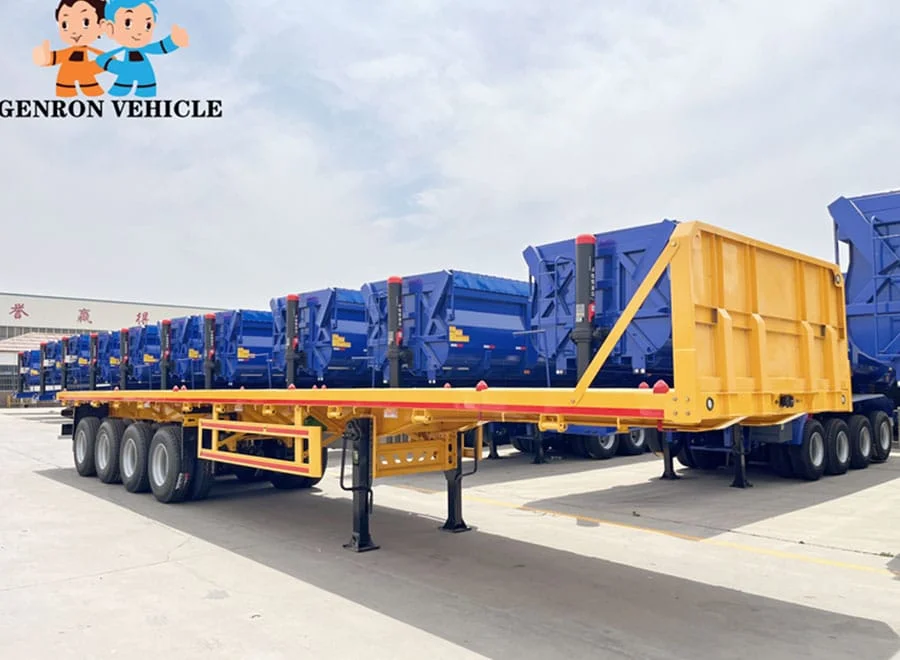
For example, a three-axle flatbed trailer may be the starting point for discussing palletised freight or long packaged products. That product category does not establish acceptance of every load placed on an open deck. The buyer should identify the actual load cases requiring assessment and ask the responsible supplier to state the configuration being offered for them. Keep the application description beside the drawing rather than assuming a later reader can infer it from the trailer outline. Any unresolved application question should remain visible before approval.
Define what the buyer is approving
An approval request should explain whether the buyer is confirming commercial scope, dimensional interfaces, appearance, operating requirements or a combination of these. Different people have different responsibilities. A purchasing manager can confirm an agreed equipment list without being the person qualified to assess structural design. A transport planner can supply route constraints without approving a braking installation. A signature should not silently transfer a technical responsibility that the signer has neither accepted nor been equipped to perform.
Ask the supplier to identify which aspects need buyer confirmation and which remain within the supplier's design and manufacturing responsibilities. Where an independent engineer, receiving-site representative or local approval specialist is required, name that role in the review process. The purpose is a clear division of work, not a blanket disclaimer. An approval package becomes stronger when a specific open issue has a named owner and a defined response, rather than an unsigned note saying that all details must be checked.
Check interfaces with the actual equipment
Interface questions often survive until delivery because the trailer and the connected equipment were ordered separately. Record the actual tractor information, loading equipment, receiving connections and site restrictions relevant to the order. A previous trailer may be a useful reference, but similarity is not proof of compatibility. Identify which dimensions or equipment records were measured, which came from a manufacturer and which are still assumptions awaiting confirmation.
If a HOWO 6×4 tractor truck is under discussion, for instance, the review should distinguish the tractor information supplied by the buyer from the trailer connection requirements. Do not approve the combination merely because both products are described with familiar model names. The responsible parties need to assess the actual interfaces and operating envelope. Attach the evidence used for that assessment or reference it clearly in the register. When the tractor changes later, the associated trailer review should be reopened where the change affects the agreed combination.
Make the equipment schedule part of the package
Drawings and commercial schedules answer different questions. A component may appear in an illustration without being included in the quoted supply, while a small but important accessory may be listed without appearing clearly on the general arrangement. Reconcile those records before approval. The schedule should identify the relevant equipment, its agreed specification or reference, the supplied quantity and any option that remains undecided. Avoid interpreting a photograph as an equipment list.
Pay particular attention to items that are commonly supplied by another party, fitted after arrival or selected late in the process. Identify who provides them, who installs them and what information the trailer supplier needs for integration. An item marked optional should not remain ambiguously optional when production begins. It should become included, excluded or formally unresolved. Where a decision is deferred, record its effect on price, production readiness and inspection so the open item cannot disappear behind an otherwise approved drawing.
Read dimensions as a connected set
Dimension checks work best when the reviewer understands the reference points and the configuration being measured. Overall length is not the same as usable cargo space. A gate opening is not necessarily the same as the unobstructed handling path. A dimension shown for an empty vehicle may not answer the buyer's loaded-envelope question. Ask what the dimensions describe and which related information is needed before treating them as acceptance criteria.
Use an annotated copy to raise specific questions, but keep the issued drawing distinguishable from informal comments. A note asking for a change is not evidence that the change has been accepted. The supplier should respond through an updated issue or a clearly controlled clarification linked to the relevant revision. Before signing the next issue, verify that the intended change has appeared and that related dimensions have been considered. This is particularly important where a change improves access in one area but affects space required elsewhere.
Resolve discrepancies before calling the issue approved
Discrepancies should be recorded in language that permits a definite response. Instead of writing wrong position, identify the component, the drawing reference and the expected requirement. Distinguish an error correction from a new buyer preference. Both may require action, but their commercial and production implications can differ. An organised discrepancy log prevents the same question from being raised repeatedly without anyone knowing whether the previous answer was accepted.
Give each issue a status and an owner. Some questions can be closed by a corrected drawing; others require a revised equipment schedule or additional application information. A response such as noted does not necessarily close the issue. Record what evidence closes it and which document now contains the agreed outcome. If production is authorised with a limited outstanding item, identify that exception explicitly and confirm that the responsible parties understand the permitted scope of work. Do not describe a conditional decision as unconditional approval.
Use a change record after configuration freeze
Configuration freeze is the point at which the agreed package becomes the reference for production and inspection. It does not mean that change is impossible. It means that later changes need a visible review rather than a silent edit. Record the reason for a proposed change, the affected documents and the parties whose decisions may be altered. A replacement component, for example, can affect more than the name shown on a schedule.
Ask the supplier to explain relevant consequences for fit, function, support, commercial scope and delivery before the change is accepted. The buyer should then give an identifiable decision through the agreed channel. Keep the superseded record for traceability while making it clear that it is no longer the production reference. A useful change log is short enough to read and complete enough to explain why the delivered vehicle differs from an earlier quotation or image. It should not depend on one person's memory of a telephone call.
Turn the agreement into an inspection reference
An inspection plan should point back to the approved configuration instead of introducing a new specification at the last moment. Identify which characteristics will be checked, the applicable reference and the evidence to be retained. Some checks are visual or documentary; others may require a defined measurement or a competent technical assessment. The buyer should understand what the proposed inspection can establish and what remains outside its scope.
Photographs can document an identifiable feature, but a photograph alone may not establish a concealed detail, component identity or functional result. Agree the required evidence in advance so that the supplier can prepare it while access is available. If a discrepancy is found, record the actual observation, the agreed response and the evidence of closure. Avoid converting an inspection into an informal redesign session. A new preference raised at that stage should enter the change process, while a departure from the agreed package should be handled as a discrepancy.
Preserve the delivered configuration
The final handover should identify the configuration actually supplied, including accepted changes made after the initial approval. Ask for the relevant final drawings, equipment records and other agreed documents under the same order reference. Where several units differ, the handover should allow the owner to identify the correct record for each unit. An orderly record is especially useful when maintenance staff later need to distinguish an original component from an approved alternative.
Retain the approval history separately from the current-use documents. Workshop staff should be able to find the applicable record without accidentally using a superseded drawing. At the same time, procurement staff may need the earlier issues to explain a commercial decision. This separation supports both purposes. It also makes a repeat order more precise: the buyer can request the previous delivered configuration and then list intended differences, rather than assuming that an old product photograph defines everything supplied on the earlier order.
Review a repeat order as a new decision
A repeat order can move faster when the original documents are reliable, but it still needs a review of the present requirement. The cargo, tractor, receiving site or equipment availability may have changed. State which earlier configuration is being referenced and which aspects are intended to remain the same. Then ask the supplier to identify any proposed differences before the new order is approved.
Do not treat equivalent as a complete technical description. If an alternative is offered, identify it and obtain the relevant assessment from the responsible parties. The buyer can then compare the actual offered scope rather than two superficially similar quotations. The most useful outcome is a compact order package that tells a future reader what was required, what was offered, what was accepted and what was delivered. That clarity reduces avoidable questions without pretending that paperwork alone establishes the suitability of a vehicle.
Frequently Asked Questions
Does signing a general arrangement approve the complete engineering design?
Not automatically. The approval request should define what the signature means and which responsibilities remain with the supplier or other specialists. A buyer may be confirming dimensions, application information or commercial scope without undertaking structural design review. Clarify that distinction before signing. If a technical assessment is needed, identify the competent party and the evidence required rather than relying on an ambiguous approval stamp.
Which record takes priority if the quotation and drawing disagree?
Do not assume an order of priority that has not been agreed. Raise the discrepancy and obtain a clear response linked to the order. The parties should reconcile the affected records and identify the applicable configuration before authorising the relevant work. A later date on one document does not, by itself, explain whether it was intended to replace a commercial requirement in another.
Can a change be approved through a message?
A message can record a decision if the parties have agreed that channel and the decision is identifiable. The difficulty is leaving the outcome only in a conversation while production and inspection documents remain unchanged. Link the accepted decision to the order, identify the affected revision and update the controlled package. Keep enough context to establish exactly what was approved and by whom.
Should every drawing dimension appear on the final inspection report?
The inspection scope should be agreed according to the order and the significance of the characteristics being checked. Copying every dimension without a workable inspection method can create an impressive-looking but weak record. Identify the checks that establish the agreed deliverable, their references and the evidence expected. A defined inspection scope does not remove the supplier's responsibility to supply the accepted configuration.
What if a component becomes unavailable during production?
Ask the supplier to identify the proposed replacement and explain the relevant implications before accepting it. The review may involve interfaces, operating requirements, support information and commercial scope, depending on the item. Record the decision and update the affected documents. A substitute should not become part of the delivered configuration merely because it appears similar in a photograph or carries a familiar description.
What should a buyer send when requesting a repeat trailer order?
Send the previous order reference, the applicable delivered-configuration record and a clear description of the new application. Identify intended changes and ask the supplier to disclose proposed differences. This gives both parties a concrete starting point. An old quotation can help locate the history, but it should not be treated as proof that the new order has identical equipment, interfaces or commercial scope.


