
 English
 Français
 Español
 Árabe
 Deutsch
 简体中文
 Português
 Русский
 日本語
 한국어
 हिंदी
 Prancis
 Türkçe
 Tiếng Việt
 Italiano
 ไทย

A fleet running mainly on paved trunk roads may ask a different question from a fleet collecting loaded trailers from soft construction yards. Both may describe the work as long-distance haulage, yet the difficult part of the operation can occur in the first few hundred metres.
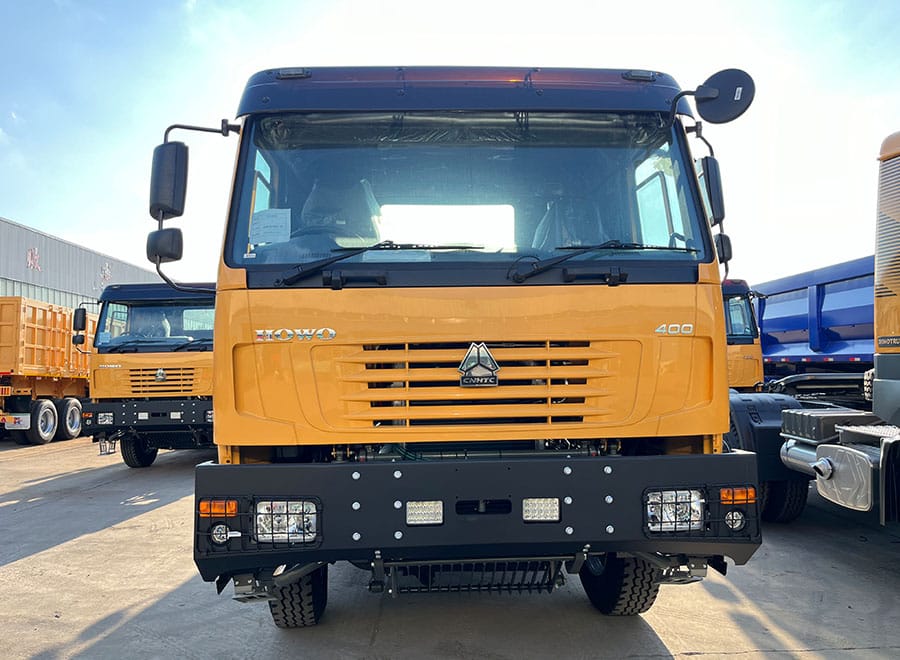
The purpose of a 6x2 versus 6x4 comparison is to identify those differences before selecting the driveline. This article explains the terminology and provides a route-based comparison method. It does not claim that every configuration is available in a particular HOWO model or destination market.
Understand what the numbers describe
In the conventional notation used here, 6x2 describes a three-axle vehicle with one driven axle, while 6x4 describes a three-axle vehicle with two driven axles. The notation refers to wheel positions and driven positions, not a literal count of every tire fitted to the vehicle.
It does not identify engine power, transmission ratios, axle ratings, suspension, tire specification or every detail of an auxiliary axle. Those features need to be stated separately. Two 6x2 proposals can differ significantly, just as two 6x4 proposals can.
Ask for a configuration drawing and a driveline schedule rather than relying on a badge or a front-view photograph. If the proposal includes a lifting, steering or load-management feature, obtain its exact specification and limitations. Do not assume those features come with every vehicle carrying the same axle notation.
Describe the worst routine access, not only the main road
Split the route into practical segments: depot, public road, customer entrance, yard and loading or unloading area. Record where the vehicle must start under load, reverse, turn tightly or travel on a surface affected by rain. The short access segment can influence the choice as much as the highway distance.
Give the supplier evidence rather than broad regional labels. Surface photographs, gradient information and the frequency of difficult access help distinguish occasional exceptions from daily work. “For Africa” or “for mining” is not a sufficient operating description on its own.
If difficult access can be avoided through an established operating arrangement, include that arrangement in the comparison. If it cannot, do not hide it in the small print. The specification should be matched to the work the fleet will actually accept, not just the easiest portion of the route.
Route questions that make an axle comparison useful
| Operating question | Information to collect | How to use it |
|---|---|---|
| Loaded starts | Mass, surface and gradient at regular departure points | Discuss startability and traction with the vehicle supplier |
| Road duty | Distance, speed pattern and terrain | Compare complete driveline proposals on the same duty |
| Access reliability | Wet-season conditions and difficult yard frequency | Identify whether the proposed vehicle covers routine work |
| Vehicle limits | Applicable combination and axle constraints | Check the actual vehicle and trailer arrangement |
| Support | Workshop capability and parts availability | Include service practicality in the purchasing decision |
Traction is not the same as engine power
Engine output alone does not establish how effectively the vehicle can start or move in a particular low-grip condition. Driven-axle arrangement, load distribution, tires and control features also matter. A higher-power engine should not be used as a blanket answer to an undefined traction requirement.
Volvo Trucks’ axle-selection guidance identifies combination weight, route topography and the transport assignment as key inputs. It also discusses driven axles and traction. That is a useful general selection principle, not a claim that Volvo equipment or a specific feature is fitted to a GENRON-supplied tractor.
For an actual proposal, ask the vehicle supplier to assess the stated operating cases and identify restrictions. If a demonstration or fleet trial is proposed, agree the conditions and evaluation method. A favourable result in one dry yard is not proof of suitability for every wet-season access point.
Further source information:
Compare complete drivelines on a common basis
List engine and transmission models, relevant ratios, axle specifications, tires and applicable vehicle ratings for each quotation. Confirm the market and exact build specification. A different axle arrangement combined with a different engine, cab or tire package is not a controlled comparison.
Keep manufacturer ratings separate from road permissions. The complete tractor-trailer combination must meet the applicable destination requirements, including its load distribution. More driven axles do not create permission to exceed legal limits, and an extra non-driven axle does not automatically increase usable payload.
Ask the supplier to identify the coupling and trailer assumptions as well. A tractor is not being purchased in isolation when its duty is to haul an existing fleet of tankers, flatbeds or low beds. The relevant trailer interfaces and operating loads belong in the quotation review.
Treat fuel and tare advantages as evidence questions
A buyer may hear that one layout always saves a fixed percentage of fuel or carries a fixed amount of additional cargo. Such statements are not a reliable comparison without the vehicle specifications, route and measurement method. Request evidence that matches the proposed duty.
Separate measured data from estimates. Record the test vehicles, load, route, speed pattern and period covered by a fuel comparison. If only a supplier estimate is available, label it as an estimate and avoid presenting it as a guaranteed operating result.
Tare comparisons deserve the same discipline. Compare vehicles with equivalent cabs, tanks, equipment and delivery scope, then check the implications for the complete combination. A lighter tractor does not automatically turn every kilogram of difference into saleable cargo on every route.
Use a simple cost model without pretending the inputs are certain
For internal planning, separate purchase price, fuel, maintenance, tires, downtime and any access-related limitations. Use documented fleet inputs where available. Keep a range for uncertain items instead of hiding them inside one apparently precise cost-per-kilometre figure.
An illustrative fuel calculation can use the difference in litres per 100 kilometres multiplied by annual kilometres, then divided by 100 and multiplied by fuel price. The arithmetic is straightforward; the difficult input is the credible consumption difference. This formula does not establish that either layout saves fuel.
Include operational consequences that the simple fuel calculation misses. If a configuration cannot cover a routine site under the agreed conditions, identify the alternative arrangement and its real cost. Equally, do not pay for capability the fleet does not need merely because the axle label sounds more heavy-duty.
Route-based tractor comparison brief
Trailer types and loaded combination range:
Daily route segments and annual distance:
Routine loaded starts, surfaces and gradients:
Seasonal access conditions and frequency:
Required axle and combination compliance review:
Exact engine, transmission, axle and tire specifications:
Evidence for fuel, tare and service-cost assumptions:
Model availability, delivery scope and local support:
Define what success looks like before a fleet trial
If a trial is available, agree the questions it is intended to answer. A route-access assessment, a fuel comparison and a driver-acceptance exercise are not the same test. Record the vehicle build, trailer, load and operating conditions for each result.
For a fuel comparison, consistent measurement matters more than an attractive single journey. For access, identify whether the observed site conditions represent the difficult routine case. The fleet and supplier should agree the evaluation method and the limits of any conclusion before treating the trial as evidence for an order.
Keep operational feedback specific. “Struggled at customer entrance after rain” is more useful than “not powerful enough,” because the first statement points to a defined condition for review. Likewise, a favourable result should describe the duty completed rather than claim that one axle layout is better everywhere. Good trial records turn experience into a purchasing input instead of another broad sales claim.
6x2 and 6x4 tractor questions
Is a 6x4 always the better heavy-duty choice?
Not automatically. It may be appropriate for a particular traction requirement, but the full vehicle, route and operating costs need comparison. A label does not replace an application review.
Does 6x2 mean the vehicle has six tires?
No. The notation describes wheel positions and driven positions in the conventional layout. Dual tires do not change the basic interpretation of that axle notation.
Can fuel savings be predicted from axle layout alone?
No. The engine, driveline, load, route, speed pattern and other vehicle details affect consumption. Use comparable measured evidence or clearly labelled estimates rather than a universal percentage.
Can I order any HOWO tractor in either layout?
Do not assume that. Availability depends on the exact model, market and build specification. Ask for a model-specific written proposal; this article explains selection principles, not a current availability list.
Related Reading
Sources and Scope
The source supports general axle-selection principles, not HOWO model availability, a guaranteed fuel result or local legal allowances. The cost formula is an editorial planning aid and requires credible fleet-specific inputs.


