
 English
 Français
 Español
 Árabe
 Deutsch
 简体中文
 Português
 Русский
 日本語
 한국어
 हिंदी
 Prancis
 Türkçe
 Tiếng Việt
 Italiano
 ไทย

Bulk bags can make a trailer layout look simple: put two across the deck, repeat the rows and compare the total with the payload. In practice, filled bags can bulge, pallets can change the footprint, and the receiver may need access that a closed-gate photograph does not reveal.
This guide is for buyers planning fence-trailer work with flexible intermediate bulk containers, usually called FIBCs or bulk bags. It focuses on cargo information and trailer access, not on prescribing a lifting technique or approving a bag for a particular product.
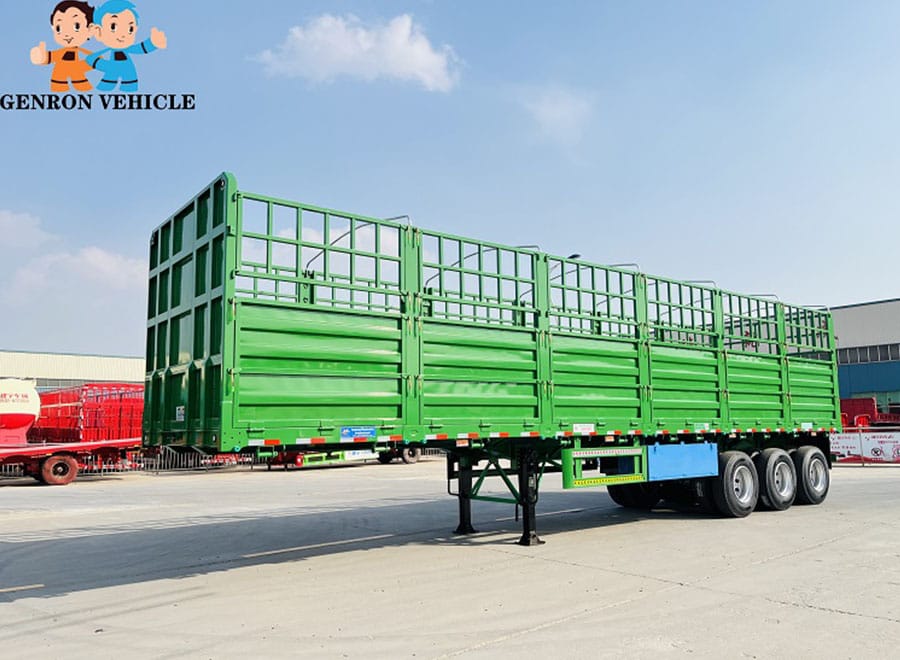
Ask for the filled-bag specification
Obtain the FIBC specification from the bag and product suppliers. Record filled dimensions, gross mass, lifting arrangement, discharge features and any relevant restrictions. Empty bag dimensions are not enough to establish the space occupied by the loaded package.
Use the actual filled shape or a supplier-approved transport drawing when planning the layout. A nominal square base does not guarantee that the bag remains within that outline after filling. Include any pallet, protective base or transport frame in the overall dimensions.
Identify the product and its handling requirements. Different powders, granules and other materials may require different packaging, moisture protection or contamination controls. The trailer body does not make an unsuitable bag acceptable for the product, and a generic “one-tonne bag” description does not establish the actual shipment mass.
Separate bag rating, cargo mass and vehicle capacity
The bag manufacturer’s rating concerns the FIBC under its specified conditions. It is not a trailer payload statement. Likewise, the product quantity ordered is not necessarily the gross mass of the package, pallet and other items that the vehicle carries.
Prepare a cargo schedule with bag quantity and verified or appropriately established gross mass per unit. Include pallets, covers and separately carried equipment where relevant. Then have the complete trailer and tractor load arrangement reviewed within the applicable vehicle and route limits.
Do not assume that a high fence or a large cubic capacity allows the deck to be filled to any chosen height. Stability, packaging limitations, axle distribution, overall dimensions and handling arrangements still need to be resolved. Space availability and permissible loading are different questions.
Bulk-bag data and the trailer feature it affects
| Cargo information | Trailer planning consequence |
|---|---|
| Filled width, length and bulge | Determines the actual row layout and side clearance |
| Gross mass per unit | Supports payload and load-distribution review |
| Pallet or base dimensions | Defines floor support and handling access |
| Approved lifting arrangement | Affects gate openings and equipment clearance |
| Product and packaging sensitivity | Defines weather and contamination requirements |
| Delivery sequence | Shows intermediate loads and access at each stop |
A layout calculation is only the first screening step
For illustration, consider a hypothetical usable deck width of 2.40 metres and a filled package width of 1.15 metres. Two packages total 2.30 metres, leaving 0.10 metre before accounting for the detailed operating clearances. That arithmetic checks a nominal footprint; it does not approve the layout or establish adequate access.
Repeat the screening with the maximum filled dimensions, not only an average bag. Then allow the responsible planner to assess support, load distribution, restraint and handling. If pallets are wider than the bags, the pallets may govern the row arrangement.
The same caution applies to deck length. Multiplying rows by a nominal bag length can miss gate posts, fixed fittings and space needed to handle the load. Ask for the usable area and obstructions on the actual trailer drawing rather than using overall vehicle dimensions.
Gate access must match the receiving equipment
Ask the receiver how the bags are handled and what equipment is approved for that operation. Provide the bag’s lifting and packaging information to the responsible handling planner. A forklift, crane or other system requires its own suitable method and clearances.
Show the clear gate opening, post positions and any upper frame that could interfere with access. If a palletised load is handled from the side, check the equipment envelope rather than only the bag width. If lifting access is required above the load, identify the cover and frame arrangement as part of the discussion.
Do not assume lifting loops are suitable road-restraint attachment points simply because they are accessible. Their intended use and the chosen securing method need to be established with the bag supplier and competent load-securing planner. This guide does not prescribe lifting or lashing through a loop.
Support and restraint need their own review
The filled bag, any pallet and the deck should form an accepted support arrangement without harmful edges, gaps or projections. Establish the bag manufacturer’s requirements and inspect the proposed contact area accordingly. A clean-looking deck photograph cannot establish the condition of a vehicle assigned months later.
Fence panels should not be assumed to provide the complete restraint system. Ask what role the body is designed to play and obtain a load-specific securing arrangement. Packaging can deform, and clear access to the selected trailer attachment points is part of making that arrangement practical.
FIBCA publishes safe-handling guidance for bulk bags, including storage and transport considerations. Use the current bag-specific instructions alongside such general guidance. Do not stack bags merely because the fence is tall enough; stacking suitability and stability must be established for the actual packages.
Further source information:
Weather protection is more than a tarpaulin in the equipment list
Ask the product and bag suppliers what protection is needed against moisture, contamination and exposure during the journey and at stops. A liner or coated fabric should not automatically be treated as permission for unrestricted outdoor exposure.
Define how the trailer cover fits the loaded envelope and how it is managed at delivery. Avoid a design that depends on unplanned climbing or handling around unstable cargo. The work method belongs with the cover specification, especially on routes with repeated opening and closing.
If a return cargo differs from the outward load, describe both. The trailer layout should accommodate the loading access, packaging and restraint requirements of each cargo. Unused pallets, covers and removable fittings also need a documented stowage arrangement during the return journey.
FIBC trailer enquiry sheet
Product and bag supplier specification:
Maximum filled dimensions and gross mass per unit:
Pallet, base or transport-frame information:
Proposed quantity and any stacking request:
Loading and unloading equipment at each site:
Gate openings, cover arrangement and access restrictions:
Support, restraint and weather-protection requirements:
Delivery sequence, return cargo and acceptance responsibilities:
Check the second delivery, not only the fully loaded departure
For a multi-stop route, show which bags leave at each site and what remains. Include pallets and handling accessories in the intermediate drawings. The load-securing planner should review those conditions rather than assuming that a plan for a full trailer also covers every partial load.
Ask the receiver to confirm which side or end needs access and what space its handling equipment requires. If a gate must open beside a fixed obstruction, resolve that mismatch before delivery. A large total side-opening area is not useful when the needed opening is in the wrong position.
The delivery list should connect package identity with unloading order without requiring unsafe access to read labels. Establish the identification method with the cargo owner and operator. This is a small administrative detail, but it helps turn a theoretical deck layout into a workable transport specification and reduces avoidable rearrangement at customer sites.
Fence trailers and bulk bags: common questions
Can I plan from the dimensions of an empty bag?
No. Obtain the filled transport dimensions and include bulging, pallets and other packaging. The loaded footprint, not the empty fabric outline, determines the layout.
Does a one-tonne bag always weigh one tonne on the vehicle?
No. Distinguish the bag’s rating, intended product quantity and actual gross package mass. Include the bag, pallet and other associated items in the vehicle load schedule.
Can the side fence replace a securing system?
Do not assume that. The body’s intended function and any relevant ratings must be understood, and the complete load needs an appropriate securing plan.
Should every bulk bag be palletised?
There is no universal rule for every FIBC and handling system. Follow the bag manufacturer’s requirements and the agreed loading and unloading method. If a pallet is used, include its support and dimensions in the plan.
Related Reading
Sources and Scope
FIBCA guidance is a general industry reference, not approval of a particular bag, stack or trailer layout. The dimensions in the worked example are hypothetical and do not establish usable space on a GENRON model.


