
 English
 Français
 Español
 Árabe
 Deutsch
 简体中文
 Português
 Русский
 日本語
 한국어
 हिंदी
 Prancis
 Türkçe
 Tiếng Việt
 Italiano
 ไทย

Buyers often compare dump bodies by volume, steel thickness and axle count, then leave the rear door to a short line in the quotation. That line can hide important differences. The opening path, clear aperture, closure arrangement and access for inspection all affect how the body fits the intended work.
This guide focuses on specifying and reviewing the tailgate. It is not an instruction for releasing a loaded gate or operating the tipping system. Those activities require the manufacturer’s instructions, trained personnel and a suitable site-specific plan.
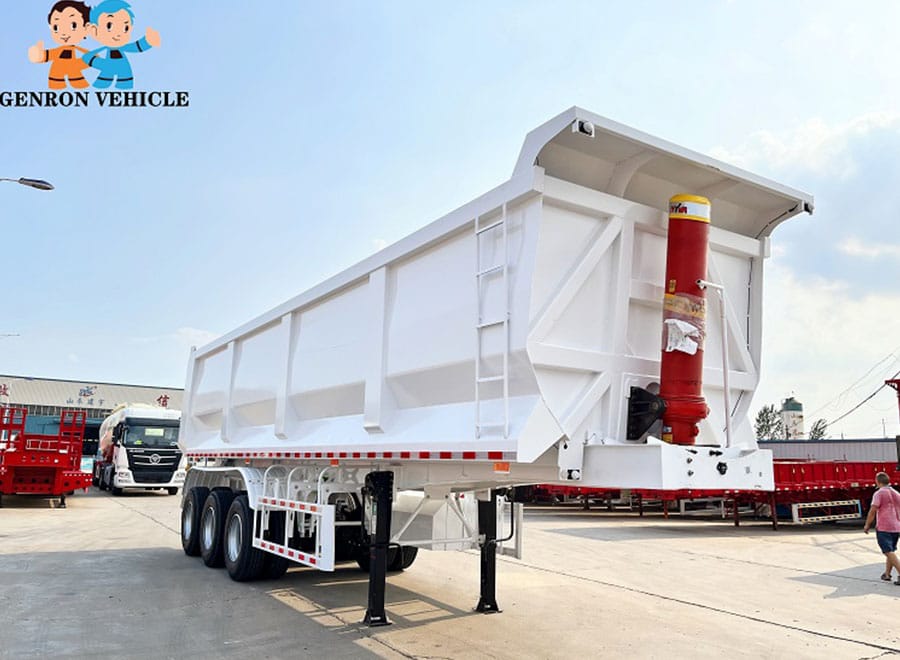
Start with the material and the receiving operation
Identify the material by more than a broad label such as sand or stone. Provide the expected size range, fines content, moisture variation and any tendency to adhere or bridge, using information from the cargo owner. The body and discharge arrangement need to be discussed against the actual material.
Describe where the material is discharged: an open stockpile area, a hopper, a processing facility or another defined receiving point. Give the trailer supplier the relevant site geometry and restrictions. A tailgate arrangement suitable for one location may conflict with equipment or available clearance at another.
Avoid asking the rear door alone to solve every flow problem. Body shape, internal condition, loading practices and material behaviour also influence discharge. If difficult material is involved, seek a complete application review rather than accepting a claim that one hinge style prevents all sticking.
Ask for the clear opening and the swept envelope
The visible rear face is not necessarily the unobstructed discharge opening. Request a drawing that distinguishes the body aperture from the space occupied by the gate, hinges, latches and other fittings. Include any equipment that remains near the outlet during the intended operation.
For a swinging or otherwise moving gate, ask the designer to show the opening path and the space it requires. The relevant site check includes that movement, not only the vehicle’s parked footprint. Do not assume an open area behind the trailer is the only clearance required.
If the buyer asks for an alternative opening arrangement, have it reviewed as part of the body design. A tailgate is not simply an interchangeable panel: its attachment, closure and interaction with the body need to be defined together.
Tailgate details to put on the accepted drawing
| Drawing item | Question it should resolve |
|---|---|
| Opening arrangement | How is the gate intended to move, and what space does it occupy? |
| Clear aperture | What unobstructed outlet remains in the intended operating condition? |
| Hinges and supports | Which parts are supplied, and how are they identified? |
| Latches and controls | What closure arrangement and operator interface are specified? |
| Containment or sealing | What material-retention requirement is actually agreed? |
| Inspection access | Which checks and service tasks are covered by the manufacturer’s instructions? |
Define containment without promising a liquid-tight body
If fines or damp material are expected, state the required containment performance. Ask the supplier what its proposed gate and body arrangement is designed to retain and what limitations apply. “Good sealing” is too vague to compare between quotations.
A body intended for bulk solids should not be assumed suitable for free liquid or a slurry simply because the rear door appears closely fitted. Product characteristics and applicable transport requirements need a separate review. Do not expand the intended duty through an informal description in a purchase order.
Where seals or replaceable contact parts are included, request their specification and replacement information. Clarify whether those parts are standard supply or an option. This makes later maintenance more predictable without claiming a universal service life.
Closure and controls need a documented operating scope
Ask the manufacturer to describe the latch and control arrangement and provide the applicable operating instructions. Identify the intended operator positions, supplied controls and any required connections to the tractor. The purchasing team should know what is included without designing an operating sequence itself.
Do not infer a safe release method from the external shape of a latch. A loaded tailgate can involve stored forces and moving material. This article deliberately gives no procedure for releasing a jammed gate, defeating a latch or clearing material beneath a raised body.
If a proposed system depends on additional equipment or controls, include them in the interface schedule. A body quotation that omits a required connection or control component is not equivalent to a complete delivered arrangement, even when the metalwork appears similar.
Keep tailgate clearance within the complete tipping-site review
The rear gate is one moving part of a much larger operation. The site review also needs to consider the vehicle, raised body, overhead environment and people nearby. A gate with generous opening clearance does not make an unsuitable tipping area acceptable.
HSE’s tipping guidance highlights the importance of a firm, level and stable site and of avoiding overhead obstructions. These are general planning considerations, not a statement that any particular site is safe or that this article replaces the responsible assessment.
Send site photographs or drawings to the transport planner with enough context to show the receiving arrangement. Treat them as planning aids, not remote approval. If the intended discharge point changes, revisit the relevant clearances before assuming the same body and gate will suit it.
Further source information:
Compare whole-life details, not just a rear photograph
Ask how the gate components are identified in the parts information and which wear or service items are replaceable. A clear parts reference is useful for a remote fleet because it reduces ambiguity when ordering a hinge component, seal or latch part later.
For example, two offers may both show a top-hinged rear door but differ in their latch arrangement, supplied controls and replacement-parts documentation. Make those differences visible in the comparison. Do not assume the photo demonstrates equivalent function or maintenance access.
At handover, verify the fitted arrangement against the final drawing and confirm that operating and maintenance documents refer to it. Record agreed changes before acceptance. Any later modification should be reviewed by the responsible manufacturer or competent specialist rather than treated as a cosmetic alteration.
Rear-door enquiry notes
Material identity, size range and moisture variation:
Required body duty and containment expectations:
Receiving-site geometry and discharge restrictions:
Proposed opening arrangement and clear aperture:
Gate movement envelope and adjacent equipment:
Latch, control and tractor-interface scope:
Seals, service parts and documentation required:
Final drawing revision and acceptance responsibilities:
Use photographs to clarify, then confirm by drawing
Photographs are useful for explaining which part of the rear arrangement a buyer means. Send an annotated image if a hinge position, outlet restriction or control location needs discussion. Then ask for the agreed feature to be identified on the final drawing and equipment list.
A photograph should not become the only acceptance document. It may show a different body size, a temporary fitting or an option that is not included in the quoted price. Clarify which visible items belong to the order and which are illustrative.
If the receiving site supplies a photograph, include enough surrounding context to show adjacent structures and the working area. The responsible site and transport specialists still need to assess the operation. This distinction keeps visual communication useful without turning a remote picture review into an unsupported safety approval or a promise that any material will discharge freely.
Dump-trailer tailgate questions
Is a larger rear opening always better?
Not automatically. The opening must suit the material and receiving operation, while the complete gate, body and closure design remains appropriate. Compare defined arrangements rather than opening size alone.
Does a U-shaped body determine the tailgate design?
No. Body shape and tailgate arrangement are related but separate order details. Ask the supplier to identify the exact configuration rather than assuming all bodies of one shape use the same rear door.
Can a sealed-looking dump body carry liquid?
Do not assume so. A body intended for bulk solids is not automatically designed or approved for free liquid or slurry. That proposed duty needs a separate equipment and regulatory review.
What should be checked before accepting a tailgate substitution?
Review the opening geometry, closure, controls, containment scope, documentation and service parts. Obtain agreement on the revised arrangement rather than accepting a substitute because it looks similar.
Related Reading
Sources and Scope
The manufacturer source illustrates that body and tailgate offerings vary; it is not a GENRON specification or endorsement. The article is an order-review guide, not a gate-release, tipping or maintenance procedure.


