
 English
 Français
 Español
 Árabe
 Deutsch
 简体中文
 Português
 Русский
 日本語
 한국어
 हिंदी
 Prancis
 Türkçe
 Tiếng Việt
 Italiano
 ไทย

A larger dump body does not automatically deliver more saleable material per journey. If the load is dense, the operation may reach its assessed mass limit before using all the available space. If it is relatively light, volume may become the practical constraint instead. Comparing cubic metres without a material record can therefore lead to a misleading purchase decision.
The worksheet below is designed for quotation discussions. Its invented numbers explain the arithmetic; they are not typical densities, GENRON specifications or loading instructions. Use actual material evidence and a reviewed vehicle configuration before turning an estimate into a dispatch decision.
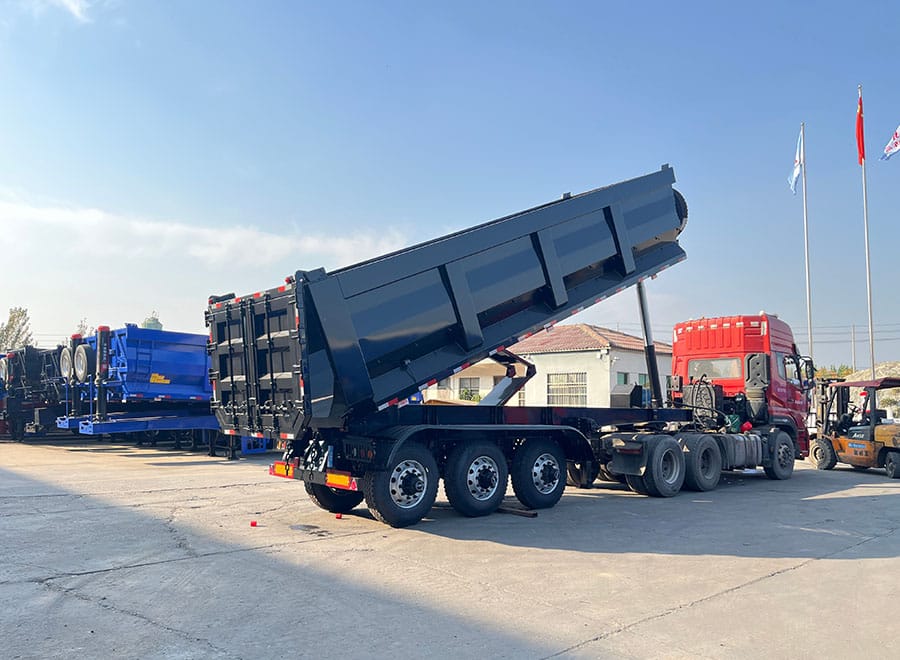
Keep Cubic Metres and Tonnes in Separate Columns
Body volume describes the internal space on a stated measurement basis. Cargo mass describes how much material is carried. Empty trailer weight, loaded trailer weight and combination weight are different fields again. A quotation that uses capacity without specifying the unit leaves the buyer to guess which of these quantities is meant.
For calculations, write the unit beside each input. One cubic metre multiplied by a density expressed in tonnes per cubic metre gives tonnes. If the material record uses kilograms per cubic metre, keep the multiplication in kilograms or convert explicitly. Do not mix a metric tonne with an undefined ton.
The useful comparison is not simply which offer has the larger body. It is which proposed configuration suits the intended materials, the assessed loading conditions and the work cycle. Put those assumptions beside the price so the larger number does not become a substitute for a technical review.
Four Figures That a Dump Trailer Quote Should Distinguish
| Figure | Definition needed from the offer |
|---|---|
| Body volume in m³ | Internal volume, drawing revision and whether the stated basis is level or includes a defined heap. |
| Cargo mass in tonnes | Material mass and the conditions under which the quoted payload is assessed. |
| Empty trailer mass | The equipment included, including the cover, spare assemblies and accessories as applicable. |
| Combination and axle loads | The tractor, trailer, cargo arrangement and separate constraints included in the review. |
Use Bulk Density for the Carried Material
The relevant density is the mass per unit volume of the bulk material in the condition being transported. Do not substitute the density of a solid constituent for a measured bulk load. Spaces between particles, moisture and the condition of the material can affect the relationship between the occupied volume and the resulting mass.
Obtain a material specification, representative measurement or operating record suitable for the intended calculation. Identify the source and date. A density copied from an unrelated supplier’s webpage may concern a different grading, moisture condition or measurement method. It can be useful background without being adequate dispatch evidence.
For a fleet carrying several materials, build separate rows rather than averaging them into one generic density. A body selected for a light product will not necessarily be useful at the same fill volume with a denser return load. Keeping the rows separate exposes that issue before the trailer is ordered.
A Worked Example Using Invented Values
Assume a hypothetical body has 30 m³ of usable space on a stated level-volume basis. For illustration only, Material A is assigned a bulk density of 0.8 t/m³. Multiplying 30 by 0.8 gives an estimated material mass of 24 tonnes. Material B, assigned 1.6 t/m³ for the same invented example, gives 48 tonnes in the same volume.
The body has not changed, but the calculated mass has doubled. This demonstrates why a volume label cannot establish payload. It does not mean that either material may be loaded to the top of a real trailer. No structural, axle, coupling, tipping or road assessment has been performed by this arithmetic.
Now suppose a separately reviewed planning scenario permits no more than 24 tonnes of Material B within its defined conditions. Dividing 24 tonnes by the assumed 1.6 t/m³ gives 15 m³. That is a volume estimate for the hypothetical scenario, not a recommended fill line or a substitute for weighing and the approved loading arrangement.
Illustrative Volume and Mass Calculation
| Scenario | Arithmetic | Meaning |
|---|---|---|
| A: 30 m³ at 0.8 t/m³ | 30 × 0.8 = 24 t | Invented material-mass estimate only. |
| B: 30 m³ at 1.6 t/m³ | 30 × 1.6 = 48 t | Same space, twice the estimated mass; not an approved load. |
| B: assumed 24 t planning allowance | 24 ÷ 1.6 = 15 m³ | Estimated volume within that hypothetical allowance; distribution still unresolved. |
Check What the Supplier Means by Body Volume
Ask for the internal body dimensions and the method used to calculate volume. Multiplying external length, width and height can overstate the available space. A tapered cross-section, curved floor, sloping front wall or internal fittings may make the body different from a simple rectangular box.
Where a quote includes a heaped volume, obtain its stated geometry rather than treating it as equivalent to level volume. Cover clearance and load containment need their own review. A heap that fits an illustration is not automatically compatible with the intended cover system or transport conditions.
For shaped bodies, a drawing-based volume statement is more useful than a buyer’s rough calculation from a side photograph. Keep the drawing revision with the figure. If the body height, shape or internal equipment changes during quotation, update the volume field instead of leaving the original number in the final comparison.
Compare More Than the Largest Cubic-Metre Figure
Body selection also needs the material’s particle size, impact and wear characteristics, loading method and discharge behaviour. A density worksheet does not specify a suitable floor or wall structure. Nor does it establish how an irregular or concentrated load should be carried. Send those material details with the calculation rather than treating volume as the complete design brief.
The discharge site is another separate part of the job. HSE guidance on tipping emphasises suitable, level, firm and stable ground and sufficient overhead clearance. This UK safety guidance is relevant background for a site review; it is not a declaration that a selected body or volume is safe at every destination.
Do not use a larger body to justify operating on an unsuitable tipping surface. The responsible operator needs an appropriate site assessment, vehicle instructions and trained personnel. The procurement worksheet should flag unresolved site information, not attempt to replace the operating procedure.
Source: HSE: Tipping-site safety considerations
Build a Material Register Before Comparing Offers
Give each regular material its own entry: product description, carried condition, density evidence, target consignment mass, loading equipment and receiving site. Add the share of journeys that the material represents. A fleet that changes cargo frequently needs a comparison across its actual work, not a body chosen solely for one occasional light load.
Include the empty equipment in the quotation record. A different cover arrangement, spare package or body specification can change the equipped trailer’s weight. Ask the supplier to identify the configuration behind any quoted weight so that the material comparison and the vehicle comparison remain consistent.
Once operational records become available, compare estimates with properly identified weighing records and investigate material differences. Keep the result as a fleet planning record. It can improve the next enquiry without turning one journey’s result into a universal density or permissible payload claim.
Copyable Material and Body-Volume Worksheet
Material description and carried condition:
Bulk-density value, unit and evidence source:
Date and conditions of the density record:
Target consignment mass:
Estimated material volume and calculation:
Body internal-volume basis and drawing revision:
Level or defined heaped volume:
Cover arrangement and required clearance:
Loading method, particle size and wear information:
Equipped trailer weight basis:
Tractor and reviewed load arrangement:
Receiving-site and route checks managed by:
Unresolved assumptions before order:
Volume and Payload Questions
Can a 30 m³ body carry 30 tonnes?
The units are not interchangeable. The mass associated with 30 m³ depends on the bulk density and material condition. Whether a real vehicle may carry that mass requires its own assessment.
Should I use the same density for dry and wet material?
Use evidence appropriate to the carried condition. Do not assume an unchanged value where moisture or other relevant conditions differ.
Is level volume the same as heaped volume?
No. Ask the supplier to define each quoted basis and provide the relevant body geometry. Compare offers on a common basis.
Does this worksheet replace a weighbridge record?
No. It is a planning calculation using specified assumptions. It does not measure the actual load or establish compliance for a journey.
Related Reading
References and Scope
The worked densities and masses are invented to explain units and arithmetic. They are not measured material values or GENRON product specifications.


