
 English
 Français
 Español
 Árabe
 Deutsch
 简体中文
 Português
 Русский
 日本語
 한국어
 हिंदी
 Prancis
 Türkçe
 Tiếng Việt
 Italiano
 ไทย

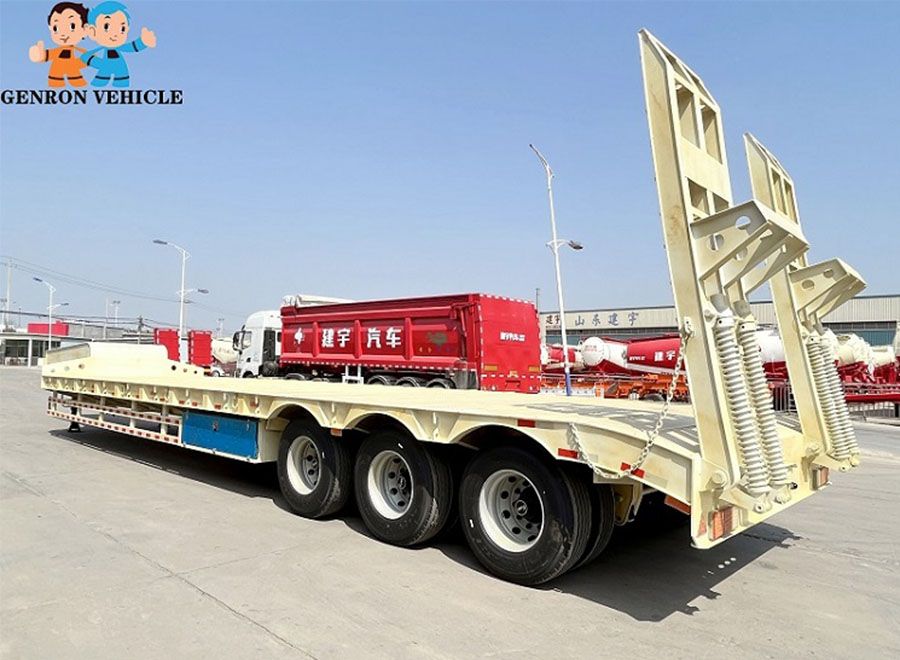
A forklift described as a three-ton machine does not necessarily weigh three tonnes. That familiar description usually concerns lifting capacity under stated conditions, not the mass presented to the transport vehicle. Confusing the two can make a trailer enquiry wrong before the buyer considers deck length, ramps or overall height.
Forklift transport also brings unusually specific geometry questions. The mast, forks, counterweight, tire arrangement and low underside can govern a move that looks simple from a side photograph. This guide explains how to specify a low bed for forklift deliveries and transfers using the actual transport configuration. It does not provide a loading procedure, a restraint calculation or instructions to modify a forklift.
Separate lifting capacity from transport mass
Ask the equipment owner for the mass of the actual forklift configuration, with a clear statement of what is included. Record the mast, carriage, forks, attachment, power-source configuration and other fitted equipment relevant to the figure. A lifting-capacity badge is not a substitute for that record, and the truck’s rated load must not be used as its assumed empty mass.
For a hypothetical example, a forklift described by a three-tonne lifting capacity might have a documented transport mass of 4.6 tonnes in its stated configuration. The latter is the relevant starting mass for that example. Neither number describes a GENRON trailer recommendation or a universal forklift specification. The actual machine record determines the load to be reviewed.
Identify the mast configuration precisely
Record the fitted mast and its transport condition, not only the maximum lifting height. A mast with a different stage arrangement can change the lowered height and overall machine geometry even where the truck family and rated lifting capacity remain similar. Include any fitted load backrest and attachments that affect the outline.
Hyster’s published mast specifications distinguish lowered height, extended height and configuration-dependent truck mass. These are different entries because they answer different questions. Use the current specifications and instructions for the actual forklift rather than borrowing a convenient height from another mast option. The relevant equipment supplier should resolve uncertainty before the trailer layout is accepted. Hyster: mast specifications, lowered heights and configuration-dependent truck weights
Measure the complete transport envelope
Provide overall length, width and height in the manufacturer-approved transport configuration. Identify whether the length includes the forks or another attachment and whether those items travel separately. Do not shorten the dimension on paper without an agreed preparation arrangement and the correct instructions for the machine.
Photographs are useful for identifying projections and explaining unusual equipment, but retain a dimensioned record. A mirror, protective structure or fitted attachment may determine the highest or widest point. Keep the outside envelope separate from the tire-contact dimensions. One is needed for clearance and route review; the other helps establish how the forklift is supported on the proposed deck.
Show wheel positions and contact areas
Give the wheelbase, track widths, tire arrangement and relevant contact geometry requested by the trailer designer. Forklift loads should not be treated as uniformly distributed cargo simply because the total machine mass is known. The proposed parking position needs to be reviewed against the trailer structure and supporting areas.
If a fleet carries several forklifts, use a machine matrix showing those differences. A compact counterbalanced truck and a longer industrial forklift can create different support and space requirements. Ask the manufacturer to identify the configurations covered by the offer, including any restrictions on position. A general statement that the trailer carries forklifts leaves too much unresolved for a repeat delivery operation.
Review low points throughout the loading path
Supply a side profile that identifies low components, overhangs and the relative positions of the supporting wheels. The forklift may fit comfortably once parked yet still have a clearance issue at a ramp or deck transition. The complete path needs assessment, not just the final outline on an empty platform.
Avoid selecting a loading arrangement from a universal ramp-angle rule. The actual machine geometry, trailer design and assumed site condition must be considered together. Ask for the load cases and restrictions to be stated in the proposal. This guide does not recommend changing fork position, mast angle or machine controls to overcome a clearance issue; preparation and loading must follow the appropriate manufacturer information and competent plan.
Compare low-bed arrangements using actual duties
GENRON’s three-axle low bed with rear loading ramps and 13.5-metre three-axle low-bed layout offer low-bed layouts to discuss for equipment transport. Compare the usable deck, proposed support positions, loading path and supplied accessories against the forklift matrix. A product page identifies a vehicle family, not acceptance of every forklift below an advertised payload.
Ask the supplier to explain which arrangement suits the stated collection and delivery work. The longest or lowest option is not automatically the best purchase. It may introduce preparation, access or equipment requirements the fleet does not need. A clear layout covering the accepted machines is easier for dispatch staff to use than a broad specification with no machine-by-machine record.
List forks and attachments as cargo items
If components travel separately, record their identity, dimensions, mass and approved handling requirements. Identify their intended storage and securing locations on the trailer drawing. The space around the forklift may be needed for loading clearance, access to securing provisions or another machine; it should not be treated as an undefined area for loose attachments.
Assign responsibility for removal and refitting. A transport quotation should not imply that the driver or trailer supplier will dismantle a mast or attachment without the correct competence, equipment and instructions. If preparation services are part of the order, describe them explicitly and retain the relevant records. Keeping those activities separate prevents a complete vehicle quote from concealing an incomplete machine-preparation plan.
Include the power-source configuration in the record
State whether the machine is battery-powered, engine-powered or uses another relevant configuration, and identify the transport information requested by the responsible parties. Batteries, fuel systems and other energy sources can affect mass, preparation and transport requirements. Do not assume that a machine with the same chassis outline has the same accepted transport condition.
Obtain the equipment manufacturer’s instructions and any applicable specialist advice for the actual move. This guide does not prescribe battery isolation, fuel preparation or dangerous-goods classification. The purchasing brief should make those responsibilities visible and ensure that the trailer proposal is based on the machine condition the owner will actually present for collection, rather than an undocumented standard configuration.
Match securing access to the chosen position
Provide the forklift manufacturer’s transport and securing information to the competent securing planner. The machine’s approved provisions and the trailer’s documented anchor points need to remain accessible when the forklift is positioned on the deck. A convenient hole in a guard or an accessible mast component should not be assumed suitable for securing.
Identify the fittings and information included with the trailer. Where removable parts obstruct access, resolve the arrangement before accepting the design. The objective is not to prescribe a generic set of chains or straps, but to ensure the responsible planner has the actual machine and vehicle information needed to establish a suitable load-specific arrangement for the stated journey.
Review multi-machine and multi-stop work separately
A dealer may deliver two forklifts together or collect a returned unit after delivering another machine. Draw each intended case, including separate attachments and packaging. Add the actual masses and support positions rather than assuming that two small machines are equivalent to one large load of similar total mass.
Review intermediate conditions on a delivery route. After one machine leaves the deck, the remaining load and loose components still need the accepted support and securing arrangement. Record the planned sequence and receiving facilities. If the destination changes the unloading order, the responsible parties should review the resulting case rather than rely solely on the fact that the full departure load had been accepted.
Check the receiver’s access and handling facilities
Confirm collection and delivery locations, available working space and the equipment needed for the proposed operation. An industrial dealer’s yard may provide conditions that a temporary warehouse entrance does not. Ask who confirms the site assumptions and who is responsible for coordinating the unloading area.
Do not assume the forklift can always be driven off under its own power or handled with the same method used at collection. A non-operational unit, a missing component or a different site condition changes the task. Identify exceptional cases in the fleet brief so that a trailer is not ordered around an attractive routine scenario while the business’s common recovery or collection work remains unresolved.
Use an overall-height screen responsibly
For initial planning, combine the actual deck support level with the machine’s agreed transport height and any other relevant geometry. Treat this as a screening record for the complete combination, not as route approval. The loaded configuration and applicable journey conditions still require the responsible planner’s assessment.
If a lowered mast height is supplied without identifying the mast, keep the height decision open. Do not choose the smallest catalogue entry to make a proposal appear suitable. A correct record that exposes a clearance problem early is more useful than a favourable number that does not describe the forklift arriving at the collection yard.
Compare the quotation and handover documents
Ask each supplier to respond to the same machine matrix, support requirements, site assumptions and equipment list. Compare what is included, excluded and awaiting information. A trailer payload, a pair of ramps and a price do not fully describe the package if the relevant forklift cases and loading arrangements remain unidentified.
At handover, reconcile the supplied trailer with the accepted drawing and removable-equipment list. Retain manufacturer instructions, fitting identification and any agreed restrictions. Give dispatch staff an accessible record showing which machine configurations are covered. This allows the fleet to use the trailer repeatedly without turning a successful first delivery into an unsupported assumption that every later forklift is equivalent.
Maintain a machine register after purchase
For each accepted forklift, retain identification, transport mass basis, mast, attachments, envelope and load-case reference. Mark the record when information is provisional or a review remains outstanding. This is especially useful for dealers and rental companies whose fleet changes more quickly than their transport equipment.
When a new mast, battery, attachment or tire arrangement is introduced, compare the relevant information with the accepted case. Small-looking changes can affect mass or geometry. Record the responsible review and any revised restrictions rather than rely on visual similarity. The resulting register improves the next trailer enquiry by showing which real machines and operations drive the requirement, not merely the largest lifting-capacity number in the fleet.
Distinguish dimensional equivalence from operational equivalence
Two forklifts may share an outside length and width while differing in mass, wheel arrangement, mast height or transport preparation. A dealer should therefore avoid marking a replacement as equivalent from one catalogue comparison. Identify the fields that govern the accepted load case and ask the responsible parties to review the actual differences.
Record the decision in the machine register so that a future dispatcher does not repeat the same uncertainty. Where information remains missing, keep the case provisional instead of using a successful collection of another machine as evidence. This gives the fleet a consistent basis for accepting substitutions without requiring staff to remember why a similar-looking forklift was treated differently on an earlier delivery.
FAQ: Low-bed trailers for forklifts
Does a three-ton forklift weigh three tonnes?
Not necessarily. That description commonly refers to rated lifting capacity under specified conditions, not transport mass. Obtain the mass of the actual machine configuration, including relevant mast, attachments and power-source equipment. Do not use the lifting-capacity badge as the assumed load on the trailer or as a substitute for manufacturer information.
Which mast height should be used for route planning?
Use the height of the actual forklift in its manufacturer-approved transport condition, with the fitted mast and relevant attachments identified. Maximum lifting height and lowered height are different measurements. A catalogue value for another mast option does not establish the loaded envelope of the machine being collected.
Can the forks simply be removed to reduce length?
Only through the correct preparation process for the actual machine, with responsibilities and instructions agreed. If components travel separately, include them in the cargo record and load arrangement. This guide does not authorise removal or refitting by unqualified personnel, and a shorter declared length must match the actual condition presented for transport.
Is a long deck enough for two forklifts?
No. Review the combined load as a distinct case, including machine masses, wheel positions, accessories and securing access. The condition after the first delivery also matters. Physical space is one input, but it does not establish suitable support, axle distribution or an accepted load-restraint arrangement for the complete journey.
Can a trailer accepted for an operating forklift collect a broken one?
Not automatically. A non-operational machine can change the loading and handling task. Identify the condition and obtain the required specialist plan and equipment review before assigning the move. The routine case should not be treated as approval for recovery work simply because the forklift’s dimensions and total mass appear unchanged.
What should be checked when another forklift replaces the quoted machine?
Compare identification, actual transport mass, mast, attachments, envelope, contact geometry and preparation condition with the accepted record. Refer differences to the responsible parties before collection. A similar model name or lifting capacity does not demonstrate that the replacement is covered by the same trailer position, loading path or route assumptions.
Product Options to Discuss
Product pages identify layouts to discuss, not acceptance of a specific load or proof that every optional component is included. Confirm the order-specific configuration with the responsible suppliers.
Related Reading
Low Bed Trailer for Excavators: A Dimension and Ramp Checklist
Fixed vs Detachable Gooseneck Low Bed Trailers: Choosing the Loading Arrangement
Low Bed Trailer Width Extensions: Deck Support, Machine Fit and Route Planning


