
 English
 Français
 Español
 Árabe
 Deutsch
 简体中文
 Português
 Русский
 日本語
 한국어
 हिंदी
 Prancis
 Türkçe
 Tiếng Việt
 Italiano
 ไทย

A bulldozer enquiry often arrives with a machine model and a request for a heavy-duty low bed. That is enough to start a conversation, but not enough to establish fit. A machine travelling with its blade and ripper installed is a different transport job from the same machine with those assemblies removed and shipped separately.
This guide focuses on the information a buyer needs before comparing trailers. It is a quotation and drawing checklist, not a loading procedure. Loading, attachment removal, restraint design and route approval remain tasks for the responsible equipment and transport specialists.
Start With the Machine as It Will Actually Travel
Identify the machine model, serial or identification number and the source document used for its dimensions. Record the blade type, ripper arrangement, track shoes and other fitted equipment. If the manufacturer provides several weight figures, retain the notes explaining each one. A bare-machine shipping figure and a fully equipped operating figure answer different questions.
Caterpillar’s D10 product specification illustrates why those notes matter: it lists shipping and operating weights separately, and describes equipment included in the operating figure, including a particular blade and ripper arrangement. That is an example of configuration-specific reporting, not a statement that a particular GENRON trailer is suitable for that machine.
For your own enquiry, use documentation for the actual machine and transport condition. Do not subtract an estimated attachment weight from a brochure total and present the result as a verified transport weight. A dated configuration sheet gives both the trailer supplier and the haulier a clear starting point.
Source: Caterpillar D10 specifications: weight definitions and equipment notes
Three Records for One Bulldozer Transport Job
| Record | Information to include | Why it matters |
|---|---|---|
| Transport envelope | Overall length, width and height in the stated configuration. | Identifies the space occupied, including projections outside the tracks. |
| Support footprint | Track contact length, track shoe width, outer track width and documented weight. | Allows the support arrangement to be reviewed rather than inferred from overall width. |
| Attachment schedule | Blade, ripper and other removed items, with dimensions, weights and proposed locations. | Prevents separately carried equipment from disappearing from the load plan. |
Blade Width Is Not the Same as Track Support Width
The widest point of a bulldozer may be the blade rather than the tracks. A trailer can therefore need a route review for a wide load even when the tracks sit within the proposed supported deck width. Conversely, a wide platform in a photograph does not establish that its extensions are designed for the actual track contact loads.
Provide a plan view showing the tracks and the blade separately. Mark the track contact zones, the machine centreline and the blade projection in the agreed transport position. This makes it possible to discuss two distinct issues: where the machine is supported, and where its outermost equipment extends.
If removable deck extensions are proposed, the drawing should identify their arrangement and permitted loading conditions. Avoid describing them simply as extra width. The important purchasing information is the supported configuration, the components supplied and the load case reviewed by the trailer designer.
Treat the Ripper as Part of the Length and Clearance Review
A rear ripper affects the machine’s transport envelope and can influence the space needed around loading transitions. Record its transport position using the manufacturer’s instructions and dimensional information. A side photograph alone can hide the lowest point or make the rear projection look shorter than it is.
Send a side view with the relevant dimensions marked. The trailer review should consider the proposed access arrangement, deck transitions and the machine in its stated transport condition. This article gives no universal ramp angle or ripper clearance: those values cannot be selected responsibly from a machine category alone.
If the ripper is removed, identify who will remove, handle, support and reinstall it. Include the detached assembly in the shipping and receiving plan. Its removal may reduce the machine envelope, but it adds a separate handling task that should be visible in the comparison of transport options.
Compare Attached and Detached Arrangements as Complete Jobs
Consider a hypothetical enquiry in which Arrangement A keeps the blade installed, while Arrangement B carries it separately. Do not rank B as cheaper merely because the base machine becomes narrower. Compare the complete job: attachment work, suitable lifting equipment, additional cargo space, restraint arrangements, destination assembly and the relevant route requirements.
Arrangement A may reduce handling steps but retain a wider transport envelope. Arrangement B may change the route assessment while adding labour and receiving-site requirements. Neither result is universal. The comparison is useful only when the haulier and equipment owner agree what each arrangement actually includes.
Record any separately carried components on the same load schedule. If they travel on another vehicle, show that vehicle as a separate cost and coordination item. If they travel on the low bed, include their weight, supports and positions in the trailer’s load-distribution review.
Questions to Resolve Before Selecting the Trailer
| Question | Evidence to request |
|---|---|
| What machine condition was assessed? | Identification and configuration sheet linked to the manufacturer’s dimensional information. |
| Where are the tracks supported? | Plan drawing showing contact areas, deck structure and any extension arrangement. |
| What loading access is proposed? | A loading-profile review for the actual machine and the selected trailer arrangement. |
| Where do detached parts travel? | Attachment list with support, location and handling responsibilities. |
| What reaches the road and coupling? | Combination-specific distribution assessment, not axle count multiplied by an axle rating. |
| What happens at the destination? | An agreed unloading, handling and reassembly scope with suitable facilities identified. |
Ask for a Drawing That the Receiving Team Can Use
A quotation drawing is most useful when the machine outline, support zones and separately carried items appear together. Mark the usable deck length instead of relying on overall trailer length. Identify any space occupied by the gooseneck, ramps, tools or accessories so the drawing does not suggest a clear platform that will not exist on the delivered vehicle.
Keep the tractor information with that drawing. Coupling height, connection geometry and the complete combination affect the assessment. If the fleet intends to use several tractors, list them rather than assuming the result for one prime mover applies to all of them.
The receiving team also needs the agreed configuration and operating documents. A revised trailer or changed attachment arrangement should trigger a document review before dispatch. Saving the drawing revision with the purchase order is a simple way to prevent the production team, haulier and customer from working from different versions.
Use Photos to Explain the Configuration, Not to Prove Capacity
Take clear side, front and rear views of the actual machine where practical. Include separate photographs of the blade, ripper and identification plate. Share sensitive identification details privately with the responsible supplier rather than posting them unnecessarily in public marketing material.
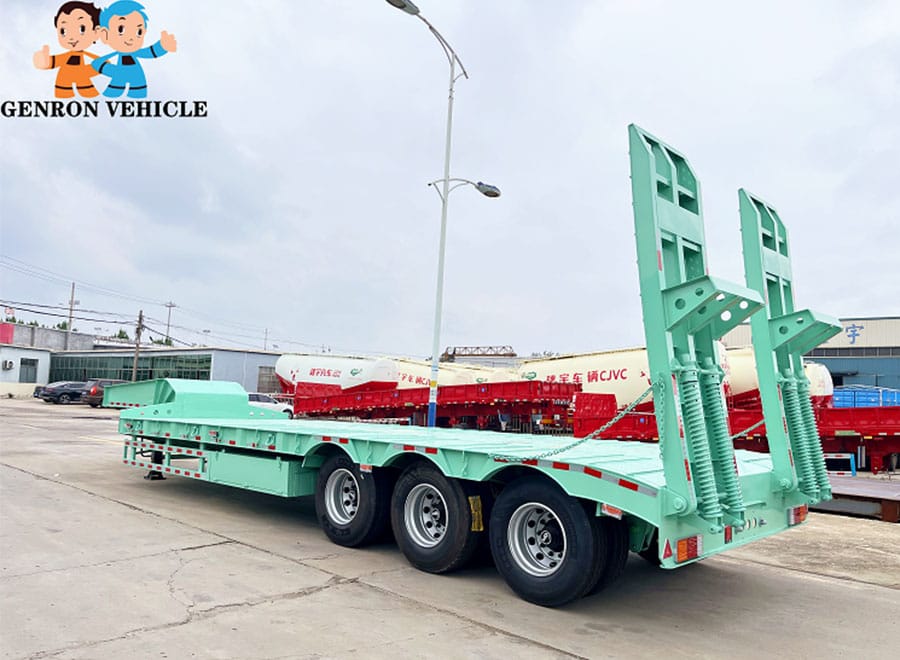
For a trailer proposal, request photographs that show the deck, ramps or front-loading arrangement, extensions and attachment-storage areas. A picture of an empty low bed can explain its layout, but it does not prove that a particular bulldozer has been assessed. Keep dimensional drawings and technical acceptance separate from illustrative sales photos.
Bulldozer Transport Enquiry Sheet
Machine manufacturer, model and identification:
Source and revision of machine specifications:
Transport condition and documented weight:
Blade type, position and overall width:
Ripper arrangement and transport projection:
Overall transport length / width / height:
Track contact length and shoe width:
Outer track width and support arrangement:
Detached attachments, weights and locations:
Proposed tractor and trailer combination:
Loading and receiving facilities:
Route assessment managed by:
Drawings, records and outstanding questions:
Bulldozer Trailer Questions
Can I choose the trailer from the bulldozer model alone?
Use the model to obtain the correct documentation, then establish the transport configuration. Attachments, tracks and fitted equipment can change the information the trailer designer and haulier need.
Does removing the blade automatically reduce the total transport cost?
No. Compare the complete arrangements, including handling equipment, labour, the vehicle carrying the blade and destination reassembly. A smaller machine envelope is one part of that comparison.
Is overall trailer width enough to confirm track support?
No. The support review needs the actual track footprint and the proposed deck or extension structure. Width alone does not establish the permitted contact loading.
Should a photo caption state the machine capacity?
Only when the claim is supported for the identified configuration. An illustrative empty-trailer photograph should be captioned as an illustration, not presented as evidence of an approved machine-trailer match.
Related Reading
References and Scope
The Caterpillar example explains why configuration notes matter. It is not a compatibility endorsement or a GENRON trailer capacity claim.


