
 English
 Français
 Español
 Árabe
 Deutsch
 简体中文
 Português
 Русский
 日本語
 한국어
 हिंदी
 Prancis
 Türkçe
 Tiếng Việt
 Italiano
 ไทย

A generator order may begin with a kilowatt rating, but transport planning begins with a different set of information. The carrier needs to know what physically arrives: an open skid, an acoustic enclosure, a containerised unit or several separate items. Each changes the footprint, mass and access required.
A low bed can be useful when the complete equipment envelope or receiving arrangement calls for it, but it is not automatically necessary for every generator. The purchasing task is to define the cargo and compare suitable carrying layouts. This guide follows that process from the equipment schedule to the final site handover.
Define the delivered unit, not just its power output
Record the generator make, model, serial reference and build specification. List the enclosure, base tank, cooling equipment, exhaust components and other parts that travel with it. Identify which items are fitted and which are packed separately. A rated electrical output does not describe any of those transport details.
Obtain a general arrangement drawing for the actual unit, including overall dimensions, skid geometry and relevant projections. Where the order combines equipment from several suppliers, make sure the drawing represents the assembled transport condition rather than only the engine-generator package.
Keep the mass basis explicit. A dry equipment mass, a shipping mass and a prepared transport mass may cover different contents or accessories. Ask the equipment supplier to establish the applicable condition and instructions. Do not add or remove fluids simply to match a quotation assumption; preparation belongs with the responsible manufacturer and transport plan.
Use skid support zones as the starting point for the deck review
A rectangular skid does not necessarily transfer load continuously along every edge. Request the designated support locations, contact geometry and any restrictions on intermediate support. The trailer designer needs those interfaces to assess how the equipment loads the floor and underlying structure.
Do not distribute the generator’s mass over its full length and width and treat that average as the deck requirement. Local skid contacts can impose a different condition. Show the support locations on the proposed trailer plan, including any transport frame, bearer or approved packing that forms part of the arrangement.
If a temporary transport base is proposed, identify who supplies and approves it and how it interfaces with the generator and trailer. A base intended for storage or installation should not silently become a road-transport fixture. Keep its intended use, attachment scope and documentation together.
Ask for centre-of-gravity information without guessing from appearance
A generator may look symmetrical while its major components are not evenly distributed. Obtain the equipment supplier’s applicable mass and centre-of-gravity information for the transport configuration. Mark the reference points clearly so the carrier and lifting planner interpret the drawing in the same way.
This information helps the responsible parties assess placement and handling, but it does not replace a trailer load-distribution review. The proposed tractor, trailer and cargo position must still be considered together. Nor does a centre-of-gravity mark by itself establish a suitable lifting arrangement.
If a base tank, enclosure or other substantial component changes, ask whether the original information remains applicable. Retain the revision history. A superseded drawing can be particularly misleading when the external dimensions remain similar but the transported condition has changed.
Separate the four interfaces in a generator move
| Interface | Information needed | Responsible review |
|---|---|---|
| Generator to transport base | Approved support and attachment provisions | Equipment supplier and relevant specialist |
| Base to trailer | Contact positions and defined road load case | Trailer designer and transport planner |
| Lifting equipment to cargo | Manufacturer lifting information and complete envelope | Competent lifting planner |
| Cargo to destination | Access, delivery position and handover condition | Receiving site and transport team |
Do not confuse lifting points with road-restraint provisions
The manufacturer should identify the intended lifting and transport provisions for the unit. Ask specifically about the complete generator assembly rather than assuming a point on one component can be used for the whole package. The lifting planner and load-securing planner may need different information.
Cummins maintains model-specific manual resources, reflecting the importance of using instructions for the equipment actually supplied. Obtain the relevant documents from the generator supplier. A manual for a different package is not a reliable basis for choosing attachment locations or preparation requirements.
This guide does not provide sling angles, lashing forces or a lifting sequence. Those decisions require the actual cargo and competent planning. The procurement contribution is to ensure that the necessary drawings, provisions and access are included before anyone is expected to handle the unit.
Source: Cummins: Manuals and technical documents
Compare a low bed with the actual cargo envelope in place
Overlay the generator, supports and projections on the proposed trailer drawing. Check the space near the gooseneck, the rear structure and fixed equipment. The relevant envelope includes the complete transport package and its supports, not simply the enclosure dimensions on a product brochure.
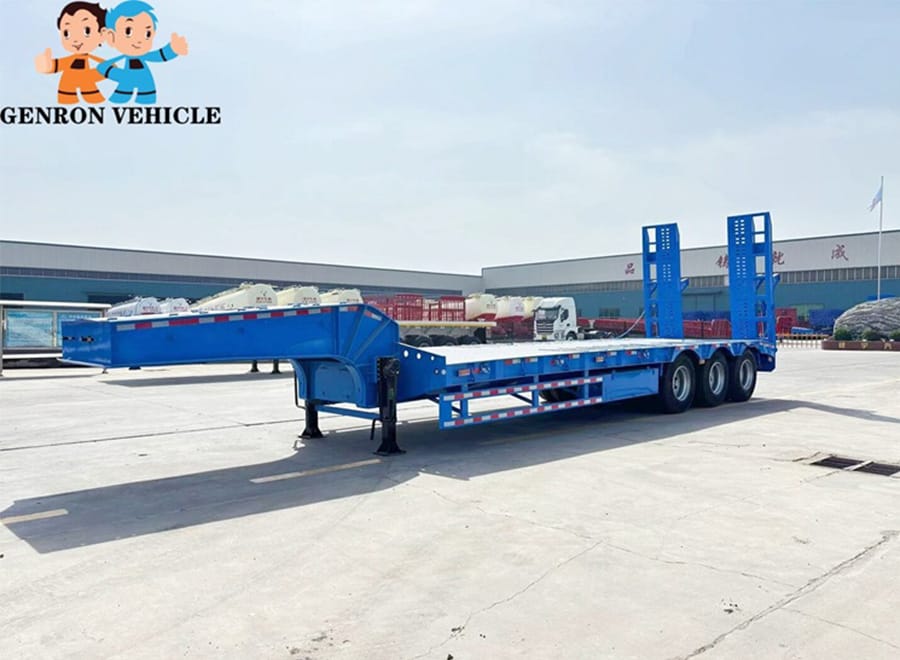
The three-axle low bed machinery platform and four-axle low bed machinery platform are two product layouts that can support a discussion with GENRON about machinery transport. Compare their proposed geometry against the unit drawing rather than treating their names as approval for a generator load. The accepted proposal should identify the specific equipment and support arrangement.
Where a conventional flatbed can meet the requirement, include it in the commercial comparison. A lower deck is valuable only when it answers a real constraint without creating other problems. Discuss handling access, vehicle interfaces and route requirements together, then compare price on the basis of a defined arrangement.
Loading access and installation access are different tasks
The collection site may have an overhead crane, while the receiving site expects a mobile crane or another approved handling system. Confirm both ends. Available access around the skid, the planned lifting equipment and the required vehicle position can affect where the generator is placed on the trailer.
Separate unloading from final installation. A transport contract may end with the unit on an agreed receiving area rather than on its operating foundation. Define the handover point, the parties responsible for subsequent movement and the condition in which the equipment is accepted.
Do not expect the driver to resolve an installation interface that was omitted from the purchase order. If the final site has restricted access, request drawings and a planned delivery arrangement early. A unit that fits the public-road envelope may still be difficult to reach or handle at the destination.
Record projections, fragile parts and separate accessories
Ask the generator supplier which components remain fitted for transport and which require separate packing. Exhaust parts, control cabinets, guards and cooling equipment may affect the envelope or be vulnerable to contact. Their treatment should follow the equipment instructions and agreed transport scope.
List every separately packed item with its mass, dimensions and package identification. Give it an allocated position and appropriate handling and restraint arrangements. A small accessory crate should not obscure a generator attachment point or become an unidentified item that the receiver cannot reconcile with the order.
Photograph the agreed prepared condition as a supplementary record. Show labels and package identities as well as the overall assembly. These images help explain the handover, but they do not establish structural ratings, replace preparation instructions or prove that an undocumented support is acceptable.
Weather protection should not obstruct the transport arrangement
An acoustic enclosure is not automatically a complete transport-protection specification. Ask the equipment supplier what protection is required during the actual journey, including storage intervals and environmental exposure. Sensitive parts and packed accessories may have different requirements from the outer enclosure.
Agree how covers, protective frames or packaging interact with the selected lifting and restraint provisions. Protection that must be removed before unloading should have an agreed work method and responsible party. Do not leave that step to improvisation around a heavy unit at the receiving site.
Keep the distinction between transport and operation clear. This article does not recommend running a generator while it is being carried or specify ventilation for an operating unit. If mobile power operation is part of the project, it is a separate equipment and installation requirement that must be explicitly designed and approved.
An illustrative order comparison: one unit or a unit plus accessories
Consider two hypothetical delivery cases. Case A carries a generator assembly with its approved transport base. Case B adds a separate enclosure component and two accessory crates. Prepare a complete cargo schedule for each rather than asking the supplier to reserve “some extra room” beside the main unit.
For both cases, ask the trailer supplier to identify the permitted cargo positions and the handling access retained around the skid. Ask the equipment supplier to confirm the support and preparation information. The aim is to connect the documents, not to make the buyer invent engineering assumptions.
Compare inclusions as carefully as dimensions. One proposal may supply an agreed support frame, another may exclude it, and a third may depend on site-provided equipment. Once these differences are visible, the quotation comparison becomes more meaningful than choosing the lowest trailer price and discovering the missing interface later.
Close the handover with an identifiable document set
Before dispatch, align the cargo list, equipment drawing, trailer arrangement and applicable operating instructions. Identify the revisions used and any agreed exceptions. The final record should describe what actually travels rather than a configuration proposed earlier in the purchasing process.
At receipt, reconcile package identities and the agreed condition with that record. Define who deals with damage, missing items or a mismatch in the delivered configuration. This is a commercial handover process, not an instruction to inspect beneath suspended cargo or undertake unsafe access.
Retain the accepted arrangement for repeat moves, but review it when the unit, support base, trailer or route changes. A generator may be moved several times over its life; a clear configuration record makes those later decisions easier without turning the first successful journey into unlimited approval.
Generator transport enquiry sheet
Generator model and complete assembly reference:
Prepared transport mass and included contents:
Skid support drawing and centre-of-gravity information:
Overall envelope and protected projections:
Separate packages, frames and accessories:
Manufacturer lifting and transport provisions:
Collection, route, unloading and installation responsibilities:
Accepted drawing revisions and handover evidence:
Check dimensions and reference points before comparing drawings
Use one clear unit convention in the enquiry and identify every drawing’s datum. A skid length measured between support contacts is not the same as the enclosure’s overall length. A height measured from the base frame can exclude a transport support that raises the complete load.
Ask the equipment and trailer suppliers to mark the same cargo reference points on their drawings. If an enclosure drawing, a skid drawing and a packing list come from different organisations, check that their revisions describe the same assembly. A neat overlay is misleading when one source uses an older frame or omits a fitted projection.
Put unresolved dimensional differences in the issue list and assign them to the party able to confirm the equipment. Do not average conflicting numbers or choose the smaller value to make the layout work. Resolving those discrepancies before manufacture gives the final carrying arrangement a traceable basis and reduces ambiguity at collection.
FAQ: Transporting generator sets on trailers
Can electrical output tell me which trailer is needed?
No. Kilowatts or kVA describe the generator’s electrical duty, not its transport mass, skid geometry or complete envelope. Obtain the actual equipment drawing and prepared condition. Different packages with similar electrical output can create different support and handling requirements.
Does every generator need a low bed trailer?
No. The appropriate carrying arrangement depends on the complete cargo, route, handling access and vehicle constraints. Compare a low bed with other suitable layouts where relevant. A low deck should answer an identified requirement rather than serve as a generic sign of heavy-duty suitability.
Can the entire skid be treated as a continuous support surface?
Not without the equipment supplier’s confirmation. Identify the designated support areas and any restrictions, then have the trailer interface reviewed. An average mass divided by the skid’s outer dimensions may conceal the actual concentrated support conditions.
Are lifting eyes automatically suitable for road restraint?
Do not assume that. Obtain the manufacturer’s instructions for the complete assembly and give them to the responsible planners. Lifting and road transport are different duties, and their provisions, ratings or access requirements may differ.
Should the trailer quote include accessory crates?
Yes, where they will travel on the vehicle. Record their gross mass, dimensions, handling needs and intended positions. They use payload and working space and need their own appropriate support and restraint; they should not be treated as free space around the main skid.
What changes require a fresh review before a repeat move?
Review relevant changes to the generator configuration, support base, cargo position, trailer, tractor or route. A different prepared mass or added enclosure can affect the original assumptions. Keep the accepted document set so the responsible parties can identify what changed.
Product Options to Discuss
These layouts are enquiry starting points. Generator-specific support and handling suitability must be confirmed in the accepted equipment and transport documents.
Related Reading
References
Use the instructions for the generator actually supplied. This article is a procurement guide, not a lifting plan, installation specification or approval to operate equipment on a trailer.


