
 English
 Français
 Español
 Árabe
 Deutsch
 简体中文
 Português
 Русский
 日本語
 한국어
 हिंदी
 Prancis
 Türkçe
 Tiếng Việt
 Italiano
 ไทย

Precast concrete is manufactured to a drawing, and its transport arrangement should be just as clearly defined. Beams, planks, panels and other units can have very different support and handling requirements. Describing them all as building materials leaves the carrier without the information that matters most.
A useful trailer enquiry links the precast producer, haulier and receiving site through one cargo schedule. This guide explains how to prepare that schedule, compare an open-deck proposal and keep the unloading sequence visible. It is intended for procurement and delivery coordination, not for designing temporary supports or lifting a concrete unit.
Start with a unit schedule tied to the producer’s drawings
Give each type of unit an identifiable drawing reference and record the quantity travelling on each journey. Include the producer’s stated mass, transport dimensions and configuration. If the load contains several shapes or lengths, do not replace the schedule with an average unit weight and one maximum length.
Identify projections, lifting inserts, bearing details and surfaces that require protection, using the producer’s information. These features can affect spacing, handling access and contact with transport equipment. A beam with the same outside dimensions as another product is not necessarily an equivalent transport load.
Keep revision references with the schedule. If a design change alters a unit’s mass, shape or handling requirement, the transport team should receive that update before the load is assembled. A drawing issued for a previous project phase may no longer describe the units presented at the factory.
Obtain transport support instructions rather than choosing convenient bearers
Ask the precast producer to identify the permitted support locations, orientation and any relevant transport restrictions. Those instructions should govern the cargo side of the arrangement. The trailer designer can then assess how the specified supports load the proposed deck and underlying structure.
Do not place bearers simply where they fit a convenient trailer cross-member or where another haulier positioned them on a different product. The producer’s requirements and trailer structure must be reconciled on a common drawing. If they conflict, obtain a reviewed alternative rather than silently changing one side of the interface.
HSE’s guidance on prestressed concrete explains that handling and support need to follow the designer’s instructions. This is a specific reminder about the product, not a universal support-spacing rule. The required arrangement for the actual units must come from the responsible producer or designer.
Source: HSE: Prestressed-concrete handling and designer instructions
Distinguish horizontal loads from framed upright loads
A unit transported horizontally on approved supports presents a different arrangement from one carried in a purpose-designed upright frame. Record which orientation the producer requires and what frame, if any, forms part of the transport system. The trailer quotation should not leave that choice unresolved.
Where a frame is used, include its own mass, footprint, support interfaces and attachment requirements. Identify who supplies it and who approves its use with the product and vehicle. A frame used in factory storage should not be assumed suitable for road transport without the relevant assessment.
The complete frame-and-product envelope governs space and access. Include any protruding hardware and the room needed for the approved handling method. Do not select a trailer from the bare unit dimensions, then discover that the required frame changes the load width or blocks the planned securing provisions.
Documents that connect the precast load to the trailer
| Document | Essential content | What it prevents |
|---|---|---|
| Unit schedule | Identities, quantities, masses and drawing revisions | A mixed load being reduced to one vague tonnage |
| Producer transport instruction | Orientation, support zones and handling restrictions | Unapproved bearer or contact assumptions |
| Frame/support drawing | Contact footprint, equipment mass and attachment interfaces | A missing part of the load path |
| Vehicle load drawing | Cargo positions and relevant load cases | A payload figure being mistaken for layout approval |
| Delivery-stage plan | Unit removal order and remaining loads | The final site being planned only after dispatch |
Match support reactions with the actual deck arrangement
Show every support line or contact area on the proposed trailer plan. The producer or responsible specialist should provide the necessary cargo information, and the vehicle designer should identify the load cases assessed. An overall payload statement cannot explain the local condition beneath a heavily loaded bearer.
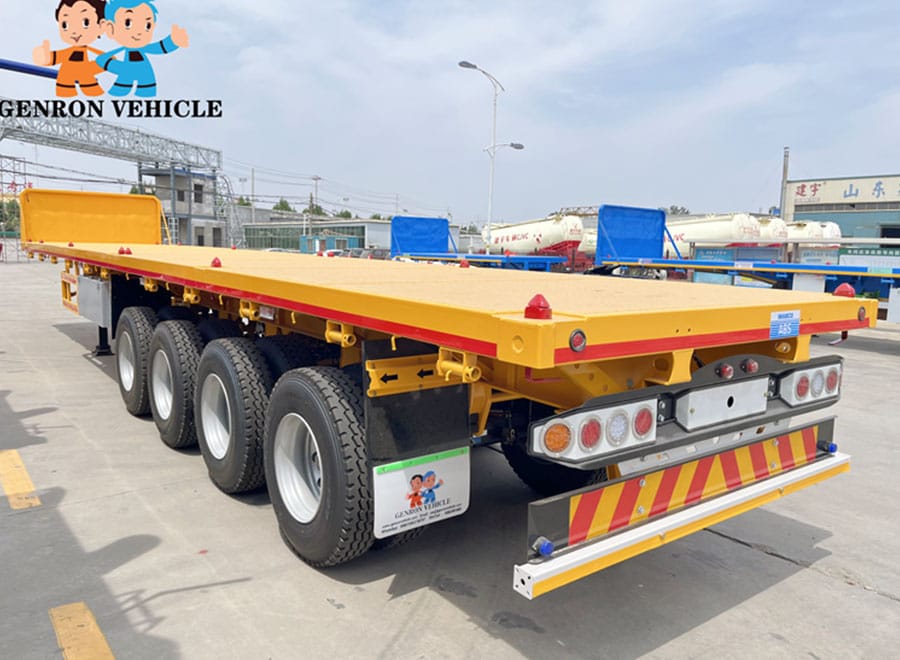
The three-axle flatbed platform is an open-deck product layout to discuss where the unit schedule permits that type of carrier. The four-axle flatbed platform offers another layout for comparison. Ask GENRON to define the proposed configuration against the supports and cargo positions; neither product page establishes acceptance of a particular beam or panel.
Keep any packing, spreader arrangement or temporary base visible in the documents. Specify its intended function and responsibility. A change to those items can alter both the product support and the vehicle interface, so it should not be treated as a minor yard adjustment with no need for review.
Make restraint compatible with fragile edges and approved contact zones
Give the competent load-securing planner the producer’s restrictions on cargo contact, lifting inserts and transport supports. The selected restraint system must work with the product rather than damage an edge or rely on a feature not intended for that duty.
Protective packing and road restraint answer different questions. Material that prevents scuffing does not necessarily restrain the load, while a strong lashing can still be inappropriate at a sensitive contact point. Ask the responsible parties to identify both functions on the arrangement.
This guide does not prescribe lashing quantities, tensions or a blocking design. Those depend on the actual units, supports, vehicle and applicable requirements. The buying decision should establish who prepares and accepts that arrangement and ensure the quoted trailer provides the necessary access and attachment provisions.
Plan the delivery sequence before assigning deck positions
A project may require units to arrive in installation order. Obtain that requirement early and distinguish it from the order that is most convenient for factory loading. If the two conflict, the producer, haulier and receiving team need an agreed solution before the trailer is filled.
For a hypothetical two-stop journey, prepare drawings for the departure condition and the load remaining after the first delivery. Review support, restraint and access in both. A partial load may no longer resemble the arrangement that was checked at the factory, even though the trailer carries less total mass.
Do not assume that the receiver can move other units aside to reach the next piece. Rearrangement adds handling and requires suitable equipment and space. If direct access cannot be achieved, compare a different loading order, a different trailer arrangement or separate deliveries as explicit commercial alternatives.
Coordinate the vehicle position with the lifting plan
The receiving site should define where the vehicle will stand and how the approved lifting operation reaches each unit. Give the lifting planner the complete transport layout, not only a unit drawing. Frames, supports, lashing access and nearby structures can all affect the working envelope.
Separate arrival access from unloading access. A vehicle may enter the site but still be unable to reach the intended standing area or provide the required working space. Ask the receiving team to confirm the route within the site and the planned vehicle orientation.
Establish responsibilities for managing people and vehicle movements during delivery. Site information should be current, especially on a project where access changes as construction progresses. A photograph from an earlier phase can help explain the location but should not substitute for a confirmed delivery arrangement.
Use a clear exception list when comparing quotations
Compare offers against the same unit schedule and producer transport instructions. Ask each supplier to identify included supports, supplied fittings and exclusions. If one proposal assumes a customer-provided frame while another includes it, make that difference visible before comparing the final prices.
Resolve unclear phrases such as reinforced deck, heavy cargo capacity or special concrete transport. A useful response identifies the cargo configuration covered and the documents still needed. It is reasonable for a quotation to contain open items, provided they remain open and have a named route to resolution.
Include site-related costs and responsibilities where they form part of the requested scope. Waiting arrangements, vehicle positioning and additional handling can influence the delivered solution. Keep those commercial items separate from engineering approval so a pricing agreement is not mistaken for acceptance of an unresolved load case.
Record condition and identity without unsafe inspection
At dispatch, record the unit and package identities, visible condition and accepted arrangement through the agreed handover process. The producer and operator should define how those records are obtained safely. This article does not recommend walking beneath suspended units or entering an unsafe loading area to take photographs.
At delivery, reconcile the units with the schedule and note discrepancies through the responsible parties. Distinguish transport damage, a drawing mismatch and a missing accessory because they require different responses. Clear identity records help the project avoid attributing a problem to the wrong unit or journey.
Retain the relevant documents after the move. If the same product is transported again, they provide a starting point, but changes to orientation, supports, vehicle or route still need review. Reusing a complete, identified arrangement is different from copying an old photograph with unknown assumptions.
A practical review: one long unit versus several shorter units
A buyer might ask whether one trailer can serve both a single long beam and several shorter units. Prepare separate cases with the producer’s support requirements for each. The long unit may drive the envelope, while the shorter group may create a different pattern of concentrated support loads and delivery stages.
Ask the trailer supplier to mark which positions are accepted in each case and which equipment changes are necessary. Check where unused frames or supports travel. A versatile trailer is useful when its changeover is documented and practical, not when every load is expected to fit through an improvised arrangement.
This comparison can reveal that one layout covers the routine work while a specialist arrangement is preferable for an occasional unit. Keep that conclusion in the fleet plan. It is more informative than describing the entire concrete product range as suitable for one nominal trailer payload.
Precast-concrete transport enquiry brief
Producer and unit drawing references:
Quantity, mass and envelope of each unit:
Required orientation and approved support positions:
Frames, bearers, packing and their responsibilities:
Trailer and tractor load-case information:
Delivery order and intermediate load stages:
Site access, standing area and lifting-plan coordination:
Handover identities, condition records and open issues:
Keep similar-looking units distinguishable through delivery
Two units can share an outside shape while differing in handedness, inserts or installation location. Retain the producer’s identities on the delivery schedule and agree how the receiver will recognise them without unplanned rearrangement. The load plan should connect each identity to its deck position and intended delivery stage.
If the project changes the installation order, check whether the transport arrangement still provides the necessary access and intermediate support conditions. Updating a customer list is not necessarily enough. A revised order can change which unit is removed first and which load remains for the next movement.
Resolve identity or sequence mismatches through the producer, haulier and receiving team before dispatch where possible. This is a coordination task with direct consequences for the carrying plan, not merely an administrative label. Clear identities help the specialists review the correct unit rather than making assumptions from a similar appearance.
FAQ: Trailers for precast-concrete deliveries
Can a standard flatbed carry precast beams?
It may be suitable for a defined load, but only after the producer’s transport requirements, supports, vehicle structure and restraint arrangement are reviewed together. A total-payload statement alone is not enough. Some units or orientations may require a purpose-designed frame or specialist carrier.
Can I choose bearer positions from the trailer cross-members?
Not on that basis alone. Obtain the producer’s permitted support positions first, then reconcile them with the trailer structure through the responsible designers. If the interfaces do not match, obtain a reviewed alternative rather than moving a support for convenience.
Are lifting inserts suitable for securing the load to the vehicle?
Do not assume so. Use the producer’s instructions and the competent restraint plan. A feature intended for lifting has a defined duty and may not be suitable for road restraint or for forces applied in another direction.
Why does the delivery sequence affect the trailer specification?
It influences which units must remain accessible and what support and restraint conditions exist after each delivery. A plan checked only for a full departure load may not cover intermediate stages. Include those stages when asking for the carrying arrangement.
Should transport-frame mass be included in payload calculations?
Yes. The vehicle carries the frame, supports and other equipment as well as the concrete. Record the complete cargo and equipment condition. The actual combination also needs the appropriate axle and route review, not only a sum of unit masses.
What should remain in the handover file?
Retain the unit schedule, producer transport instructions, accepted support/frame and vehicle drawings, relevant planning responsibilities and identity/condition records. These should represent the delivered configuration and revisions. They make repeat moves easier to assess without treating an old journey as blanket approval.
Product Options to Discuss
Discuss a defined precast load and producer-approved supports before selecting a product configuration. Product-page capacities are not project-specific transport approval.
Related Reading
References
The HSE source concerns prestressed concrete and supports the need for designer instructions. Other precast products require their own producer information. No lifting, support or restraint design is supplied here.


