
 English
 Français
 Español
 Árabe
 Deutsch
 简体中文
 Português
 Русский
 日本語
 한국어
 हिंदी
 Prancis
 Türkçe
 Tiếng Việt
 Italiano
 ไทย

A quotation can look satisfactory when the total coil mass is below the advertised trailer payload. The missing detail is where that mass enters the trailer. A few compact coils create a different support problem from evenly distributed palletised freight, even when the total cargo mass is identical.
For a useful steel-coil trailer enquiry, start with the cargo drawing rather than a request for a thicker floor. This guide explains the information to put on that drawing and the questions that distinguish a suitable coil-carrying arrangement from an ordinary flatbed with loose equipment added later.
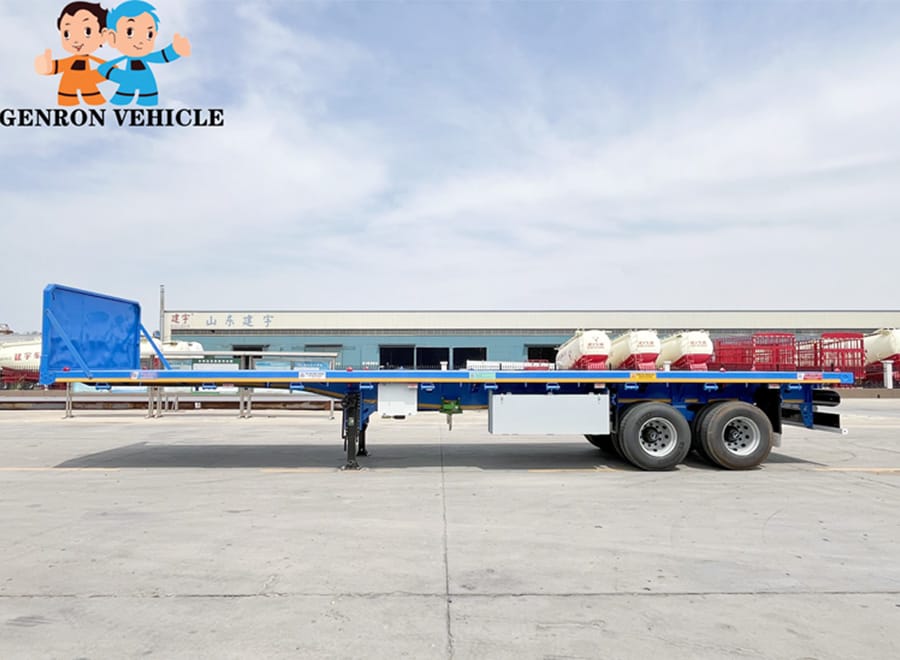
First describe the coil as it will travel
Record the maximum and minimum mass per coil, outside diameter, eye diameter and coil width. Identify whether coils arrive individually, on transport pallets or in purpose-built frames. Packaging dimensions matter because the supported footprint can be quite different from the steel itself. Include the mass of any frame or pallet in the cargo schedule.
State the proposed eye orientation in plain language and on a sketch: vertical, longitudinal or transverse to the vehicle. Avoid relying on “eye to sky” or “eye to side” alone when several people translate the order. The coil supplier, haulier and trailer designer need to interpret the same arrangement.
Also identify surface-protection requirements. An exposed hot-rolled coil, a wrapped finished coil and a sensitive coated product may call for different contact surfaces and weather protection. A support that is structurally adequate can still be unacceptable if it damages the product or traps water against its packaging.
Payload and concentrated-load capacity answer different questions
Total payload describes one aspect of the vehicle’s loading envelope. Concentrated loading concerns how a particular cargo footprint is supported by the floor, cross-members and main structure. An overall payload figure cannot replace a load case showing the number, position and contact geometry of the coils.
Consider an illustrative consignment of three coils weighing 8 tonnes each. The steel totals 24 tonnes, but dividing that number by the entire deck area tells the designer very little about the forces beneath each support. The relevant enquiry includes the three coil locations and the dimensions of the actual supporting cradles. This example is a quotation exercise, not a capacity approval.
Ask for the proposed load arrangement to be identified on the supplier’s drawing. If several coil sizes will be carried, show the most demanding combinations rather than only the convenient middle case. A movable cradle position should not be treated as unrestricted positioning anywhere along the deck.
Information that should accompany a coil-trailer quotation
| Order item | What to record | What the response should identify |
|---|---|---|
| Coil range | Mass, diameter, width and packaging for each family | Which combinations the proposal covers |
| Support | Orientation and actual contact footprint | Cradle or well arrangement and approved positions |
| Vehicle loading | Tractor details and intended coil locations | Assumptions used in axle and kingpin-load review |
| Restraint | Cargo contact restrictions and available securing access | Rated attachment points and a load-specific plan |
| Unloading | Crane, coil grab or other approved equipment | Access clearances and removable items |
A cradle is part of a system, not a loose accessory
Distinguish a built-in coil well from a removable cradle or a frame carried on a flat deck. They are not interchangeable descriptions. The quotation should explain how the coil bears on the support, how the support bears on the trailer and how the support itself is prevented from moving.
Ask who supplies the cradle, who approves its attachment and what identification will remain on the delivered equipment. If the buyer supplies an existing frame, provide its drawing and condition information. “Customer-supplied” should not leave the interface between that frame and the trailer undefined.
For mixed work, consider the empty return and the next non-coil load. Removable equipment needs a documented stowage arrangement when it is not in use. A deck cover over a coil well also needs a stated use and rating; its appearance alone does not show that forklifts or other cargo may travel over it.
Keep support, packaging and road restraint separate
A coil can be securely banded to its transport frame yet still require a complete restraint arrangement between the frame and the vehicle. Conversely, adding lashings does not make an unstable support arrangement acceptable. Treat product packaging, stable support and transport restraint as connected but separate design questions.
Have a competent load-securing planner determine the required equipment and arrangement for the actual load and route. This article does not prescribe a universal number of chains or straps. Coil orientation, cargo mass, contact conditions, attachment ratings and applicable rules all affect that decision.
The UNECE CTU Code provides a general reference for cargo packing and securing across transport modes. It is not evidence that a particular GENRON trailer or a photographed cradle has been approved for a coil load. The order still needs its own documented arrangement.
Further source information:
Check access before choosing permanent fittings
Send the unloading contractor a plan view of the proposed deck and supports. Ask how lifting equipment reaches the coil and where the equipment needs clearance. A practical conflict may involve a headboard, side stake, cover frame or securing point rather than the trailer’s overall width.
If the receiver uses a crane, identify the approved lifting method with the cargo owner. If a specialised forklift attachment is involved, give the planner its operating envelope and the receiving-area restrictions. Do not assume ordinary forks can handle an unpackaged coil safely.
Weather covers deserve the same attention. Specify whether the load is covered before dispatch, where covers are removed and how that work is managed without exposing people to moving cargo or unsafe access. A tarpaulin keeps neither the cargo nor the people safe unless it fits the agreed operation.
Approve a repeatable load case, not a one-off photograph
At order review, connect the trailer drawing, cradle drawing, coil schedule and restraint plan with revision references. A yard photograph can help explain the layout, but it cannot establish material properties, attachment ratings or permissible load positions.
At handover, check that identification and supplied equipment match the agreed documents. Record any substitutions before use. If the fleet later accepts a heavier coil, a different orientation or a new transport frame, return to the load-case review rather than treating the original approval as unlimited.
A concise steel-coil enquiry brief
Coil mass range and maximum quantity per journey:
Outside diameter, eye diameter and width:
Packaging or transport-frame drawing:
Proposed eye orientation and deck positions:
Tractor and destination route:
Surface-protection requirements:
Loading and unloading equipment:
Responsibility for support, restraint plan and acceptance:
How to close a gap between two coil proposals
A practical comparison sheet can contain one line for every item that is not yet agreed. For example, one supplier may include a removable support frame while another expects the buyer to provide it. Record the frame drawing, attachment scope, price and delivery responsibility before comparing the totals. Otherwise, the cheaper offer may simply exclude part of the carrying system.
Use the same approach for protective contact materials, covers and stowage of empty supports. Identify whether the quotation includes them, merely shows them in a photograph or leaves them to the operator. Ask for unresolved items to be answered against the same coil schedule rather than through unrelated messages.
The result should be a small set of accepted documents that describe what will arrive and which coils it is intended to carry. This is more useful at handover than a long list of attractive but undefined phrases such as reinforced structure, heavy-duty floor or universal coil support.
Steel-coil trailer questions
Can a general flatbed carry steel coils?
Possibly, but only within a reviewed arrangement covering the specific coils, supports, trailer structure and restraint system. A general payload statement is not enough to establish suitability. Some work may call for a purpose-designed coil carrier instead.
Does a thicker floor solve the concentrated-load problem?
Not by itself. The floor is one component in the load path. The supporting structure, cradle contact geometry and cargo position also matter. Compare drawings and defined load cases rather than floor thickness alone.
Can one cradle arrangement cover every coil size?
Do not assume so. Ask for the supported coil range, permitted orientation and any position restrictions. Changes to coil dimensions or packaging may change the way the support contacts the cargo and the deck.
What should I send GENRON first?
Send the coil schedule and packaging drawings, together with the intended tractor, route and unloading method. That gives the quotation team a concrete starting point and makes exclusions easier to identify before an order is placed.
Related Reading
Sources and Scope
The source is a general cargo-packing reference. The quotation examples and enquiry checklist are editorial planning tools, not a restraint calculation, engineering approval or statement of local legal limits.


