
 English
 Français
 Español
 Árabe
 Deutsch
 简体中文
 Português
 Русский
 日本語
 한국어
 हिंदी
 Prancis
 Türkçe
 Tiếng Việt
 Italiano
 ไทย

A pipe order is rarely defined well enough by “12-metre pipes” and a total tonnage. Different diameters, wall thicknesses, coatings and packaging arrangements can change the usable load pattern. The same trailer may also visit a crane-equipped depot on one trip and a restricted construction site on the next.
The purchasing challenge is to give the trailer supplier a repeatable description of that work. This guide focuses on bundle support and access, rather than repeating a general flatbed buying checklist. It is intended for commercial planning; the final lifting and securing arrangements require the responsible specialists.
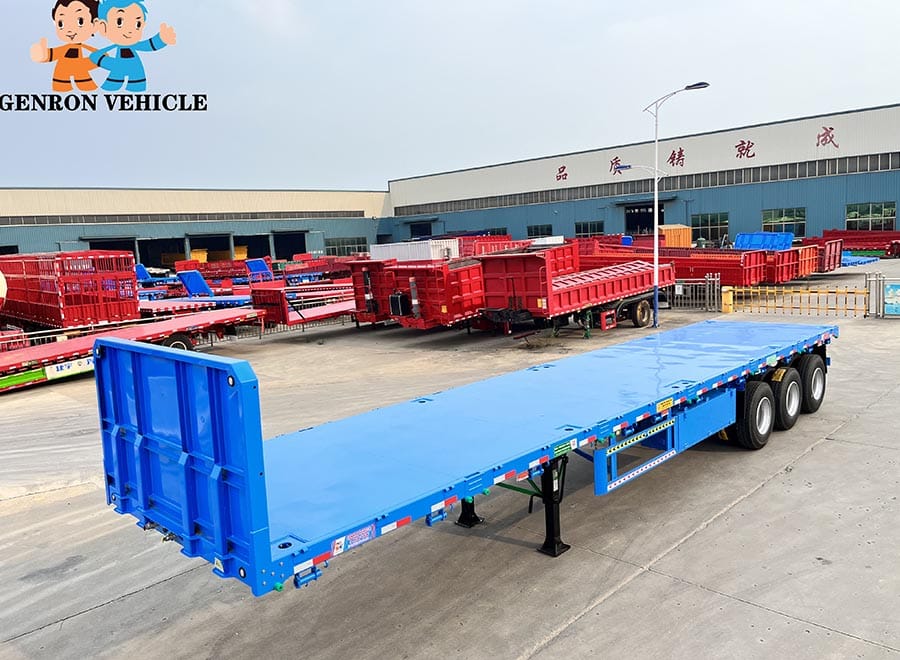
Describe the bundle, not just the pipe length
List pipe length, outside diameter, wall thickness or verified unit mass, and the number of pipes in a bundle. Then give the overall bundle dimensions and gross mass, including packaging. If the supplier provides a bundle drawing, use that drawing as the cargo reference instead of estimating the shape from a sales photograph.
Identify whether pipe ends have caps, flanges, sockets or other projections. A nominal length may exclude packaging or fittings that affect clearance. The widest point may also be at a flange rather than along the pipe body. Measure the transport envelope that actually reaches the loading yard.
Record the coating and any prohibited contact surfaces. Painted steel, lined pipe, bare steel and plastic products do not necessarily accept the same supports or handling equipment. The cargo manufacturer should specify acceptable support zones and protection where product damage is a concern.
Support positions determine what the deck must carry
A bundle resting on two or three bearers transfers its mass through those bearers, not uniformly through the deck area beneath the entire load. Show the bearer positions, contact width and material on the proposed loading drawing. Give the trailer designer a defined support arrangement to assess.
Do not choose support spacing simply because it matches convenient cross-member locations. The pipe or packaging supplier may have limits on unsupported length and on where supports can contact the product. The cargo requirement and trailer structure must be reconciled on the same plan.
Where several layers are proposed, describe the supports between layers as well as those at deck level. Alignment and stability need a load-specific review. A photograph of stacked pipes on another vehicle is not sufficient evidence that the same stack is suitable for a different product or trailer.
Pipe-load information and the trailer decision it affects
| Cargo detail | Trailer or operating question |
|---|---|
| Maximum bundle mass and footprint | What concentrated load enters each supported deck area? |
| Pipe length and end projections | Is usable deck space adequate without an unplanned overhang? |
| Manufacturer-approved support zones | Where must deck supports or cradles be located? |
| Coating and packaging restrictions | Which contact surfaces and edge protection are acceptable? |
| Delivery order and unloading equipment | Which stakes or fittings must be removable, and where is access needed? |
| Return cargo | Where will unused supports and stakes be secured? |
Specify stakes by function and position
A stake can help define the load space or form part of a designed restraint arrangement, but its presence does not establish a rated containment system. Ask what the proposed stakes are intended to do and what supporting information is available for that duty. Avoid calling every upright a load-bearing stanchion without clarification.
The quotation should identify stake quantity, pocket positions, working height and whether removal is intended. Also identify any restrictions on loading beside or above them. If stakes are removable, agree how they are handled and secured when not fitted; a loose stake is itself cargo during travel.
Stakes and pockets should not obstruct the cargo’s approved lifting method. A full-height upright near a sling position can be inconvenient, while removing it at the wrong stage could affect load stability. Resolve this in the operating plan, not by asking a driver to improvise at the delivery point.
Bundle bands are not the same as vehicle restraint
Packaging bands may keep a bundle together for a particular handling purpose. They should not automatically be treated as the means of securing that bundle to the vehicle. Ask the cargo supplier what the bands are designed for and whether the package has any transport restrictions.
The road-restraint plan needs to address the actual bundle, supports, trailer attachment points and route. It should also account for the risk of rolling or sliding as appropriate. This guide deliberately does not specify a generic strap count or a universal stacking pattern.
The UNECE CTU Code is a useful general reference for cargo packing and securing. Its existence does not make an unspecified stake-and-strap arrangement adequate. The responsible planner still needs a documented solution for the particular pipes and vehicle.
Further source information:
Plan the final delivery before maximising the first load
A loading plan that fills the deck efficiently at the factory may become awkward after the first delivery. If a route has several stops, show which bundles leave at each stop and how the remaining load is supported and restrained. Include the intermediate load conditions in the planning discussion.
Obtain the receiver’s unloading method in writing. A crane needs an approved lifting plan and suitable access around the cargo. A forklift or specialised attachment has a different operating envelope. Ground conditions, available working space and exclusion arrangements belong in that discussion as well.
HSE’s loading guidance stresses planning and cooperation between those involved in loading and unloading. For international buyers, use that as a general safety reference rather than as a substitute for local requirements. The commercial point is straightforward: the receiver’s equipment should influence the trailer specification before the order is finalised.
Further source information:
An illustrative mixed-diameter enquiry
Suppose a distributor expects to carry large-diameter bundles on one journey and smaller wrapped bundles on another. Instead of requesting one maximum tonnage, prepare two cargo schedules. Each schedule should show bundle quantity, dimensions, support locations and the loading order. These are alternative load cases, not a claim that either arrangement is already acceptable.
Ask the supplier to identify which fittings are common to both proposals and which must change. Removable supports may improve flexibility, but only if their permitted positions, attachment method and stowage are clear. A flexible design is useful when the changeover is repeatable and documented.
At handover, check the supplied stake and support quantities against that agreement. Keep the load drawings with the operating documents. When a new pipe product is introduced, review its packaging and support requirements before treating it as equivalent to an existing bundle.
Pipe-transport enquiry notes
Pipe product and coating:
Maximum and minimum length, diameter and bundle mass:
Transport packaging and overall bundle dimensions:
Approved support positions and contact restrictions:
Proposed quantity, layers and delivery sequence:
Required stake positions and removal access:
Loading and unloading equipment at each site:
Return cargo and stowage of unused fittings:
Check a partial delivery as a separate load case
Consider a hypothetical route with one bundle leaving at the first site and two remaining for a second site. Draw both the departure load and the intermediate condition. Mark which supports remain occupied, which items become loose equipment and which restraint points need to stay accessible. This is a planning example, not an approved unloading sequence.
Give those two drawings to the transport planner and the receiving parties before agreeing on the gate or stake arrangement. If the remaining bundles cannot be accessed or secured as intended, the answer may involve a different load order, different equipment or separate deliveries. It should not depend on an improvised decision beside the trailer.
Include the empty condition too. A pipe carrier returning with bearers, stakes and packaging still needs an organised equipment layout. Defining that return condition during procurement can reveal useful storage requirements that are easy to miss when attention stays on the full outward load.
Questions about trailers for pipe bundles
Is a longer deck always better for pipe transport?
No. Usable support positions, axle distribution, route restrictions and unloading access matter alongside length. A longer deck does not automatically make an overhanging or poorly supported load suitable.
Can side stakes replace lashings?
Only a competent, load-specific assessment can establish the required restraint system. Do not assume ordinary removable stakes provide the complete restraint needed for road travel. Their intended function and any ratings should be documented.
Should the trailer supplier decide pipe support spacing?
The cargo manufacturer should provide product-support restrictions, and the trailer designer should assess how those supports load the vehicle. Both sets of requirements need to be satisfied together.
What usually makes two pipe quotations difficult to compare?
Missing bundle dimensions, undefined supports and different assumptions about supplied fittings. Compare quotations against the same cargo schedule, drawing revision and unloading requirement rather than total payload alone.
Related Reading
Sources and Scope
These sources provide general safety context. The cargo examples and enquiry notes are editorial procurement tools, not pipe-manufacturer instructions, a lifting plan or a road-restraint calculation.


