
 English
 Français
 Español
 Árabe
 Deutsch
 简体中文
 Português
 Русский
 日本語
 한국어
 हिंदी
 Prancis
 Türkçe
 Tiếng Việt
 Italiano
 ไทย

Sawn timber is often ordered in commercial lengths and cubic metres, while the trailer receives strapped bundles with bearers, wrapping and varying package sizes. The difference matters. A load can fit the nominal deck dimensions yet be awkward to support, cover or unload at the last customer.
This guide concerns packaged sawn timber and lumber, not a universal system for round logs or other forest products. It explains how a merchant, mill or haulier can turn a product list into a clear flatbed enquiry and a practical delivery schedule. The final securing and handling methods remain the responsibility of competent planners.
Translate the sales order into a transport package schedule
For each bundle, record its identity, outside length, width, height and gross mass. Include wrapping, bearers and other packaging. If the timber is supplied in several lengths or grades, keep them as separate lines rather than describing the journey with one average bundle size.
Ask whether package dimensions are maximum transport dimensions or nominal product measurements. Wrapping, uneven ends and packaging features can affect the space required. The drawing should represent what reaches the loading area, not only the finished board dimensions on an order sheet.
Retain a link between the transport package identity and the customer order. That makes unloading sequence and quantity reconciliation easier, especially where bundles have a similar appearance. Clear package records can reduce unnecessary handling without promising a particular reduction in damage or delivery time.
Keep volume and transport mass as separate records
Cubic metres are useful for buying and selling timber, but they do not establish the mass carried by a vehicle. Species, product condition, moisture and packaging can affect mass. Obtain a credible gross-mass basis for the actual bundles instead of relying on one assumed density for every consignment.
If an estimate is used during quotation, identify its source and keep it labelled as an estimate. The operator should establish the actual loaded condition through appropriate records and verification before movement. A planning estimate should not become an undeclared payload allowance simply because the order quantity has not changed.
Include bearers, protective equipment and separately carried materials in the vehicle load schedule. Then review the complete tractor-trailer arrangement within its applicable limits. A nominal cargo volume or a product-page capacity does not resolve axle distribution, trailer loading positions or the requirements of a particular route.
Define bearer positions before asking for a thicker floor
Obtain the timber supplier’s requirements for supporting the packaged product. Identify the support locations, contact dimensions and any limitations relevant to bundle handling or deformation. The trailer designer needs to understand how the package transfers load to the deck through those supports.
Show the bearers on the proposed load plan. A few narrow supports do not create the same local deck condition as cargo evenly spread over the complete platform. Ask the supplier to assess the arrangement rather than choosing a floor thickness from a broad heavy-duty description.
Where bundles are stacked, include the packaging and support requirements between layers in the responsible planning discussion. Do not infer a safe stacking height or bearer layout from the side-panel height of a trailer. Product support, load stability, restraint and overall dimensions need to be considered together.
Timber enquiry details and their practical purpose
| Package detail | Question for the transport proposal |
|---|---|
| Maximum outside dimensions | What usable deck and working space is required? |
| Gross mass and evidence | Which defined load cases are being assessed? |
| Bearer/contact arrangement | Where does the package load the trailer structure? |
| Packaging restrictions | Which contact and handling methods are acceptable? |
| Delivery identity and order | Which bundles need access at each stop? |
| Cover requirements | How will the agreed cargo condition be protected? |
Choose a platform around routine bundle combinations
List the combinations that the fleet actually carries: one length throughout, several lengths on one journey or full bundles mixed with smaller prepared packages. Show the normal cases and the difficult occasional case separately. Trying to describe all of them with a single maximum length hides useful differences.
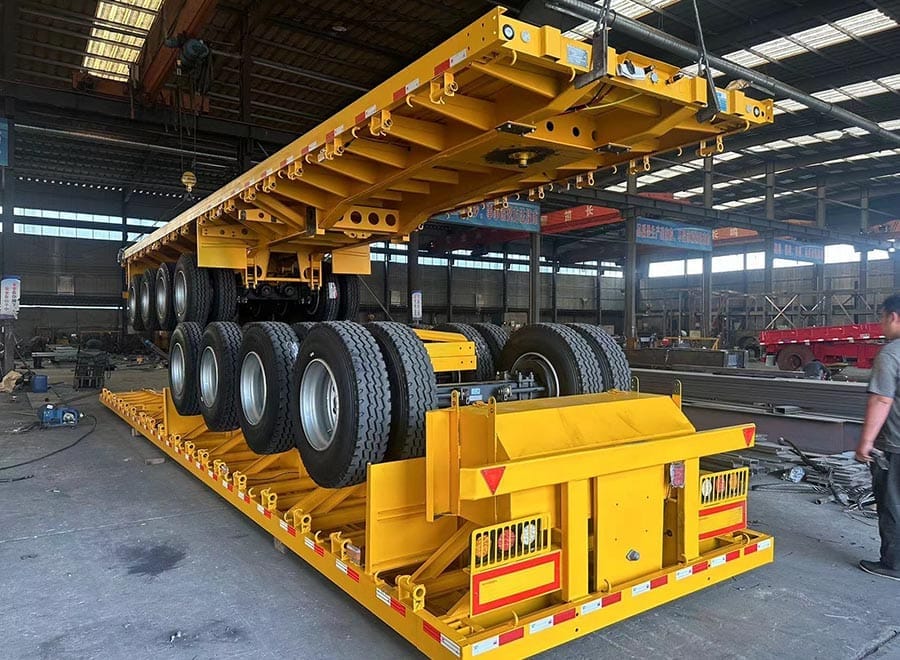
GENRON’s three-axle flatbed platform and two-axle open-deck flatbed platform are product layouts to compare where an open deck suits the agreed duty. Use the actual bundle schedule to discuss support positions, equipment and usable space. The number of axles or a capacity phrase on a page does not by itself determine the permissible timber load.
If a different body arrangement is proposed, ask what problem it solves. Removable stakes or panels may be useful in a defined system, but they also affect access and equipment handling. Compare the complete routine operation rather than adding fittings merely because another timber vehicle has them.
Separate packaging bands from the road-securing system
Ask the timber supplier what the bundle bands are designed to do and how the package is intended to be handled. Keeping boards together as a package is not automatically the same duty as securing the package to the road vehicle. Both interfaces need to be understood.
The competent load-securing planner should select the arrangement for the actual load, vehicle and applicable rules. It must work with the bundle shape, support materials and product-contact restrictions. This article does not specify a universal strap quantity, tension or stacking pattern.
DVSA’s load-security guidance includes timber among the loads requiring an appropriate securing method. Its Great Britain context should not be treated as a universal destination rule. Use the relevant requirements for the journey and retain the accepted load-specific instructions with the operating records.
Source: DVSA: Carrying different loads, including timber
Specify stakes and headboards by their intended role
If stakes are requested, state why they are needed and where they must be positioned. Ask the manufacturer to identify their intended function and any applicable ratings or restrictions. A visible upright is not evidence of a complete rated containment system.
Check how the fittings interact with the loading method. A stake near a crane access point or forklift approach can complicate handling even when the deck is otherwise large enough. Any intended removal and refitting should be included in the operating arrangement, with storage for unused equipment.
The headboard should be considered within the complete restraint and cargo layout rather than as a blanket guarantee of forward containment. The responsible planner needs the actual vehicle information. Do not use overall headboard height as a substitute for understanding the position and behaviour of the timber packages.
Agree weather protection with the cargo owner
Ask what condition the timber must maintain during transport and temporary stops. Product grade, packaging and the receiving process may lead to different protection requirements. Do not assume that all timber can be exposed equally or that wrapping makes a cover unnecessary in every situation.
Specify the cover and frame arrangement against the actual loaded envelope. Include how the cover is managed at each delivery and who is responsible. A cover listed as supplied equipment is not a complete solution if it conflicts with package access or requires an unplanned working method.
Keep moisture and ventilation decisions with the product owner’s requirements. This guide does not prescribe a universal moisture content, storage interval or ventilation gap. The practical buying point is to obtain the cargo requirement early enough that the trailer and cover proposal can address it explicitly.
Design a delivery sequence that avoids unnecessary rearrangement
Mark customer identities and delivery order on the load plan. Ask the receiver which side or end will be accessible and what equipment will handle the bundles. The most space-efficient departure layout may not be the easiest arrangement for a restricted yard at the second or third stop.
Draw the intermediate loads as well as the full load. Remaining bundles need suitable support and restraint after each delivery, and unused bearers or fittings must still be secured. Lower total mass does not remove the need for a reviewed arrangement.
If a requested bundle is buried beneath another customer’s goods, compare alternatives before dispatch. A different order, a changed layout or separate deliveries may be more practical than relying on the receiver to provide space and handling equipment for rearrangement. Make that trade-off visible in the commercial plan.
Work through a mixed-length consignment on paper
Consider an illustrative consignment containing six-metre bundles and three-metre bundles. Two shorter bundles have the same summed nominal length as one longer bundle, but they do not necessarily create the same support pattern, package gaps or handling access. Draw the actual packages rather than substituting a single length total.
Record which bundles can share the agreed supports and which require a different arrangement, based on the product supplier’s information. Include any space needed around packaging or equipment. The purpose is to test the enquiry assumptions, not to claim that a particular number of bundles fits a GENRON model.
Then compare the full load with the state after the first customer’s delivery. This small exercise often reveals whether a flexible open deck needs additional defined fittings or whether the job should be split. It also gives the trailer supplier a much clearer brief than a request to carry a set number of cubic metres.
Use package and condition records at both ends of the journey
At loading, reconcile package labels with the schedule and record the visible condition through the agreed safe process. Distinguish an already damaged wrapper, an unidentified bundle and a missing item. They are separate handover issues rather than one general note that the cargo was loaded.
At receipt, use the same identities to confirm delivery quantities and report differences. The records should explain which packages travelled and which remained after an intermediate stop. This improves traceability without claiming that paperwork can prevent every instance of damage or loss.
For repeat work, retain the accepted package families and trailer arrangements. Review changes to bundle dimensions, support requirements, handling equipment or route conditions. A consistent record lets the fleet build useful experience while keeping the limits of earlier decisions clear.
Sawn-timber trailer enquiry notes
Timber product, package identities and customer orders:
Maximum bundle dimensions and gross-mass basis:
Bearer positions and product support restrictions:
Normal and occasional mixed-length combinations:
Proposed fittings and restraint-planning responsibility:
Weather-protection requirements and delivery access:
Intermediate loads and return equipment:
Drawing revisions, package records and open decisions:
Reconcile quantities by package identity, not appearance
For a hypothetical twelve-bundle delivery split between two customers, identify the seven packages for the first stop and the five for the second. Keep those identities on the cargo list and deck plan. This example concerns traceability only; it does not establish a permitted quantity or loading arrangement.
If a package is split or substituted at the mill, update its dimensions, mass and customer allocation before treating the schedule as final. The total commercial volume may remain the same while the number and shape of packages change. That can affect both support and delivery access.
After each stop, reconcile the remaining packages with the next-stage plan. Avoid relying on similar wrappers or a driver’s memory of where an order was placed. A small, accurate package register connects the commercial order with the physical cargo and helps keep the accepted transport arrangement meaningful throughout the route.
FAQ: Flatbed trailers for sawn timber
Can I choose a trailer from the timber volume alone?
No. Establish the packaged dimensions and gross mass, then include supports, restraint access and the delivery arrangement. Cubic metres describe product quantity but do not establish actual vehicle loading or axle distribution. Keep any early mass estimate clearly identified until the operating load is verified.
Do bundle bands secure the timber to the trailer?
Not automatically. Packaging bands have a defined purpose that should be confirmed with the supplier. The package-to-vehicle interface needs its own appropriate securing arrangement, selected for the actual load and carrier. Do not merge the two functions without evidence.
Are removable side stakes essential for every timber load?
There is no universal answer for every packaged product and vehicle. Identify the intended duty, load plan and responsible restraint assessment. If stakes are included, document their function, positions, restrictions and stowage when removed.
Can shorter bundles simply replace longer ones in the same spaces?
Not necessarily. They may change bearer contacts, gaps, handling access and partial-delivery conditions. Prepare the alternative bundle layout and have the relevant support and restraint questions reviewed instead of comparing summed lengths alone.
Does wrapped timber need no further weather protection?
That depends on the product, packaging and journey requirements. Ask the cargo owner to define acceptable exposure and condition. Then specify the cover arrangement and delivery work method accordingly; do not infer universal protection from the appearance of the wrapper.
Does this guide also cover round-log transport?
No. It addresses packaged sawn timber and lumber. Round logs and other forest products can require different vehicles, supports and securing arrangements. Give the supplier the actual cargo type rather than treating every timber product as the same transport duty.
Product Options to Discuss
Compare these layouts against the agreed package schedule, support pattern, tractor and route. No timber payload is approved by the link alone.
Related Reading
References
DVSA guidance applies in Great Britain. This article provides an enquiry method, not a destination-specific legal assessment or a designed load-securing system.


