
 English
 Français
 Español
 Árabe
 Deutsch
 简体中文
 Português
 Русский
 日本語
 한국어
 हिंदी
 Prancis
 Türkçe
 Tiếng Việt
 Italiano
 ไทย

Packed glass requires a transport enquiry that explains the packaging as carefully as the vehicle. Two consignments described as glass crates can have different bases, permitted orientations, lifting interfaces and weather limitations. The outside of a wooden case may conceal the features that matter most to transport planning. Before selecting a flatbed trailer, the buyer needs a reliable description of the complete package and written instructions from the company responsible for preparing it for transport.
This guide is for buyers comparing trailers for glass already packed in approved cases or transport frames. It does not cover loose glass loading, prescribe a glass restraint design or establish that an ordinary flatbed is suitable for every glass shipment. Where the packaging or handling method requires a dedicated vehicle, follow that requirement. The useful starting question is how the approved package will interface with the proposed vehicle, not whether its outline fits on a deck.
Identify the package and its permitted orientation
Ask the glass supplier to identify the product, package type, package reference and gross mass for each transport unit. Request overall dimensions in the permitted transport orientation, including skids, braces and projecting parts. Distinguish a closed crate from a reusable frame or a pack attached to a rack. These descriptions should not be used interchangeably in the enquiry. The supplier should confirm whether the shipment may travel on the proposed vehicle type and which features of the packaging must remain supported throughout the journey.
Orientation markings must be understood before deck space is calculated. Do not assume that a case may be laid flat, turned on another edge or stacked simply to increase the number carried. Obtain a package drawing that shows the intended base and relevant handling interfaces. If marks are missing or inconsistent with the documents, return the question to the packer. Changing the orientation of a fragile cargo package is not a space-saving decision for a purchaser or driver to make without the responsible supplier's approval.
Use the instructions for the actual glass product
Glass manufacturers publish different guidance for their particular products and packaging systems. For example, AGC's IMAGIN processing guide includes product-specific handling and unloading arrangements, illustrating why a general description such as fragile cargo is insufficient. Its packaging section describes specific transport arrangements; it does not establish approval for an uncovered flatbed. Consult the AGC IMAGIN processing guide where that product is involved, but do not copy its detailed method to unrelated glass. Obtain the instructions applicable to the order, including any restrictions arising from coatings, laminates, package construction or the approved lifting system.
The instructions should come from a named source and carry a revision or issue date. Ask how the carrier can obtain clarification when the physical package differs from the drawing. If glass is bought through a trading company, identify who prepared the packaging and who can answer technical questions about it. A purchase contract can pass through several commercial parties while the package itself remains the responsibility of a particular producer. The transport team needs that technical contact before dispatch rather than after a damaged case reaches its destination.
Explain the base and load path to the trailer supplier
Provide a drawing showing where the crate or frame bears on the deck. The full outside footprint may be much larger than its actual contact areas. Ask the responsible designer to identify the support requirements, then have the trailer supplier review the proposed arrangement against the deck and supporting structure. Avoid reducing the enquiry to a total payload and a photograph. Even a relatively short group of packages can require careful positioning when their support areas occupy only a small part of the available platform.
If intermediate supports are proposed, identify who designs and supplies them and how their use affects the loaded dimensions. The support arrangement must remain compatible with the package instructions rather than being chosen solely to make loading convenient. Keep the deck clear of components that could interfere with the approved base. Ask whether inspection of the supports remains possible once the cases are placed. Any required attachment to the trailer should be included in the engineering discussion, not introduced through an informal modification at the dispatch yard.
Compare the vehicle using a complete position drawing
Draw the package arrangement with identifiers, gross masses and dimensions. Show the tractor connection, trailer axle group, supports and the working spaces needed during loading. Have the proposed distribution reviewed for the actual vehicle and applicable route conditions. A deck drawing that contains only package rectangles is a useful first sketch, but it does not establish axle loading or structural suitability. Include removable frames, protective equipment and other carried items when the transport mass is assessed.
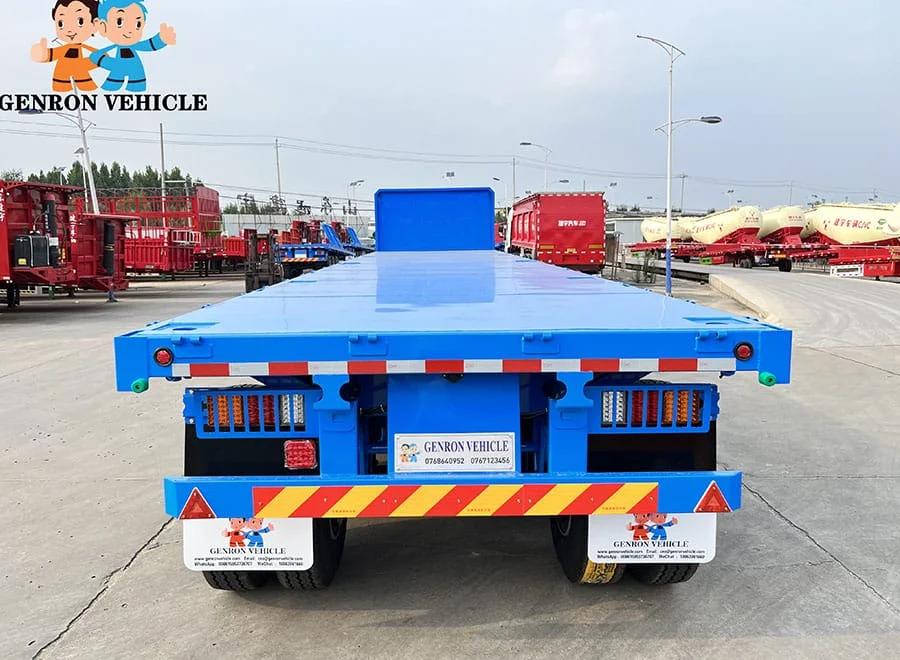
GENRON's three-axle flatbed trailer is one flatbed option to include in an initial discussion, while the four-axle flatbed layout provides a different configuration for comparison where justified by the assessed load case. Ask for the exact specification offered rather than assuming that a product name resolves every interface. A configuration with more axles is not automatically the better choice for fragile cargo. The relevant question is whether its approved loading arrangement, route access and handling space fit the operation at an acceptable total cost.
Separate package restraint from vehicle restraint
Ask who has responsibility for the complete securing plan, including the connection between the glass package and the trailer. Bands or wrapping that hold components together inside a package are not automatically an approved means of securing that package to a vehicle. Conversely, adding external restraint without reference to the package design can introduce contact or force where the packer did not intend it. Resolve the interfaces with the packaging supplier and the competent transport specialist before finalising the equipment list.
The quotation should identify the trailer attachment points and the separate equipment, if any, supplied with the vehicle. Obtain the relevant rated information and intended attachment positions. Do not prescribe restraint tension or contact locations from the appearance of a crate. Ask the specialist to document the arrangement for the actual cargo and vehicle, including any protective interfaces and inspection requirements. If the proposed method depends on a frame component, the frame designer should confirm that it is intended for that function.
Confirm handling access without changing the package
Record the equipment and approved attachment used at dispatch. A forklift, crane and specialist glass handler have different access requirements; availability of one does not establish suitability for the others. Ask the loading contractor to review the package arrangement and trailer accessories before the drawing is accepted. Headboards, toolboxes and stored equipment should not prevent the approved handling method. If a case needs access from a particular direction, make that direction visible on the layout rather than leaving it to verbal explanation.
Repeat the review with the receiving contractor. Confirm the unloading equipment, standing area, working space and planned position for the delivered cases. The package must be accepted in the condition in which it arrives, not on the assumption that workers can remove braces or packaging to make an unsuitable handler fit. Any opening, dismantling or transfer operation belongs in the glass supplier's approved procedure. Obtain agreement before dispatch when the receiver's equipment differs from that used at the factory.
Set the weather and waiting-time requirements
Ask the glass supplier what protection the specific product and packaging require during road transport and intermediate waiting. A timber case does not by itself establish protection against rain, condensation, dust or other exposure. Record any limitations on outdoor storage and clarify who supplies the required protection. Avoid assuming that a carrier's standard sheet provides the same conditions as the producer's transport packaging. Where an enclosed or specialist vehicle is required, that requirement should determine the vehicle choice.
For a flatbed proposal, have the protection arrangement reviewed alongside the package and securing design. State how covers will be installed and removed without interfering with marked handling points or package components. Consider planned stops, terminal waiting and transfers between carriers, not merely the driving time. If protection must be inspected or renewed, give that responsibility to a named party. Unclear responsibility is particularly costly when several companies each believe that a closed case makes further weather planning unnecessary.
Protect the unloading sequence and package identity
Mixed orders often contain cases for different buildings, floors or installation teams. Keep each case identifier linked to its destination and the packing list. Do not rearrange a load only to make the first delivery quicker without reviewing the remaining cargo and vehicle condition. The responsible transport planner should assess each planned unloading stage. The receiver should also know which cases will be accessible and which must remain untouched until a later stage, rather than making these decisions around a parked trailer.
Agree on the response to a receiving delay before the journey starts. If a site cannot accept the case, the carrier needs instructions for an approved waiting or alternative delivery arrangement. An improvised unloading location may lack the handling equipment and support conditions originally agreed. Make clear who can authorise a change and which technical checks must follow. This is especially important for project deliveries where access or lifting equipment is available only during a reserved working period.
Inspect and document the interfaces at handover
At dispatch, connect the inspection record to package identifiers and the approved loading arrangement. Record visible package condition, relevant markings and any agreed exceptions before departure. Photographs are helpful for identifying damage or changes, but they should supplement written records rather than stand in for handling instructions or equipment ratings. If the case arrives with unexpected damage or movement, the receiver should follow the agreed escalation process instead of opening or releasing it merely to complete the delivery paperwork.
For the trailer purchase, retain the accepted drawing, equipment schedule and exclusions with the final quotation. Distinguish what the vehicle manufacturer provides from cargo packaging, specialist handling and transport planning services supplied by others. When future shipments use a new case design, repeat the interface review even if the glass product is unchanged. The strongest specification is not a blanket promise to carry glass; it is a documented vehicle arrangement for clearly described packages and the operations that accompany them.
Frequently asked questions
Can any wooden glass crate travel on a flatbed?
No such assumption should be made from the material of the case. Ask the packer to confirm the permitted transport arrangement, support areas, orientation, protection and handling method. Some products or packaging systems may need a dedicated vehicle or particular environmental conditions. Compare those requirements with the proposed flatbed before requesting a final price. If the required information is unavailable, the enquiry remains incomplete. A clear photograph and an estimated gross weight may begin the discussion, but neither establishes that the package is suitable for an open-deck journey.
Is a larger deck always better for fragile cargo?
Additional space can help with access and layout, but deck size alone does not establish a better transport arrangement. The actual support locations, mass distribution, attachment interfaces and handling clearances matter. A larger vehicle may also present different access constraints at the receiving site. Ask suppliers to compare defined cargo cases on dimensioned drawings. The preferred proposal should show how the packages are supported and handled, not simply offer the greatest platform area. Unused space is not a substitute for an approved loading plan.
May cases be turned sideways to fit more onto the trailer?
Only within the orientation and layout permitted by the packaging supplier and the approved transport plan. Turning a case can alter its contact with the deck, handling access and relationship to the securing arrangement. It may also conflict with package markings. Send any proposed change to the responsible parties before loading, and obtain an updated drawing where needed. Do not treat unused deck space as permission to rotate or stack a package. Packaging that protects glass in one arrangement does not automatically provide equivalent protection in another.
Should the trailer supplier design the glass restraint system?
Confirm the scope rather than assuming it. A vehicle supplier can describe the offered structure and attachment provisions, but a complete cargo plan also depends on package design and transport conditions. Some orders may include a separately engineered system; others may supply only the trailer. The contract should identify who coordinates the complete arrangement and obtains the necessary technical input. Keep package, vehicle and restraint responsibilities connected. A quotation that says lashing points included still needs clarification about the equipment and design work outside that phrase.
What if the receiver only has a forklift?
Check whether the actual case is approved for handling with the receiver's particular equipment and attachment. Obtain package interface dimensions and ask the receiving contractor to review access, capacity and working space. Do not assume that a case suitable for one forklift can be handled by another or that an operator can create a new lifting method on arrival. If the equipment is unsuitable, arrange the correct handling resources or revise the delivery plan before dispatch. The trailer choice should support the approved operation rather than force a workaround.
How should returnable glass frames be included in the enquiry?
Describe their empty dimensions, mass, permitted arrangement and collection method separately from the loaded outward cargo. State who owns them, how their condition is recorded and which equipment returns with them. The empty frames may have different support and securing needs, so do not reuse the outward plan without review. If return collection is important to the business case, include the required trailer space and handling time in the comparison. A lower purchase price can be misleading when frame returns repeatedly require an additional vehicle or unplanned handling work.
Product Options to Discuss
Related Reading
Flatbed Trailer Floor Specification for Pallets and Loading Equipment
Semi Trailer Pre-Delivery Inspection: Drawings, Photos and Handover Records
Semi Trailer Quotation Checklist: Cargo, Tractor and Configuration Details


