
 English
 Français
 Español
 Árabe
 Deutsch
 简体中文
 Português
 Русский
 日本語
 한국어
 हिंदी
 Prancis
 Türkçe
 Tiếng Việt
 Italiano
 ไทย

An aluminium-profile shipment can arrive on time and within the vehicle’s weight limits yet still be rejected because the bundles are marked, bent, wet or difficult to unload. Choosing a trailer therefore requires more than matching total cargo mass to a payload figure. The package design, support positions, surface finish and receiving equipment all affect the transport arrangement.
For extrusion producers, window-system suppliers and building-material distributors, the most useful enquiry starts with the finished shipping package. Describe what will actually be collected, not just the length of the bare extrusion. This guide explains how to connect that package with a flatbed specification, a weather-protection plan and a practical delivery record.
Describe the finish and the delivered condition
Identify whether the profiles are mill-finished, anodised, painted or protected by another specified finish. Explain the customer’s acceptance requirements, including visible surfaces and packaging that must remain intact. Two bundles with the same outside dimensions may need different handling arrangements if one contains unfinished industrial sections and the other contains finished architectural components.
Do not turn a broad description such as corrosion-resistant aluminium into permission to ignore moisture or contamination. Hydro’s handling guidance addresses covered transport, package movement and moisture-related surface damage. It is a useful reminder that material identity alone does not protect a finished shipment. Obtain the profile producer’s current instructions for the actual finish and packaging system. Hydro: general rules for transport, storage and handling of aluminium profiles
Measure the complete shipping package
Give the loaded package length, width, height and gross mass, including pallets, bearers, protective materials and any frame. State whether bundles of different lengths travel together. A nominal six-metre extrusion is not necessarily a six-metre shipping unit once end protection, packaging and handling provisions are included.
Number the packages and provide a packing list that matches the labels used at collection. This lets the trailer supplier and transport planner work from identifiable units rather than an estimated stack. Where final bundle dimensions are not yet available, identify which measurements are provisional and when they will be confirmed. Avoid finalising a layout on optimistic packing assumptions that production cannot reproduce.
Get support requirements from the profile producer
Long profiles need a support arrangement suited to their section, package and condition. Ask the producer to identify acceptable supporting locations and any limits on stacking or unsupported lengths. Do not select bearer spacing solely from trailer cross-member spacing or from a photograph of another aluminium shipment.
Give those requirements to the trailer manufacturer so that the proposed support positions can be reviewed against the deck structure. A flat floor does not establish uniform support capacity at every point. Packaging design and vehicle support need to be considered together. If a transport frame is required, include its dimensions, mass, contact areas and responsibility for supply in the order rather than adding it at dispatch.
Compare flatbed layouts against the package matrix
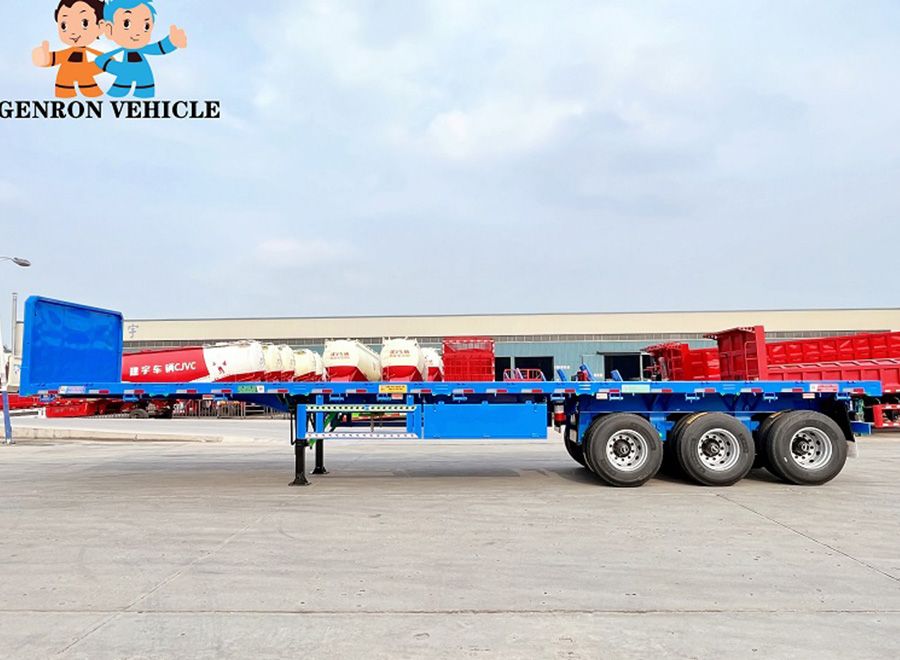
GENRON’s three-axle flatbed trailer and four-axle flatbed layout provide open-deck layouts to discuss for packaged cargo. Compare their usable supporting area, access and proposed fittings against the actual package matrix. Product titles and quoted payloads do not establish that every aluminium bundle, bearer arrangement or unloading method is accepted.
Ask the supplier to show the intended package positions on a drawing. Include space occupied by securing equipment and handling access, not just the cargo rectangles. A larger platform is useful only if the complete arrangement covers the delivery work. For a regular route carrying standardised packages, a clearly defined repeatable layout may be more valuable than extra space that has no agreed use.
Separate package bands from vehicle restraint
Bands or wrapping that hold profiles together during production should not automatically be treated as the means of securing the shipment to the vehicle. Ask the producer what the packaging is intended to do and give that information to the competent load-securing planner. The vehicle restraint system needs its own assessment.
Surface protection must also be considered where securing equipment contacts a package. Identify the proposed protective materials and their suitability for the finish and package geometry. This guide does not prescribe lashing forces or a universal strap count. The enquiry should provide enough information for a load-specific arrangement that addresses movement without assuming a delicate bundle can tolerate any convenient restraint method.
Design weather protection around the whole journey
State whether the trailer will operate through rain, coastal conditions, dusty roads or long outdoor waiting periods. Include collection and delivery dwell time. A cover is only one part of the protection plan; handling interruptions and the condition of the original packaging can affect whether the profiles remain within the customer’s acceptance requirements.
Ask the producer to specify the required protection and ventilation approach for the actual product. Do not assume that adding another impermeable layer always improves the result. Equally, do not remove packaging to improve ventilation without approval. Keep the responsibilities clear: the producer defines product and packaging requirements, while the carrier and trailer supplier address the proposed vehicle and journey within that brief.
Plan side access before ordering fittings
Confirm how each package will be loaded and unloaded. A receiver using side-entry forklifts needs a different access discussion from a receiver using overhead lifting equipment. Identify the package’s approved handling provisions and provide the handling-equipment details requested by the responsible planner.
Fixed fittings, storage boxes, side structures and cover supports can reduce usable access. Show them on the layout rather than assuming an open-deck trailer is unobstructed everywhere. If removable parts are needed, include their handling and stowage in the scope. The quotation should describe the arrangement as it will be used, including the equipment that must be moved before a package can be reached.
Check the receiving site, not just the factory
A producer may load packages under cover using equipment designed for long profiles. A distributor may unload outdoors using different equipment and limited working space. Ask the receiver to confirm the facilities available, the preferred delivery position and any package-length limitations before selecting a trailer layout.
Record whether the receiver accepts complete bundles or expects packages to be split. Package opening changes the handling situation and should be governed by the producer’s instructions and a suitable site plan. A transport quotation should not silently include on-site repacking or manual separation. If the customer requires additional handling services, identify the provider, scope and acceptance conditions separately.
Give mixed-length shipments a clear arrangement
When short and long packages travel together, show their proposed positions rather than treating all packages as identical cargo units. The arrangement should retain suitable support for each package and avoid making one package depend on another package that will be removed earlier in the route.
Include differences in finish, customer destination and permitted stacking. The densest-looking arrangement may create extra handling at a delivery point or block access to an important securing provision. Ask the planner to compare the arrangement across the complete journey, including the condition after each delivery. A little unused deck area can be preferable to a layout that requires unnecessary unloading and reloading of another customer’s goods.
Use package identity to prevent delivery errors
Give each bundle a durable reference connected to the packing list, customer order and delivery stop. Record package count and any agreed mass basis. Labels should remain readable without requiring the receiver to dismantle the load or remove protective packaging simply to identify which bundle belongs to the order.
For repetitive shipments, use a consistent layout reference and a standard photograph record. This improves communication between production, dispatch, the carrier and the receiver. If a package is substituted, update the list before loading. A trailer that fits the original package matrix may not cover a longer or differently packed replacement, even where the total shipment mass remains almost unchanged.
Record condition at transfer points
Agree what condition evidence is needed at collection and delivery. Photographs can show package identity, visible wrapping damage, support positions and the overall load arrangement. They are most useful when linked to a date, shipment reference and named transfer point rather than stored as anonymous pictures on a phone.
Make exceptions visible before the vehicle departs. If a bundle arrives at collection with damaged packaging, record the issue and obtain the responsible party’s decision. Do not hide it under a cover and assume the receiver will accept it later. This discipline does not eliminate damage, but it makes the agreed starting condition and the responsibility for unresolved packaging questions easier to establish.
Compare complete transport costs without inventing savings
A trailer’s purchase price does not describe every cost associated with finished-profile deliveries. Compare the equipment required for protection, repeat handling, removable fittings, receiver access and routine preparation. Ask suppliers to state which items are included and which remain the buyer’s responsibility.
Avoid a universal claim that one layout prevents a fixed percentage of damage or always carries more saleable product. The result depends on the actual packages and operation. A better comparison identifies the activities each option requires, the evidence supporting its suitability and any remaining limitation. This helps purchasing staff explain a decision without presenting a hypothetical benefit as a measured result from the fleet.
Resolve a two-customer delivery example
Consider a hypothetical route delivering long architectural-profile bundles to one customer and shorter industrial sections to another. Start with package identities, approved supports and the unloading method at each stop. Draw the arrangement at departure and after the first delivery. Do not decide the order solely from the easiest package to reach at the factory.
If the shorter packages obstruct access to the long bundles, compare changing the loading order, changing the route sequence or using a different accepted arrangement. Each option has handling consequences. The responsible planner should select the arrangement using the actual facilities and product requirements, rather than assume that a physically compact load is automatically the most efficient delivery plan.
Keep the agreed specification usable
The final purchase record should include the package matrix, trailer drawing, support assumptions, required fittings and the relevant product-handling instructions. Identify the revision accepted by both parties. Keep the description practical enough for dispatch staff to recognise the approved packages and the situations that require another review.
After purchase, update the record when package length, finish, protective wrapping or receiver equipment changes. An established route can drift away from its original assumptions through small production changes. Reviewing those changes early is easier than resolving a rejected load at a building site. The goal is a repeatable connection between what production ships, what the trailer provides and what the receiver can accept.
Agree inspection points without opening every package
Ask the producer and receiver which checks can be performed on a closed package and which require a controlled opening process. Record visible packaging condition separately from the condition of concealed profiles. A clean outer wrap does not prove that every finished surface is acceptable, while a marked wrap does not by itself establish damage to the product inside.
Define how an exception is reported and who decides the next step. The carrier should not be expected to dismantle a carefully prepared package merely to answer an undocumented inspection request. A consistent transfer record lets the parties compare what was visible at collection and delivery while preserving the producer’s packaging requirements and the receiver’s agreed acceptance process.
FAQ: Flatbed trailers for aluminium profiles
Is aluminium’s low density enough to make trailer selection simple?
No. The shipment can be limited by length, support, stacking, finish protection or unloading access before total mass becomes the main issue. Work from the packaged units, including their bearers and protective materials. A low shipment mass does not establish that a long or delicate bundle can be supported anywhere on the deck.
Can I use the bundle bands as the vehicle restraint system?
Do not assume so. Ask the producer what the package bands are designed to do and provide that information to the competent load-securing planner. Package integrity and restraint to the vehicle are separate questions. The selected arrangement should also address protection where securing equipment contacts the finished product or its packaging.
Does a tarpaulin make an open flatbed suitable for every profile finish?
No. The producer’s product-specific handling and protection requirements still apply. Consider weather, moisture, packaging condition, ventilation requirements and waiting time across the whole journey. A cover alone is not proof of a suitable environment, and additional wrapping should not be added or removed without considering the actual product instructions.
Should bearer spacing follow the trailer cross-members?
It should be established through a combined review of package support requirements and trailer structure. Obtain the producer’s requirements first, then ask the manufacturer to assess the proposed positions. Neither a generic bearer-spacing rule nor a photograph of another shipment establishes the right support arrangement for a different extrusion and package.
What information should the receiver provide?
Confirm the unloading method, available equipment, working area, maximum package dimensions and any requirement to split bundles. Explain whether delivery can occur under cover and how packages will be identified. These details help prevent a trailer arrangement that works at the producer’s factory but cannot be used as intended at the receiving site.
What should change when a supplier alters the packaging?
Update the package dimensions, gross mass, support information and handling instructions. Review the effects on securing, protection and delivery access before relying on the previous layout. A familiar product name does not prove that a revised shipping package is equivalent to the one used when the trailer specification was first accepted.
Product Options to Discuss
Product pages identify layouts to discuss, not acceptance of a specific load or proof that every optional component is included. Confirm the order-specific configuration with the responsible suppliers.
Related Reading
Flatbed Trailer Floor Specification for Pallets and Loading Equipment
How to Specify a Flatbed Trailer for Steel and Packaged Building Materials
Semi Trailer Paint and Corrosion Protection: Specifying the Finish for Coastal Service


