
 English
 Français
 Español
 Árabe
 Deutsch
 简体中文
 Português
 Русский
 日本語
 한국어
 हिंदी
 Prancis
 Türkçe
 Tiếng Việt
 Italiano
 ไทย

A dump-trailer quotation often reduces the body to two numbers: floor thickness and side-wall thickness. Those are useful details, but they do not identify the steel, the body design or the conditions it is expected to withstand. Comparing only millimetres can therefore make unlike proposals look equivalent.
This guide explains how to build a material schedule and compare complete body proposals. It is not a steel-selection calculation, welding procedure or approval for reducing plate thickness. The responsible designer and manufacturer must assess the actual material and duty.
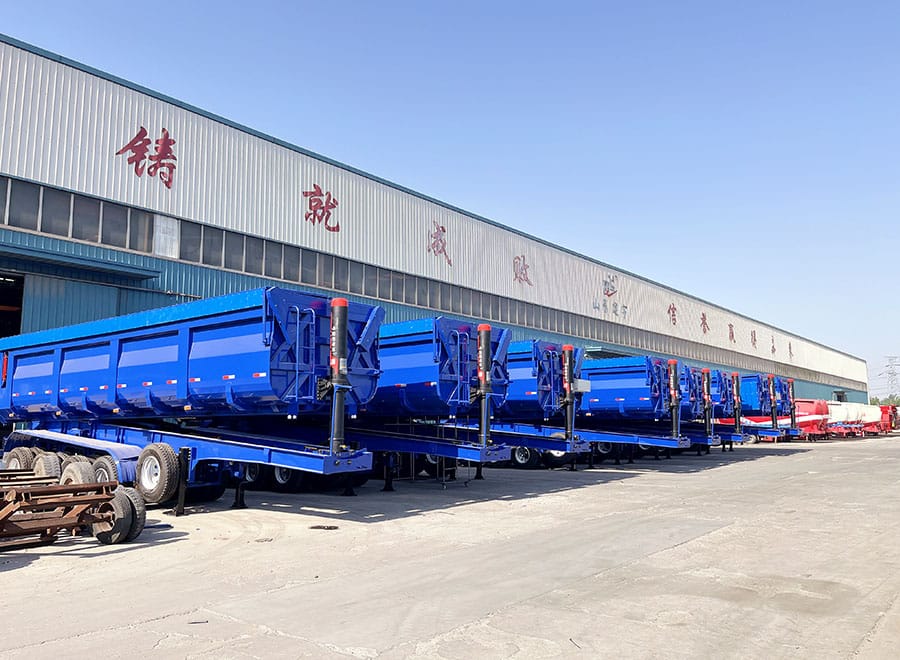
Describe the carried material and the way it reaches the body
Identify the cargo and its expected size range, shape and operating variation. Fine abrasive material, large angular pieces and mixed demolition material do not present the same duty. Give the supplier credible information from the operation rather than relying on a broad label such as mining or construction.
Describe the loading method and relevant conditions the manufacturer needs to assess. The body experiences the actual loading and discharge cycle, not merely the static mass stated on the order. Avoid inventing a universal allowable drop condition or treating a photograph of a loader as a complete application brief.
Include route and receiving conditions where they affect the body proposal. If the material or operation changes seasonally, identify the routine and demanding cases separately. A quotation can then state which duty it covers instead of making an undefined promise of heavy-duty performance.
Ask for a plate schedule by body area
Separate the floor, side walls, front wall, rear gate and any liners or local wear components. For each, request the proposed material identification and nominal thickness, together with relevant specification information. A single phrase such as wear-resistant steel does not identify the complete body.
Distinguish body material from chassis material. Different parts of the vehicle serve different functions, and a grade named for one component should not be assumed throughout the trailer. The order should identify where each material is used rather than leave the reader to infer it from a sales heading.
If alternative materials are offered, compare complete schedules against the same duty. One proposal may use different materials in different areas, while another quotes a single general grade. Make those differences visible before deciding that a thicker or more expensive offer is automatically superior.
A material schedule that supports a meaningful comparison
| Body area | Information to identify | Question to resolve |
|---|---|---|
| Floor | Grade, thickness and any liner arrangement | What loading and wear duty is assessed? |
| Side/front walls | Grade, thickness and complete design | How do containment and operating loads fit the proposal? |
| Rear gate | Material, closure and interface details | Does it match the agreed body and discharge duty? |
| Local wear parts | Locations, material and replacement scope | What is supplied and how is service handled? |
| Complete body | Finished configuration and mass basis | Are offers being compared on the same scope? |
Keep abrasion resistance and impact behaviour distinct
Wear from material moving against a surface and damage from an impact are different questions. Ask the manufacturer to explain which properties and design features address the intended duty. A hardness statement alone is not a complete description of how the finished body will perform.
SSAB’s tipper-design material treats wear and dent resistance as separate design topics. Its Hardox information also discusses a combination of hardness and toughness. These are useful examples of why a material assessment is broader than thickness; they do not prove that a particular branded steel is fitted to a GENRON body.
Request the actual proposed grade information and the relevant conditions behind any property claim. Do not compare isolated test values without their meaning or assume one property replaces all others. The responsible designer should connect material characteristics with body geometry, duty and manufacturing requirements.
Source: SSAB: Tipper design, wear and dent-resistance topics; SSAB: Hardox material examples for tipper bodies
Do not turn a plate property into a complete-body guarantee
The finished body includes formed plates, supports, joints, fittings and interfaces. Its performance cannot be inferred from one material property printed on a plate brochure. Ask for the proposed complete design and the scope of the manufacturer’s application assessment.
A lighter plate may form part of an appropriately engineered body, but that does not authorise reducing thickness in an existing design. Likewise, adding thickness locally does not automatically resolve every structural or operating problem. Changes should be reviewed by the responsible manufacturer rather than treated as a simple upgrade.
When a quotation makes a durability or payload claim, ask what configuration and evidence it refers to. Separate a material supplier’s example from a body builder’s actual proposal. A successful case on another vehicle is background information, not a guaranteed result for the buyer’s cargo and operation.
Use a plate-mass calculation only for the plate it describes
A screening calculation can illustrate why thickness affects material mass. For a hypothetical flat plate area of 20 square metres, a one-millimetre thickness difference represents 0.020 cubic metre. Using an assumed steel density of 7,850 kilograms per cubic metre gives a plate-only mass difference of 157 kilograms.
Every value in that example is an assumption for arithmetic. It is not a GENRON body measurement, a recommended thickness change or a finished-body weight saving. Formed geometry, supports, liners, fittings and other design changes can alter the complete result.
Nor does a lighter body automatically create the same additional permitted cargo on every route. Vehicle ratings, axle distribution and applicable limits still matter. Use a complete configuration and actual mass evidence when comparing usable payload, rather than promoting a plate-only calculation as a fleet operating guarantee.
What a thickness comparison does not establish
| Statement | Information still missing |
|---|---|
| Proposal A has a thicker floor | Steel identity, design, loading duty and complete scope |
| Proposal B uses a branded wear plate | Actual supplied grade, locations and traceability |
| A plate calculation is lighter | Finished-body mass and permissible operating payload |
| A material has high hardness | Other relevant properties, fabrication and complete-body assessment |
| Another fleet achieved long life | Comparable cargo, operation, design and evidence |
Compare actual dump-body layouts against the same duty
GENRON’s three-axle rear dump body layout and four-axle rear dump body layout provide two body layouts to discuss during enquiry. Their product descriptions do not establish a particular steel grade, thickness schedule or life expectancy for every order. Ask for the exact material and equipment proposal for your operation.
Keep body shape, material schedule, rear-gate arrangement and other supplied equipment visible in the comparison. If those features differ, explain which requirement each is intended to address. A material decision should not obscure differences elsewhere in the complete trailer scope.
Where one option includes an additional liner or replaceable wear part, identify its mass, location and service assumptions. Do not compare the plate thickness of a lined body with an unlined proposal as though those were identical arrangements. The final order should describe the whole configuration.
Ask for material evidence that matches the supplied parts
Agree the material-documentation scope before ordering. Identify which records will establish the supplied grades and how they relate to the relevant body components. A general certificate or a brochure logo is less useful when it cannot be connected to the order’s material schedule.
Keep brand, grade and manufacturer status distinct. A claim that a body uses a particular material is not automatically a claim of membership in a material supplier’s certification or branding programme. Do not add logos or approval language unless the business has evidence and authority for the exact claim.
At handover, reconcile the final material schedule and any agreed evidence with substitutions made during manufacture. If an alternative grade is proposed, obtain the responsible design review and commercial agreement. Similar appearance or nominal thickness is not enough to establish equivalence.
Include fabrication and repair support in the purchasing discussion
Ask the manufacturer what documentation and service support accompany the chosen materials and design. The fleet should understand how to identify the relevant parts and obtain approved advice. Local availability is a practical issue, but it should not lead to unreviewed replacement materials.
This article provides no welding, heating, cutting or forming instructions. Such work can affect the material and finished structure and requires the appropriate manufacturer information and qualified personnel. Do not treat a generic workshop practice as suitable for every proposed body steel.
If a remote operation expects local repairs, disclose that during enquiry. Ask how the chosen configuration can be supported and which activities require specialist involvement. A material option is easier to compare fairly when its service implications are part of the scope rather than discovered after damage occurs.
Define wear parts and inspection records without inventing service life
Where replaceable components are proposed, identify what they are intended to protect and how the manufacturer expects their condition to be assessed. The operating and maintenance documents should cover the supplied arrangement. Do not assume every visible plate is a sacrificial liner or every liner is independently replaceable.
Ask what evidence supports any service-life statement and whether the conditions match the buyer’s operation. Cargo, loading practices, route and maintenance can differ substantially between fleets. A fixed universal lifespan or percentage improvement is not justified by a material name alone.
For the buyer’s own records, keep cargo duty, observed condition and any approved repairs linked to the vehicle identity. Over time, those records can support a better enquiry. They should not be turned into broad marketing claims without enough evidence to explain the configuration and operating conditions.
Resolve a hypothetical thicker-versus-thinner quotation fairly
Suppose Proposal A lists a six-millimetre floor but does not identify the steel, while Proposal B lists a five-millimetre floor with a named material. These are hypothetical descriptions, not recommendations. Neither line alone establishes the better finished body.
Request the missing material and design information from A and the complete duty and configuration evidence from B. Compare both against the same cargo, loading and service requirements. A named grade improves identification, but it does not remove the need to assess the complete proposal.
Record the resulting inclusions, exclusions and unresolved items. If the supplier needs more operating information, provide it or keep that decision open. The aim is not to force a winner from incomplete numbers, but to make the offers comparable before price and delivery commitments are finalised.
Make the accepted material schedule part of change control
At order acceptance, retain the body drawing, material schedule, stated duty and agreed evidence together. Identify the revision used. This connects the product actually supplied with the operating requirement that led to the specification.
If the cargo changes from routine fines to a materially different loading duty, refer the change for review. Do not assume a high quoted payload covers every material or loading method. The body may still require a different application assessment even where the total cargo mass stays similar.
Use the same approach for later modifications, liners or structural repairs. The final record should show what changed and who accepted it. A clear history makes future purchasing and service decisions more defensible than relying on paint colour, a remembered plate thickness or a generic heavy-duty label.
Dump-body material enquiry brief
Cargo identity, size/shape range and operating variation:
Loading method and relevant duty conditions:
Floor, wall, gate and liner material schedule requested:
Complete body arrangement and mass basis:
Evidence behind wear, impact or service-life claims:
Material identification and substitution process:
Service support, wear parts and repair responsibilities:
Accepted drawings, open items and future change control:
FAQ: Dump-trailer steel and plate thickness
Is a thicker floor always the better option?
No. Compare the identified material, complete body design and intended duty. Thickness is one input, not an automatic quality ranking. A proposal needs enough detail to explain how the body addresses the actual cargo and loading conditions.
Does wear-resistant steel mean the body cannot dent?
No such unconditional conclusion follows from the label. Abrasion and impact are different questions, and complete-body design also matters. Ask the responsible manufacturer to identify the relevant material properties, duty and evidence behind its proposal.
Can I reduce thickness after choosing a harder grade?
Not from that comparison alone. Any change requires an appropriate design and manufacturing review. This article does not approve substituting a grade or reducing plate thickness in a new or existing body.
Does the 157-kilogram example describe a GENRON body?
No. It is a hypothetical plate-only calculation using assumed area, thickness difference and density. It does not establish finished-body weight savings, extra road payload, durability or a recommended specification.
Does a material brand name prove a certification claim?
No. Identify the actual supplied grade and relevant evidence, and keep that separate from any certification or authorised branding programme. Do not infer membership, approval or complete-body performance from a brochure name or logo.
What should be compared before deciding between two quotations?
Use the same cargo and loading brief, then compare body drawings, material schedules, complete mass basis, supplied equipment, evidence and service support. Make exclusions and open items visible so the final price represents a defined configuration rather than a pair of thickness numbers.
Product Options to Discuss
Confirm the order-specific steel schedule and complete application review. No material brand, thickness or performance result is implied for every linked model.
Related Reading
References
Material-supplier examples are not GENRON specifications or guaranteed results. Calculations and quotation examples are hypothetical; no fabrication or repair procedure is supplied.


