
 English
 Français
 Español
 Árabe
 Deutsch
 简体中文
 Português
 Русский
 日本語
 한국어
 हिंदी
 Prancis
 Türkçe
 Tiếng Việt
 Italiano
 ไทย

A fuel tanker payload calculation should begin with the actual vehicle combination and the product mass it can carry under the reviewed conditions. Tank volume enters the calculation after the equipped empty mass, applicable weight constraints and product density basis are established. A larger tank does not create a larger permissible payload. It may simply provide unused volume on the route you intend to serve.
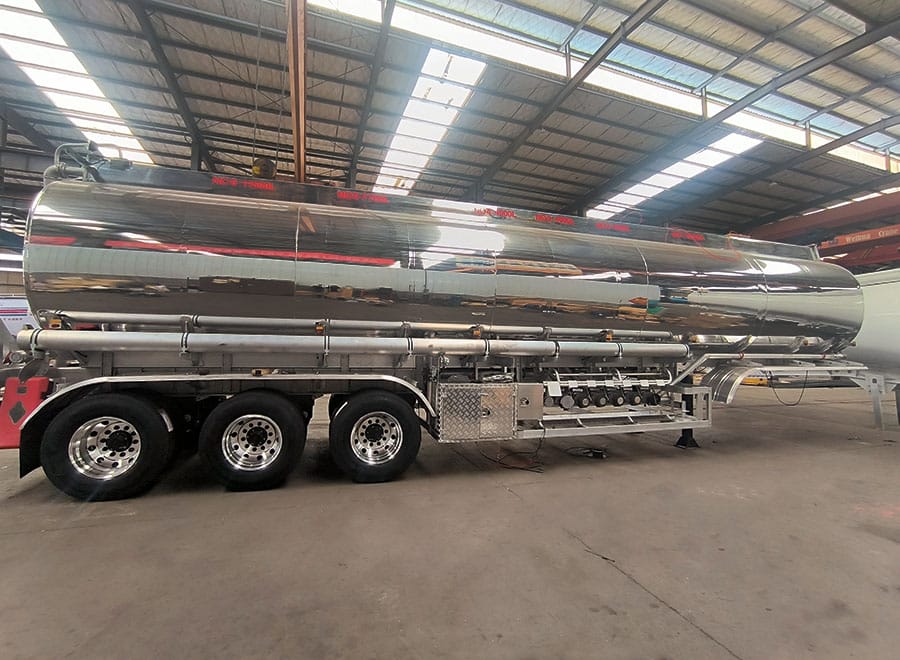
Prepared on 29 October 2026, this guide develops a purchasing worksheet for comparing proposed tanker configurations. The numerical cases are deliberately hypothetical. They show how changing an input changes the purchasing result; they do not establish the permitted loading quantity of a GENRON vehicle or the requirements of any particular country.
The fuel tanker capacity guide introduces the different vehicle and volume categories. The explanation of litres, tonnes and quotation terminology separates the definitions. The next purchasing step is to turn those definitions into a traceable mass budget that can be checked against a specific quotation.
What information belongs in a tanker mass budget?
Record the proposed tractor, tanker, installed delivery equipment and operating mass assumptions as separate inputs. Identify the source of each value and the configuration to which it applies. A manufacturer's drawing, an estimated specification and a dated weighing record provide different levels of evidence. Treat an estimate as an estimate until the agreed acceptance process replaces it with the required record.
For a semi trailer combination, establish whether the stated empty mass covers the trailer alone or the tractor and trailer together. Then identify the allowance for fuel, personnel, tools and other operating items that are outside the supplied empty-mass figure. This avoids subtracting a trailer-only number from a combination weight limit and mistakenly assigning the tractor's mass to cargo.
The budget also needs a product description, density units and the conditions attached to that density. Keep these with the calculation rather than leaving a bare number in a spreadsheet cell. A later reviewer should be able to understand the result without asking the original estimator which fuel, temperature basis or vehicle version was intended.
How do you calculate the mass allowance for product?
For an initial purchasing comparison, product mass allowance equals the reviewed total mass allowance minus the combination's equipped operating empty mass. This subtraction is only one screening calculation. Axle loads, coupling loads, component ratings and the actual tank documentation can impose further constraints. The purchasing team needs those assessments before treating the result as an acceptable operating case.
Consider an invented combination for which the reviewed total mass allowance is 46,000 kg and the agreed operating empty mass is 16,000 kg. The screening result is 30,000 kg of product. These numbers describe a worksheet exercise, not a legal vehicle category. The result is useful because it exposes the inputs and gives competing proposals the same calculation framework.
Now suppose a revised equipment package adds 650 kg and a tractor substitution adds another 350 kg. With the same assumed total allowance, the product mass screen becomes 29,000 kg. If a supplier continues advertising the original payload after those changes, the worksheet will reveal the mismatch. Ask for the revised calculation and its configuration reference before accepting the new offer.
How does product density change the volume result?
Once a consistent product-mass allowance has been established, divide kilograms by density in kilograms per litre to obtain litres. Use the density applicable to the actual product and the calculation basis. Do not select a convenient generic density simply because it produces the advertised tank volume. Product and measurement specialists should resolve incompatible reference conditions before the purchasing comparison is finalized.
Using the hypothetical 30,000 kg allowance, an invented density of 0.75 kg/L produces 40,000 L. An invented density of 0.84 kg/L produces approximately 35,714 L. At an invented density of 0.90 kg/L, the result is approximately 33,333 L. These are sensitivity examples, not density specifications for petrol, diesel or another named fuel.
The comparison explains why one tanker can encounter different constraints on different contracts. The available tank space may matter for a lower-density product, while mass can become restrictive for a higher-density product. Keep the tank's documented operating quantity separate from the calculated mass-based volume. The smaller applicable constraint still needs to be established for the actual configuration and intended use.
How should uncertainty be shown in a quotation comparison?
A precise-looking payload can hide uncertain inputs. For example, an estimated trailer mass rounded to the nearest half tonne should not support a product-volume promise expressed to the nearest litre. Record the source and expected verification stage of each input. Separate a provisional comparison from a contractual acceptance quantity so the purchasing team knows what remains unresolved.
Use a sensitivity column for plausible changes that the supplier or fleet has identified. If the operating empty mass could increase by 500 kg during final specification, calculate the effect with the same product-density basis. At the invented density of 0.84 kg/L, 500 kg corresponds to approximately 595 L. That calculation describes exposure to a mass change, not a new filling instruction.
Avoid adding an unexplained blanket deduction to make the worksheet appear conservative. A deduction needs a stated reason, such as specified equipment not included in the preliminary mass estimate. Otherwise the allowance may be counted twice when the final weighing record arrives. A transparent unresolved item is more useful than an arbitrary margin concealed inside the final payload figure.
Why does the mass budget still need an axle-load assessment?
Two combinations with equal total mass can distribute that mass differently. Tank position, compartment arrangement, tractor geometry and the location of fitted equipment affect the loading of individual axles and groups. Passing the total-mass subtraction therefore does not demonstrate that every axle or coupling condition is acceptable. Request the supplier's assessment using the proposed tractor and relevant loading cases.
As one jurisdiction-specific illustration, the US FHWA explanation of bridge formula weights shows that axle spacing and axle groups matter alongside gross weight. That example supports the need to assess configuration. It does not supply a worldwide weight limit or establish that a particular export trailer is accepted on a destination route.
Ask the responsible parties to state which full and intermediate delivery cases they reviewed. A mass budget for the initial departure condition cannot describe every remaining load after multiple deliveries. The outcome should identify the applicable constraints and required operating documentation, rather than leaving the buyer to infer acceptance from axle count or the number printed on a tank photograph.
How do you compare two tanker proposals on the same basis?
Start with a common enquiry: the same tractor information, product description, delivery-equipment scope and intended route conditions. Then compare the tank-volume definition, equipped empty mass and documented load cases separately. This structure prevents a low bare-trailer estimate from appearing superior to a fully equipped offer simply because one supplier included more of the required equipment.
For example, a proposed carbon steel fuel tanker semi trailer and an aluminium fuel tanker semi trailer may warrant comparison for the same duty. Obtain the current configuration-specific specification from GENRON. Material names and broad product-family capacity ranges do not establish the tare difference, usable quantity or lifecycle cost of the actual two offers.
Keep price beside a list of included equipment and acceptance evidence. A proposal that is lighter because it omits a required pump, meter, hose assembly or other agreed item may lose that apparent advantage once completed. Ask both suppliers to price the same delivery-ready scope and document any remaining differences that could affect the product-mass calculation.
What changes require the payload worksheet to be revised?
Revise the worksheet when the tractor, tank arrangement, equipment package or operating assumptions change. Give the worksheet its own revision reference and connect it to the current drawing and quotation. A purchase order can otherwise contain a new equipment list while retaining a payload calculation made for an earlier vehicle. The apparent agreement between documents then becomes misleading.
Track changes by their effect, not just by component name. A replacement pump can alter mass and mounting position; a revised compartment layout can alter the load distribution; a different tractor can change both operating mass and geometry. The supplier's review should explain which calculations and records need updating rather than assuming that an unchanged nominal tank volume makes the change irrelevant.
At handover, match the supplied unit's identification and equipment to the agreed documents. Reconcile the accepted empty-mass evidence with the provisional purchasing worksheet. Where values differ, close out the calculation with the responsible technical parties before using the original sales estimate for dispatch planning. Retain the earlier version as a change record rather than silently overwriting it.
What should you send GENRON for a useful capacity proposal?
Provide the destination, intended routes, proposed tractor data and the products to be transported. Describe the delivery duty and list the installed equipment expected in the offer. State whether a requested litre quantity refers to a commercial order size, a nominal tank description or another defined measure. This helps the supplier address the actual buying requirement instead of responding with the largest available tank.
Include representative departure and delivery scenarios, together with the parties responsible for checking destination requirements and operating acceptance. Request the configuration-specific mass estimate, its exclusions and the planned verification method. Ask for a capacity and compartment schedule tied to the same drawing revision. These documents allow the fleet to compare proposals without pretending that all unanswered questions are resolved.
Finish the enquiry with the decision you need to make. A fleet seeking to replace an existing tanker may prioritize matching a delivery contract; a new operation may need a broader route and equipment review. Send that context through GENRON's contact page so the response can identify the remaining technical inputs and the relevant product configuration.
How do you identify the constraint that actually changes the purchase?
For each candidate, record the assessed limit that prevents the next increment of useful delivery quantity. The result might be a vehicle-mass condition, a tank-documentation condition or the work available on the route. Record the supporting document and the party responsible for the assessment. This gives purchasing a more useful question than simply asking the supplier for more litres.
Suppose a candidate has enough nominal space for a contract but its assessed product-mass allowance is the restrictive input. Increasing nominal volume alone will not resolve that case. Ask the responsible parties which feasible configuration changes, if any, could address the requirement, then compare their full cost and implications. Do not assume that changing axle count or tank material necessarily produces the desired result.
If the limiting factor is instead a receiving site's order size or access, the relevant response may sit outside tank design. A different route grouping or vehicle allocation could warrant evaluation. Keeping the constraint visible prevents the fleet from paying for an equipment change that does not improve the work it needs to perform. It also makes the final purchase recommendation easier to explain and inspect.
Frequently asked questions about fuel tanker payload calculations
Can I calculate tonnes directly from a tank's advertised litres?
You can calculate an illustrative product mass only when the volume and product-density basis are defined and compatible. That result still does not establish what the vehicle may carry. The equipped operating mass, relevant vehicle constraints and tank documentation must be assessed separately. In a purchasing comparison, keep each of those checks visible instead of presenting one converted number as the complete payload approval.
Does a lighter tanker always carry more saleable fuel?
A lower equipped empty mass can increase the mass allowance under an otherwise identical reviewed constraint. The benefit may remain unused if another condition limits the required load, such as tank documentation, a delivery contract or an axle-load case. Compare the same installed equipment and tractor basis first, then check whether the lower mass changes the quantity that can actually serve the intended duty.
Should the tractor's mass be included in the calculation?
Yes, when the constraint being assessed applies to the whole combination. A trailer-only mass cannot represent a tractor and trailer operating empty mass. Obtain the appropriate tractor information and clarify operating allowances, including items outside the supplied weight figure. Keep a separate trailer calculation where needed, but do not mix the two calculation boundaries in the same subtraction.
Is a weighbridge ticket enough to confirm payload?
A weighing record can establish mass for the identified condition at the time of weighing. Its usefulness depends on the recorded unit, fitted equipment and operating state. It does not replace tank documentation or the assessment of destination constraints and load distribution. Use it to verify an input in the agreed acceptance process, then reconcile the remaining documents rather than treating the ticket as universal road approval.
Can one worksheet cover petrol and diesel contracts?
A worksheet can contain separate product cases, provided each has the appropriate product documentation and calculation basis. Do not assign one generic density or one unrestricted volume to every contract. Identify which inputs are shared and which are product-specific. Where the actual products or their conditions change, the responsible parties should review the relevant calculations and operating documentation before relying on a previous case.
What makes a payload claim suitable for a purchase order?
A useful claim identifies the vehicle configuration, calculation boundary, product assumptions and supporting documents. It also states which acceptance evidence will replace estimates and how changes will be handled. A headline tonne figure without those details is difficult to verify. Ask for a written schedule linked to the agreed drawing and equipment scope so delivery inspection can assess the same proposal that purchasing approved.


